
Editor’s note: this story contains instances of potentially triggering situations, including violence.
Irandokht, an IU student from Iran, woke up Friday and, like the day before, tried to get in contact with her family back home. She checked social media for any news that might have gotten out of the country.
Even when Iran’s connectivity been shut down in the past, like during the 12-day war with Israel last summer, she was able to reach family. But since mass protests escalated across the country Thursday into the weekend, she hasn’t heard anything.
Nobody has heard anything.
“We have no idea of where our families are, if they're alive or not,” she said.
Irandokht is a pseudonym meaning “Iran’s daughter.” The student requested anonymity out of fear for her family still in Iran.
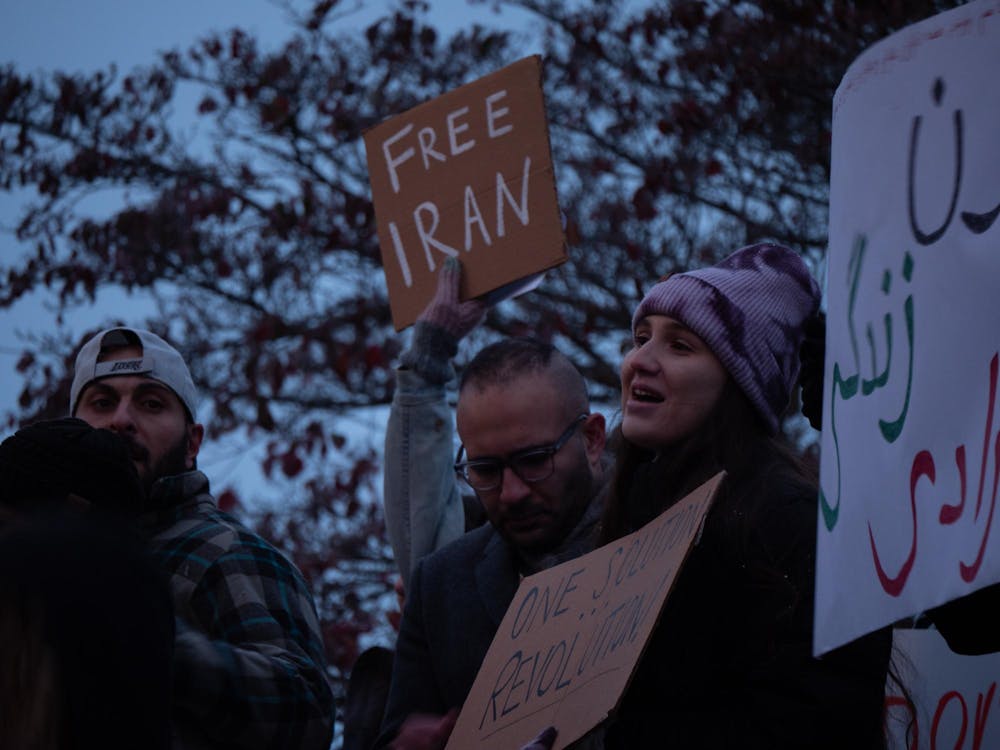
Protests began Dec. 28 amid a worsening economic crisis and anger with the country’s authoritarian, theocratic government. Since then, demonstrations have spread to more than 100 cities and towns across the country. Protesters have chanted slogans including “death to the dictator” and “Iranians, raise your voice, shout out for your rights.”
On Thursday, as protests swelled, the government completely cut off Iran’s internet. As of publication, few videos and messages have made it out of the country. Those few have included videos showing buildings and vehicles on fire, thousands protesting in the streets and bodies lying on the ground in a hospital.
On Saturday, Iran’s attorney general said protesters and those who supported them would be considered an “enemy of God,” a charge carrying the death-penalty.
***
Babak Seradjeh, an IU physics professor who left Iran in 2000, said many of his friends and family members have left the country. They’ve seen protest waves before, Seradjeh said, and have been paying attention to the ongoing unrest.
“The first one I remember after the revolution was in 1999, then about 10 years later in 2009,” Seradjeh said. “But then since then, there have been periodically, more and more protests.”
He’s noticed a different tone in the recent protests than prior waves. He’s seen big slogans, and big demands for change.
“This could very well be the inflection point in the trajectory of the protests and a historic moment for Iran,” Seradjeh said in an email after his interview with the Indiana Daily Student. “Of course, only time will tell the true import of what we are witnessing.”
Another doctoral student at IU, who wished to remain anonymous out of fear for their family’s safety, said they felt the ongoing protests are much bigger than prior waves. And in previous mass demonstrations, they said, protesters were mostly younger. This time, it’s everyone.
“This means that more people are being killed,” they said.
It’s unclear how many have been killed since the unrest flared, but one doctor in Tehran, the nation’s capital, told TIME on Friday that six hospitals had recorded more than 200 protester deaths.
President Donald Trump said the United States would intervene if Iran killed protesters. Thus far, intervention hasn’t happened. The Wall Street Journal, citing unnamed officials, reported Saturday that the Trump administration has had preliminary discussions on options to strike Iranian military targets.
In an X post early Saturday, Secretary of State Marco Rubio wrote that “The United States supports the brave people of Iran.”
***
Both students want their community in Bloomington to know and try to understand what’s happening in Iran. Irandokht said she hopes people contact their representatives in Congress.
“It seems like no one knows. That no one cares,” she said.
It’s isolating more than anything. The doctoral student woke up Friday and tried every means possible to get in contact with their family. Fixed phone lines, messaging apps and telephone services are all down.
It’s been about two years since they’ve been home to Iran, they said. Especially after Trump imposed a travel ban on 19 countries last summer, including Iran, it’s unclear whether they’d be allowed back in the United States after traveling home.
“We have no rights at all,” Irandokht said. “We can't go back home. No one can visit us. Financially, it's horrifying, because we can't work more than 20 hours on campus.”
Students on F-1 visas at IU can’t work more than 20 hours per week during the fall and spring semesters unless the Office of International Services authorizes it.
According to university enrollment data, 67 students at IU Bloomington had Iran marked as their country of origin fall semester last year. When Irandokht tries to talk with her Iranian friends in the United States, she said she feels hopeless. They have no idea how their families back home are doing.
“They are at such horrible positions that we can't even talk to each other,” she said. “We call and just cry.”


