
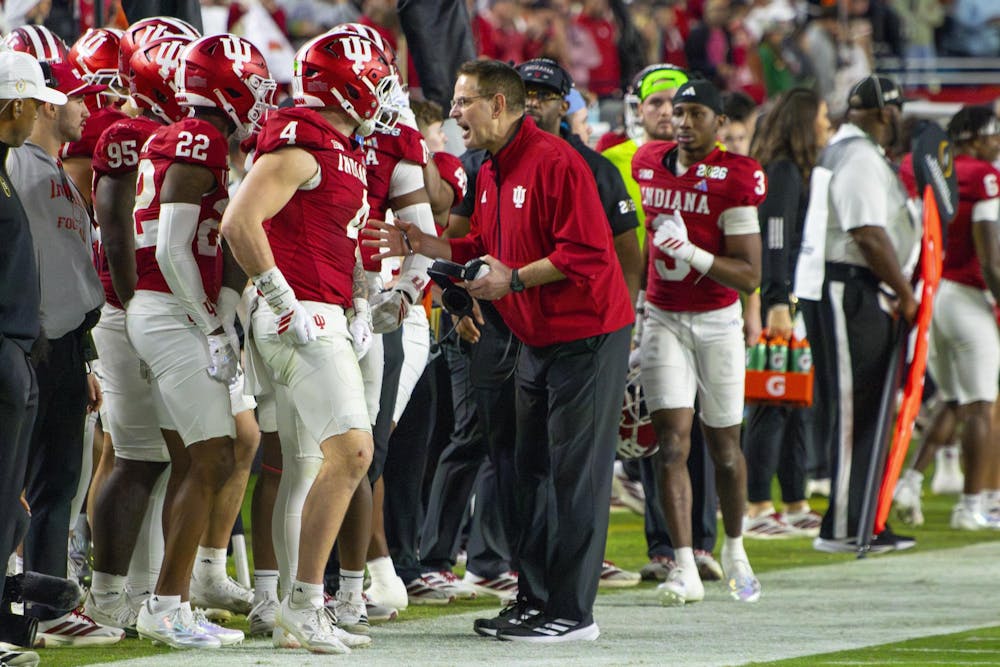
MIAMI GARDENS, Fla. — Curt Cignetti tried to place his glasses on the collar of his red quarter zip as he walked toward midfield. Ultimately, he held them in his right hand.
The second-year Indiana football head coach smiled, which he seldom does, as he raised both arms and pointed toward the sky.
The Hoosiers had just completed one of the greatest stories in college football history with their 27-21 victory over the No. 10 University of Miami in the College Football Playoff National Championship. It was an accomplishment worthy of the rare sign of satisfaction. But in perhaps the most historic moment of Cignetti’s 43-year coaching career, his father, Frank Cignetti Sr., was on his mind.
“Hopefully he was watching today,” Cignetti said postgame. “He was a great role model. I was very blessed to have a father like that.”
Cignetti’s path to becoming a head coach
From the third grade, Cignetti’s eyes were set on leading a program.
After four collegiate seasons playing quarterback, he began his coaching career as a graduate assistant and made five stops before what he’s deemed the most important one. Cignetti’s four seasons at the University of Alabama under legendary head coach Nick Saban taught him how to overcome the difficulties of achieving greatness.
Although the Crimson Tide went 7-6 in Saban’s first season at the helm, it brought all the lessons Cignetti learned together.
He wound up spending three more seasons under Saban, including a perfect 14-0 campaign in 2009 capped by a national championship. Cignetti was approaching his 50th birthday.
Throughout his years entrenched in college football, he was familiar with career-long assistants. They were guys who spent 40-plus years working under a head coach but never leading their own team.
Cignetti didn’t want to finish his career that way.
“I'd seen what those lives look like as a kid,” he said. “So, I took a chance.”
From waxing tables to leading Indiana football
When Cignetti left Alabama for Indiana University of Pennsylvania, it was an “unprecedented” move, he said, from one of the sport’s most prestigious programs to a Football Championship Subdivision squad.
He led the Crimson Hawks to a 53-17 mark over his six seasons. He waxed tables inside the program’s facility when the school shut down for the playoffs. Cignetti continued his climb through the ranks, taking head coaching jobs at Elon University and eventually James Madison University.
The kind of success Cignetti found at JMU was foreign to the Hoosiers at the time. Indiana University President Pamela Whitten and Athletic Director Scott Dolson sought a change after the 3-9 2023 season.
Cignetti wasn’t looking to leave Harrisonburg, Virginia. It was a place he viewed as his last stop — one he could retire at. But as the 62-year-old had conversations with Whitten and Dolson, he remained steadfast in his winning ways, ones he knew he could take to Bloomington.
“I know Indiana's football history has been pretty poor with some good years sprinkled in there,” Cignetti said. “It was because it wasn't an emphasis on football, plain and simple.”
Cignetti wanted to change the way people think about Indiana football, explaining there was no reason why it couldn’t be a source of pride for the school, Bloomington and the state of Indiana.
He instilled his tried-and-true blueprint — the same one he used at Elon and JMU. Cignetti said it would work on his first day in Bloomington on Dec. 1, 2023.
From visions to proven product
Now, just 780 days after his introductory press conference in Bloomington, Cignetti stood on the sideline inside Hard Rock Stadium with a national championship and college football immortality at stake.
Although the Hoosiers dominated the Rose Bowl and Peach Bowl en route to Monday night’s ultimate game, the Hurricanes met the challenge. The Cream and Crimson didn’t run away with the victory, but instead truly had to earn it.
While Heisman Trophy-winning quarterback Fernando Mendoza’s stat line didn’t resemble that of his across the last two games, he made perhaps his greatest play in an Indiana uniform on a fourth down in the final quarter.
After sustaining shot after shot from Miami’s vaunted front seven, earning him a bloodied lip, Mendoza dropped back before running a draw up the middle. He bounced off a would-be tackler before reaching the goal line — touchdown.
The Hoosiers’ storybook season could’ve taken a turn for the worse without Mendoza’s crucial conversion.
It didn’t, though. Mendoza instead made a play that will live in Indiana football lore forever. He was determined to reach the end zone, willing to do whatever it took — a mindset the Hoosiers exemplified all season with all sorts of different variations of victories.
“I think we sent a message, first of all, to society that if you keep your nose to the grindstone and work hard and you've got the right people,” Cignetti said, “anything's possible.”
Cignetti and the Hoosiers reach immortality
Cignetti stood on the victory stage having just led his team to a perfect 16-0 season and the program’s first national championship. Not only did Cignetti bring his plan to fruition, he also used it to take him to heights he had yet to reach as a head coach.
It took just two seasons for Cignetti to not only turn Indiana into a respected program, but a college football power.
Cinderella stories aren’t new to sports. Whether it was the United States hockey team defeating the Soviet Union in the 1980 Olympics or North Carolina State University basketball making an improbable run through the NCAA Tournament in 1983, there’s a lengthy history of unthinkable success.
Milan High School basketball’s Indiana state championship in 1954 resulted in the film “Hoosiers.” When Indiana won the Rose Bowl, Cignetti said the Cream and Crimson’s two-year run would be a “helluva movie.”
Now, Indiana’s fairytale season is complete. A movie could follow because, after all, Cignetti and the Hoosiers finished off an unlikely march to college football immortality.
“It's a great story, tremendous story,” Cignetti said. “Most people would tell you that are in the know, it's probably one of the greatest stories of all time in terms of a team that most people — we got it done.”
Follow reporters Dalton James (@DaltonMJames and jamesdm@iu.edu) and Conor Banks (@Conorbanks06 and conbanks@iu.edu) and columnist Quinn Richards (@Quinn_richa and qmrichar@iu.edu) for updates throughout the Indiana football season.


