
SPOILER: This column contains potential spoilers for “28 Years Later: The Bone Temple.”
Historically, January serves as a “dump month" for movie studios due to their focus being on the blockbusters released in the prior month. For this reason, January tends to be the ideal release date for risky horror films or movies that are not easily marketable and have lower box office expectations. After seeing “28 Years Later: The Bone Temple,” I can safely say that this pattern has been broken.
Going into this film, I already knew that it would be much different from its predecessors. Danny Boyle has shifted back from director to producer, with Nia DaCosta stepping in to fill his shoes. The difference in directorial style is evident.
Boyle has a clear signature with this series, whether it be the bold camera choices or intense editing sequences. DaCosta has a more contemporary horror style, as seen in her past films like “Candyman.”
Unlike the last film, which used iPhone 15 Pro Max cameras, DaCosta opted for a standard digital camera, as most modern films use. While I understand that Boyle preferred to use cameras that are relevant to the time of these films, the quality of cinematography is much stronger when using a professional camera. DaCosta also requested that more of the infected be present in the screenplay, as she pitched this film as her own unique take on the franchise.
“28 Years Later: The Bone Temple” is the second movie in the “28 Years Later” trilogy, which comes nearly 25 years after the original film, “28 Days Later.”
This film picks up immediately after the events of the first “28 Years Later” and explores Spike (Alfie Williams) navigating his way through a mysterious cult while Dr. Ian Kelson (Ralph Fiennes) grows a relationship with an infected that has the power to change the world.
Throughout the first half of the film, DaCosta frequently goes back and forth between the two characters’ experiences, which complement each other tremendously. As Spike is thrown deeper into the darkest parts of what is left of humanity, Dr. Kelson looks for the beauty in what society sees as a monstrosity.
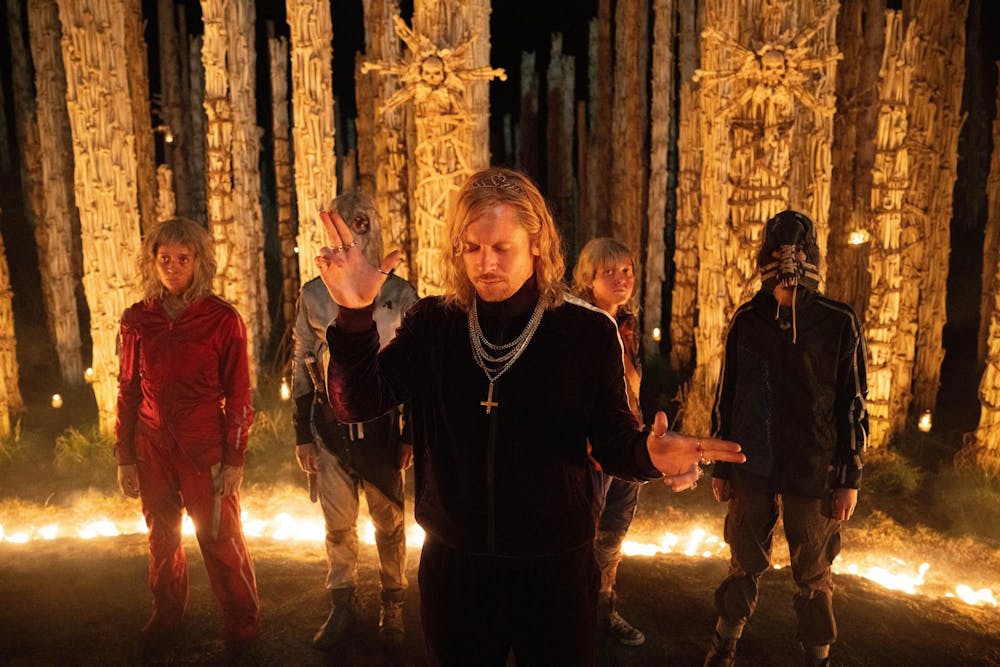
While the followers of the cult do not have unique personalities, their actions as a group are so brutal that it reminiscent of the “Saw” franchise. There were several points when I struggled to look at the screen because the action depicted was so intense and visceral.
The cult leader, Jimmy (Jack O’Connell), was introduced in the previous film’s flashback, when he witnessed his father, a priest, sacrifice himself in his own church after giving Jimmy his cross necklace. Given that it was the opening scene in the last film, I was slightly disappointed that his background isn’t further developed in this film.
Although I did not find the cult itself to be that original, I loved seeing this franchise explore how far humanity has fallen since the virus outbreak. While the first film touched upon this concept a little with a crazed military squad, it was done in a very predictable manner that did not feel as memorable to me.
As Jimmy’s cult commits horrifying acts of violence, Dr. Kelson forms a relationship with Samson (Chi Lewis-Parry), an infected human with enhanced strength. Dr. Kelson gives Samson a mix of drugs, including morphine, to learn more about the virus, which ultimately leads to his breakthrough in finding a cure for the infection.
While there is a clear tonal shift between Dr. Kelson’s research with Samson and Spike’s time with the cult, I found this parallel to work extremely well. DaCosta was able to show both sides of the coin when it came to humanity in this virus-filled landscape while still moving the plot forward.
Alongside the great structure of the story, Fiennes and O’Connell’s performances are the biggest standouts of the film. While both of their characters were alive well before the infection spread, the two could not be more different. Dr. Kelson uses science to heal the world, while Jimmy uses religion to tear it down.
Many sequels in famous trilogies are often labelled as "filler” movies that mainly serve to move the story forward to prepare for the third film, but “28 Years Later: The Bone Temple” sets itself apart. While Alex Garland returned to the series to write the screenplay for “Bone Temple” and Boyle served as a producer, it was clear that DaCosta’s own flair is to be credited for this film’s originality.
As the final scene of the film reintroduces Jim (Cillian Murphy), the main character of "28 Days Later,” I am hoping that the last film does not prioritize fan service, but a compelling story like DaCosta’s movie.


