When you settle in for the six-part, 12-hour storytelling of the American Revolution, you sense immediately that it won’t be another glorified review of Founding Fathers and candle-lit taverns.
Directed by Ken Burns with Sarah Botstein and David Schmidt, “The American Revolution” takes away the trimmings of nostalgia and myth from U.S. history. Instead, it gives audiences a raw, humane and somewhat violent re-telling of what revolution really meant for the people who lived it.
From the outset, Burns places human cost and complexity front-and-center.
“We think that if we acknowledge the violence, that somehow it will diminish those big ideas,” Burns told NPR’s Morning Edition. “In fact, I think that those big ideas are even more inspiring when you understand that they come out of a revolution that is bloody, just guerrilla warfare at times and unbelievably brutal, a revolution that is also a civil war.”
Part of what makes this series impressive is the vast chorus of voices the filmmakers resurrect. It’s not just generals and statesmen, but ordinary soldiers, women, enslaved and free African Americans, Native Americans, loyalists, immigrants and even mercenaries hired by the British. As announced, the cast includes a staggering roster: almost 200 historical figures voiced by major names including Kenneth Branagh, Morgan Freeman, Meryl Streep, Tom Hanks and more.
That diversity of voices is precisely what makes “The American Revolution” different from many earlier retellings. It’s not a sanitized patriotic homage to the war, but rather a tapestry reflecting the complexity of our country’s founding.
“When you look at the revolution, we were really divided then, really divided,” Burns told NPR. “People were killing their neighbors.”
And the series doesn’t shy away from the worst of that history. It explores the contradictions between freedom-loving rhetoric and brutal slavery as well as the ideals of revolution and the violence of war.
As with many of Burns’ works — like "The Civil War" or "The Vietnam War"— moments when the historians comment on certain strategies and outcomes become the most energized parts of the film.
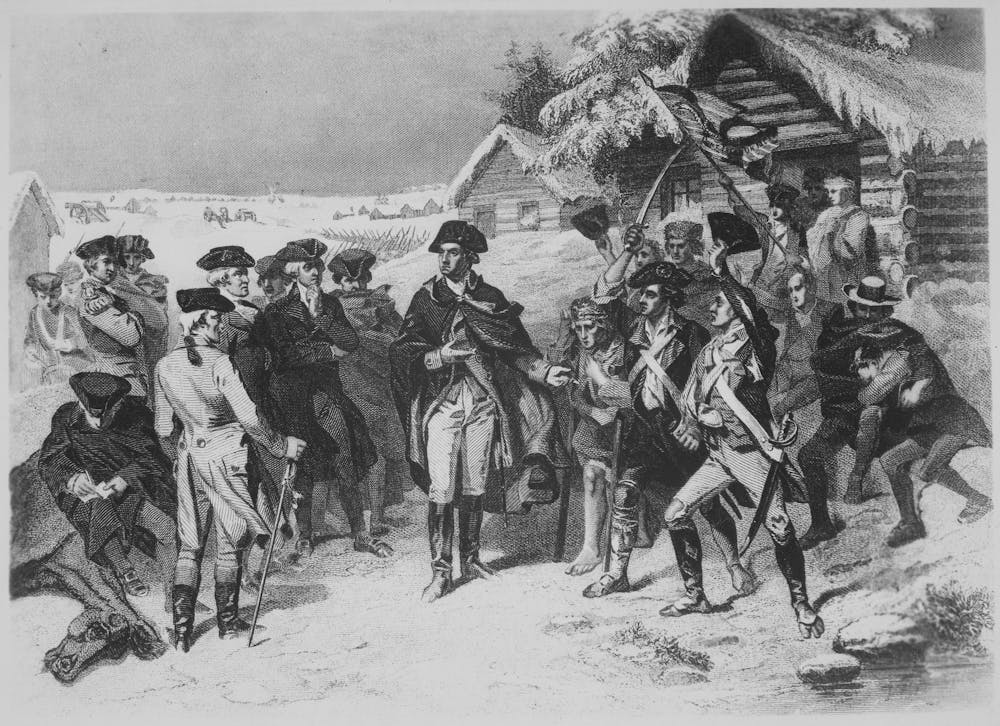
For history lovers, the series is a perfect match. You learn more about the events at Bunker Hill, the long battle at Valley Forge and the campaigning in the Southern theatres (especially South Carolina in 1781). One of the richer episodes shows how, during the harsh winter at Valley Forge, frigid weather and lack of resources nearly triggered mutiny and the collapse of the Revolution itself.
The sheer human desperation is important, especially when talking about the Continental Army. Burns calls the survival of this army “a standing miracle,” and details the human cost through people like Private Joseph Plumb Martin, whose lice-infested clothes had to be baked in an oven when returning home from the icy battles at Trenton, New Jersey.
At a moment when the meaning of citizenship, freedom and belonging is polarizing in America, this series doesn’t offer nostalgia. Instead, it invites reflection, showing that independence was messy, difficult and incomplete. Before it was a reality, it was a combination of aspirations offering promise, but at the cost of unimaginable loss.
If you watch closely, listen to the voices and absorb the perspectives, “The American Revolution” rewards you with more than just facts. It offers a new way to confront the founding of this country that acknowledges its beauty, brutality and complexity.