
Editor's note: All opinions, columns and letters reflect the views of the individual writer and not necessarily those of the IDS or its staffers.
“The name is Mamdani, M-A-M-D-A-N-I" spits the viral TikTok sound, backtracked with Gwen Stefani’s “Hollaback Girl,” a remix of New York City’s mayor-elect, Zohran Mamdani, spelling his name for political opponent Andrew Cuomo. Some see this as a diss track to Cuomo and his cronies who assumed New York City would hand itself over. Considering previous mayor Eric Adams’ purported systematically corrupt police and Cuomo's support from fearful capitalists and President Donald Trump’s reluctant endorsement, the internet recognizes the win not just for Mamdani, but democracy.
As a proclaimed democratic socialist, Mamdani represents the Democratic Party’s increasingly positive view of socialism, which rose from half to about two-thirds among those surveyed by Gallup from 2010 to 2025. Their positive perception of capitalism fell from 51% to 42% in the same period. So, while Republicans roughly hold their pro-capitalist and anti-socialist ideologies, Democrats like Mamdani have hitched their wagons to the rising star that is socialism.
But what is socialism, in actuality? Trump, the demagogue that he is, has made incendiary claims that Mamdani is a communist. However, one peek at his political platform quickly dispels the myth — sending billionaires scrambling, but the real people of the Big Apple looking up. Mamdani’s platform is built on his fight for the working class, lowering costs and making life easier and safer for New Yorkers. His plan includes tactics such as fast-tracking rent-stabilized, union-built and affordable homes commissioned by the city, city-owned grocery stores and raising taxes on big corporations and the top 1%.
Thus, his platform’s pillars strongly echo the cornerstone of socialism, in which a society lives, works, produces, owns and controls all products and property for the common good. It is an economic doctrine rooted, first and foremost, in community. Mamdani’s win, then, should come as no surprise, as NYC is a national hub of production within a society backsliding into fascism and withering in the flames of late-stage capitalism like an ant under a microscope.
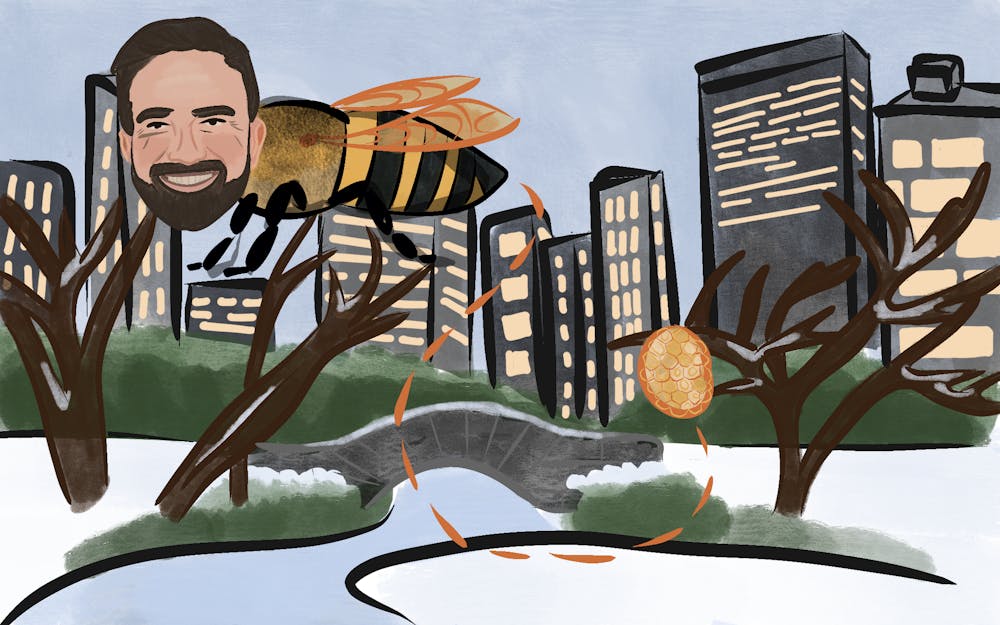
But, speaking of ants: there’ve been tiny socialists all this time, all around us — just not so much in the so-called concrete jungle.
The Hymenoptera order of insects is vast and primarily beneficial to humans: pollinators, parasites of other injurious insects and honey makers. As altruistic as they are to us, it comes as no shock that the suborder Apocrita includes common colonial insects — ants and some species of bees and wasps — whose eusocial societies mimic an ideal socialist one.
If you think long and hard, back to your days of ant farms and peeking under rocks, you already know what I mean. Recall how they all marched along in a line, setting off from home at the anthill together, forging ahead on a convivial journey like the Fellowship of the Ring?
Or consider how fundamental social learning is for a honeybee colony, who tell their nestmates visual information like how far, where and how good the resources in the environment are. All this is communicated through the “waggle dance” — shaking what their mama gave them, in breakneck figure-eight patterns — a behavior young honeybees learn from watching others in the community, a trailblazing 2023 Science paper found. Bees basically have free, cooperative schooling for the youth and public distribution of goods.
Clearly, colonies of ants or bees work almost like a multicellular organism, or synchronized swimmers: they organize, function and care for the group cooperatively. Eusocial species of these insects, according to Britannica, live in “multigenerational family groups in which the vast majority of individuals cooperate to aid relatively few (or even a single) reproductive group members.” These societies are extremely efficient, with members exhibiting task specialization, and practical about gathering resources, with workers focusing on rearing young instead of reproducing in times of environmental pressure — skill needs, appropriate weather and food and mate availability.
Essentially, everybody has a role and plays it well for the community at large; they look out for each other and act as a superorganism or a “Star Trek” Borg hive mind.
Personally, this sounds an awful lot like the ideology that Karl Marx and Friedrich Engels wrote so optimistically about, or the NYC that Mamdani promises to work toward. Socialist doctrine and eusocial species alike share community as a tent-pole of their societies; both call for an attention to the whole in work, life and familial structures.
While we bipeds celebrate Mamdani’s hard-wrought socialist win in a city teeming with capitalists, many of the insects crawling in the background evolved an innate sense of altruism and balance. Maybe it’s time for us to take a page out of their book. Maybe, the inner workings of an anthill or a beehive should sound a bit more like your own life, your own community, your own society.
The opportunities are there in Bloomington: share in the adrenaline with your fellow Hoosiers at the Nov. 27 Turkey Trot, take part in the public library’s Community Toy Swap, support local produce at the Nov. 29 Holiday Market, attend a performance at Constellation Stage & Screen. Community events like these, by and for Bloomington, therefore strengthen collective consciousness and connections and often encourage equality and generosity.
This Christmas season, absorb the yuletide tidings of family and generosity and think like an ant or a bee, not an individualistic American. Attend that event.
Odessa Lyon (she/her) is a senior studying biology and English, pursuing a minor in European studies.



