
All opinions, columns and letters reflect the views of the individual writer and not necessarily those of the IDS or its staffers.
With the push of a button, the U.S. Mint ended production of the penny on a fateful day in November. President Donald Trump ordered the move, citing pennies’ cost: compared to their 1-cent value, they required nearly 4 cents to make. However, the federal government offered little guidance on what to do when pennies became scarce. The little copper-colored coin’s discontinuation was rushed into, with nothing in place to deal with the consequences.
The U.S. Mint ordered its final batch of blanks — the sheets of metal used to make pennies — in May. That means even before the last penny was minted, the coins were becoming scarce, as penny distribution slowed.
This is problematic for businesses, which could not provide exact change for cash paying customers. Some, like Kroger, opted to post signs requesting customers to use exact change. Others were forced to round transactions up or down to the nearest nickel.
The rounding procedure isn’t simple. In some states, there are laws against rounding up charges, aimed at keeping cash- and card-paying customers on equal footing. So, businesses had to round down. When businesses round down every transaction, however, they lose money over time. For example, Kwik Trip, a convenience store chain, is predicted to lose about $3 million this year because of the penny shortage.
These businesses also risk Supplemental Nutrition Assistance Program non-compliance because the program requires that people using SNAP benefits be treated the same, as in charged the same amount, as other customers. Without pennies, it may not be possible to do so.
The alternative in states where it’s allowed is rounding up, which could leave consumers on the receiving end of higher costs. In fact, rounding every transaction to the nearest nickel, whether up or down, is estimated to cost consumers a potential $6 million annually. People without access to credit or debit cards would be most affected by this because they are the most likely to pay with cash.
Congress’ “Common Cents Act” would rectify these rounding problems. If it became law, the bill would standardize procedures across the country by mandating retailers round to the nearest nickel, based on an item’s price tag. For example, a price ending in 0.99 would be rounded up to the next whole number, and a price ending in 0.01 would be rounded down.
This solves the problems of compliance with state laws. However, the bill could have become law before penny production slowed. The Common Cents Act was proposed in both the House and the Senate in April, two months after Trump proposed the U.S. Department of the Treasury stop producing pennies in February. Yet the bill did not become law before the last penny was minted in November. In fact, it still is not law. If the White House and Congress had worked together, there would be no scramble to figure out how to comply with existing state laws.
The federal government’s seeming lack of a plan beyond simply discontinuing the penny is disheartening. It indicates little understanding of how much the humble coin can and did change things. It seems Trump learned how much pennies cost to produce and decided they needed to be discontinued with little more thought on the matter.
I agree it is time for the penny to go. I am merely suggesting that any decision the government makes should be well thought out. All the possible problems should be addressed before taking action.
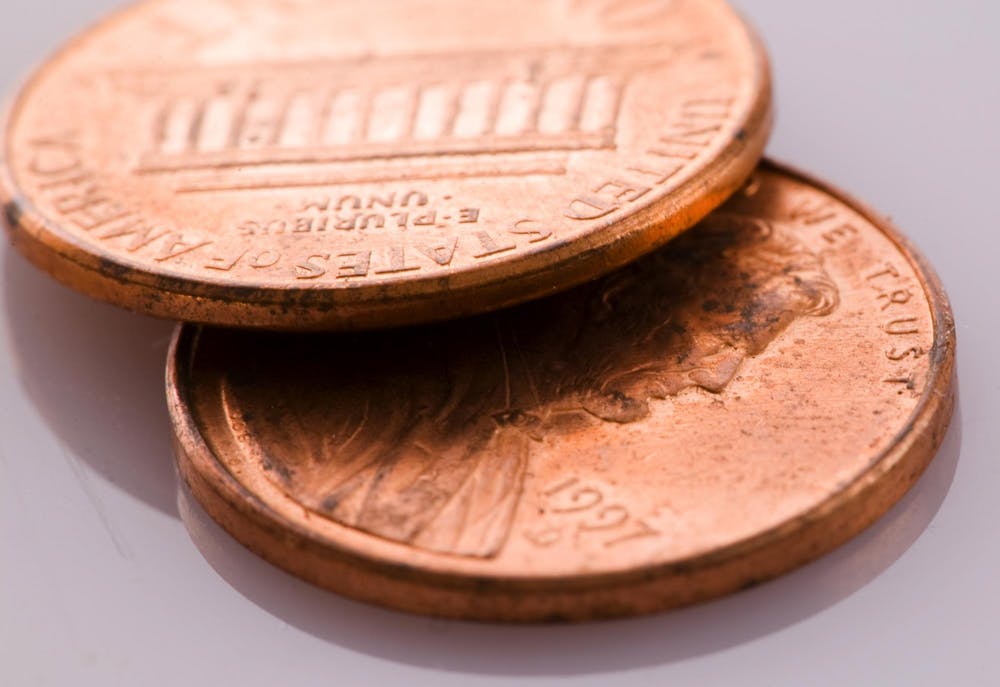
I would be remiss if I didn’t discuss the penny itself. While pennies will no longer be produced, they can stick around as sentimental items. As someone who owned several piggy banks as a kid, I know I will hold my leftover pennies close as a relic of a less digital world.
Getting out of the car in the grocery store parking lot and spotting a little copper coin on the ground, pocketing it for good luck. Flipping a small coin into a fountain and watching it sink to the bottom. Pushing a coin into a machine and getting a pressed souvenir. This is how I encountered pennies in everyday life. Soon, it will be the only way.
For those of us who cling to sentimentality, pennies will always be good luck symbols and pressed souvenirs. I hope we will all remember the penny that way, and not for its perceived uselessness, or the damage its scarcity has caused. I also hope the penny will serve as a reminder that actions have consequences, and that our government should be capable of weighing the costs and benefits before jumping into a decision.
Sasha Burton (she/her) is a sophomore studying elementary education with minors in English and Spanish.



