
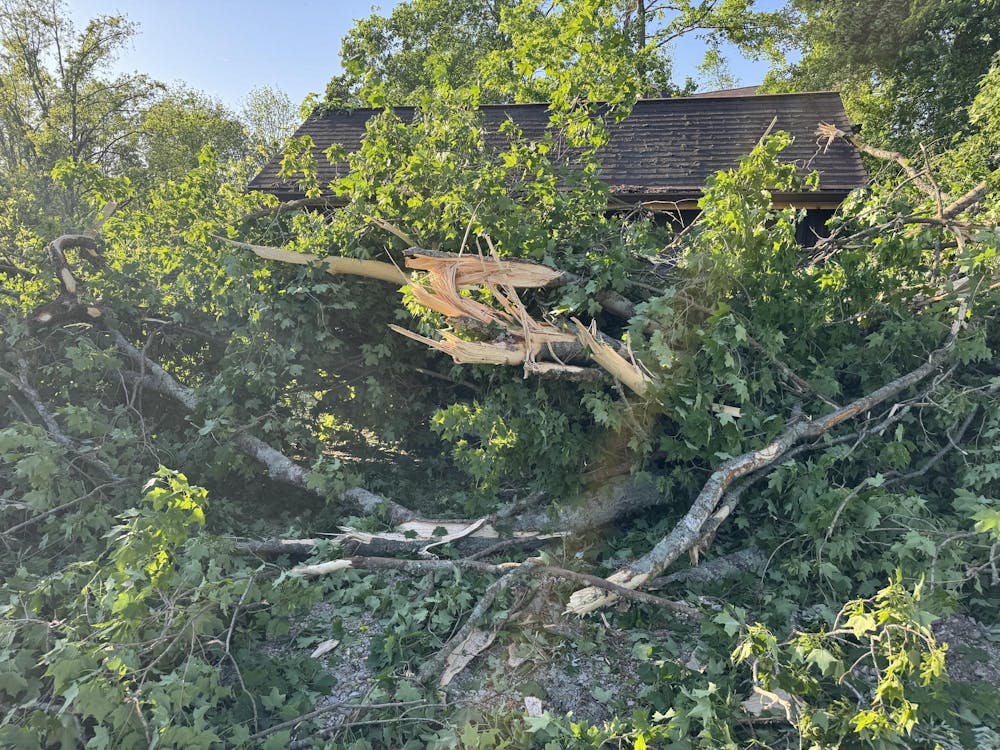
On the evening of May 16, Bloomington schoolteacher Eve Cusack looked out her kitchen window and watched trees topple over in her yard.
“We had a row of white pine that have been there my entire life that fell like dominoes,” Cusack said. “While I was watching I saw about eight of them just fall, one at a time.”
A minute before, Cusack had been in her bedroom working on reports for a parent-teacher conference. Then the light from the window shifted, and when she glanced outside, the wind was bending trees back and forth.
“I’ve lived here for 50 years, and I’ve never seen anything like that,” Cusack said.
Cusack sprinted for the stairs, buffeted by a tunnel of wind from her daughter’s open bathroom window. When she and her parents reached the basement door, the whole house was shaking, making a rhythmic noise like a jackhammer.
An EF-2 tornado, categorized by the National Weather Service as strong enough to shift homes off their foundations or rip off parts of rooftops, crossed through the south of Bloomington on May 16, ripping up trees, causing at least five injuries and damaging more than 100 buildings, according to WLKY.
The Midwest has seen an unusually high number of tornadoes this year. Indiana has had 60 tornadoes so far, high above the statewide average of 22, according to Indiana Weather Online. Tornado outbreaks, where a number of tornadoes form in a short period, have also become more common.
Scientists don’t have a definite answer on why tornado patterns are changing, or how trends will shift in the future.
Ethan Choo, a graduate student studying atmospheric science at IU, said weather forecasters check for certain environmental clues to predict tornadoes, like thunderstorms and pockets of air rising in the atmosphere.
But tracking those factors isn’t an exact science.
“We still scratch our heads over some of the dynamics behind the formation,” Rebecca Porter, another IU graduate student studying atmospheric science, said.
Climate change is shifting the world’s patterns of drought and moisture, and the results of that aren’t yet clear, Choo said. Tornadoes might decrease in some places, but increase in others.
Long-term trends haven’t shown an overall increase in the number of tornadoes across the nation. But in 2018, one study found tornadoes are decreasing in frequency in the “Tornado Valley” of the central U.S. and increasing in several states further east, including Indiana and the Midwest.
Climate change is also increasing the frequency of severe weather events, like flooding and heavy precipitation. In 2023, the Indiana Climate Change Impacts Assessment found that annual precipitation had increased by about 6.5 inches from 1895 to 2019, and researchers expect that number to continue rising.
Justin Baker, deputy director of the Monroe County Emergency Management Agency, said people in mobile or manufactured homes are at particular risk of being impacted by tornadoes, and so are people who primarily work outside, like construction workers.
Baker said tornadoes also pose a threat to places where people gather in large clusters, like nursing homes or football stadiums.
Janet McCabe, former deputy administrator at the Environmental Protection Agency and a visiting professor at IU, said increased severe weather could lead to more evacuations and property damage, while increased floods could contribute to environmental hazards like mold. Those consequences won’t fall equally for all residents.
“There are some people, including in Bloomington, who would be more vulnerable to harms than others,” McCabe said. “People who don't have a support network, people who live in areas that are particularly vulnerable to flooding, or live in housing that is not as secure.”
Aleka Alonge lives in the south of Bloomington. She said on the morning of May 16, the sun was out and the birds were chirping. She and her boyfriend were watching the sky for signs of trouble when they saw what looked like a flock of birds. It turned out to be a cloud of shingles and debris from nearby homes.
The tornado hit their house a few moments later.
“It was an eerie green sky, and a sound like a freight train, and our ears were popping,” Alonge said.
After the tornado passed by, Alonge discovered the tornado tore up the turf of her daughter’s batting cage, popped out the windows of the house and ripped up her pool deck.
A billboard ad for a local realty service, with a plank of wood impaled in its steel frame, was swept into her backyard from several blocks away.
“A 2 by 4 was, like, going through the metal, just from the actual speed of the objects flying,” Alonge said. “So, it was just really weird to see.”
Baker said residents should protect themselves from tornadoes by keeping track of weather predictions, watching the weather forecasts on local news stations and signing up for national and local weather alert services.
They should also avoid making outdoor plans when there’s a chance of storms, Baker said, and make sure they have access to emergency shelter when spending time outside.
Monroe County residents can sign up for local emergency warnings through the county website, and can also download the Federal Emergency Management Agency app for weather alerts. The Monroe County Emergency Management Agency is also giving out a limited number of weather radios, which residents can request by contacting the office.


