
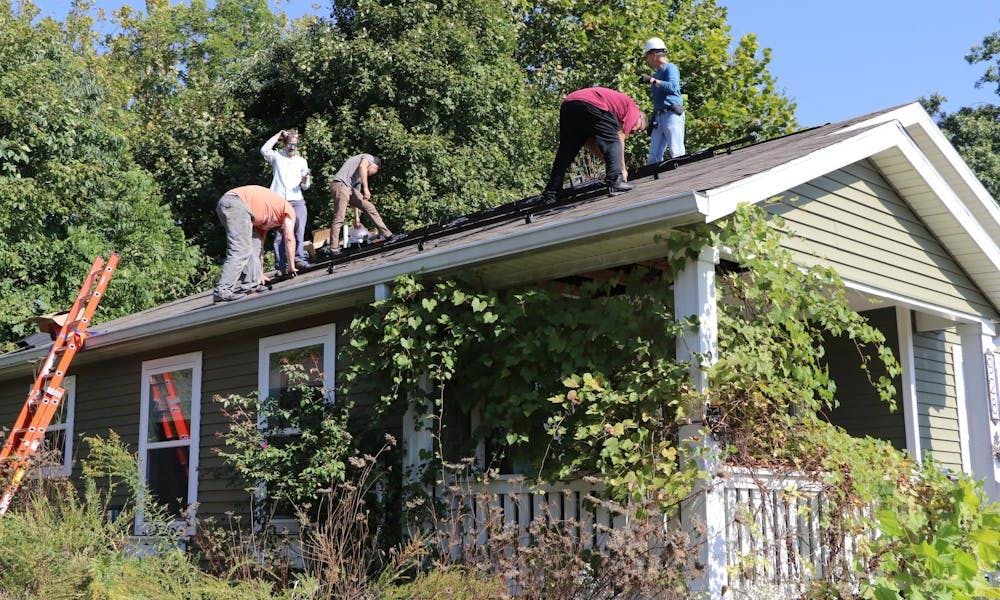
A city program launched Dec. 10 offers homeowners and building owners free guidance on how to implement clean energy solutions.
Bloomington Energy Works funds energy usage audits and outreach efforts as part of a national program to build the market for clean energy projects like solar systems or electric vehicles that reduce greenhouse gas emissions and air pollution.
Shawn Miya, assistant director of sustainability at Bloomington’s Economic and Sustainable Development Department, said the program will help the community save on energy bills while pushing Bloomington toward its Climate Action Plan goal to reduce greenhouse gas emissions by 25% below 2018 emission levels by 2030.
For the first stage of the program, Bloomington Energy Works hired energy development company Donovan Energy, which provides consulting services for businesses interested in reducing their carbon output and energy bills.
Developers and large building owners who apply and are selected can receive free technical assistance, which could include an analysis on 12 months of energy usage data or an on-site visit to determine the best path to improving the building’s energy usage.
Donovan Energy could also provide recommendations for specific clean energy projects or a financial analysis of potential solutions, including information on possible cost-saving measures like tax credits or incentives.
The possible solutions include measures like solar energy systems, optimized temperature controls, LED lighting and electric vehicle charging stations.
To inform homeowners and residents on clean energy solutions, Bloomington Energy Works hired local green energy nonprofit Electrify Indiana to spearhead community involvement and outreach.
Electrify Indiana is seeking adults and high schoolers to serve as “Energy Navigators,” who will give educational presentations or go door to door informing residents on solutions for energy efficiency and financial incentives or cost-saving measures for implementing the solutions.
It is also looking for homeowners who have implemented electric energy solutions like induction stoves, heat pumps or solar panels to host a show-and-tell displaying the technology.
Building owners or homeowners in or near Bloomington can learn more on the Bloomington Energy Works website, or watch its launch webinar for detailed information.
The City of Bloomington launched the program in partnership with the Indiana Energy Independence Fund, a nonprofit “green bank,” or financial institution that facilitates investment in green energy projects.
IEIF paid for the project with a $250,000 Municipal Investment Fund grant, a funding opportunity designed by the Coalition for Green Capital, a national nonprofit green bank. ICLEI USA, a national chapter of a global network for sustainable urban development, awarded the funding to the IEIF with the intention of using it for Bloomington’s program.
Through the MIF program, about 49 local and tribal governments and nonprofits have received $250,000 each to help create a list of potential public-private partnership plans.
By April 15, Miya said Bloomington Energy Works plans to create and submit a public-private partnership plan for the second phase of the MIF program, which will select 10 of the original grantees for an additional $2 million in funding to further develop the project plans.
The Coalition for Green Capital is partly funded with money from the National Clean Investment Fund, a program of the Inflation Reduction Act. Earlier this year, the Trump administration froze billions of dollars of that funding.
In response, CGC filed a lawsuit against Citibank, the bank holding the grant money.
CGC plans to build the funds for the next phase of the MIF grant through “philanthropic and private resources,” according to a statement from ICLEI USA in July.
Miya said the outlook of what money Bloomington and other cities would get is uncertain.
“Everything is potential at this point,” Miya said.
IEIF Executive Director Alex Crowley said Bloomington Energy Works plans to do its best with its current funding.
"This is a great beginning, or down payment grant. We will optimize that, and then let's set ourselves up to compete for whatever's available,” Crowley said.
If the next phase of the grant is able to be funded, Crowley said Bloomington Energy Works could be positioned to stand out against other applications.
Indiana lacks tools like Commercial Property Assessed Clean Energy, a system for financing clean energy projects available in other parts of the country, and many Indiana counties ban solar energy installations. Monroe County allows rooftop and ground-mounted solar installations that meet permitting and zoning requirements.
Crowley said Bloomington Energy Works could help demonstrate green energy’s viability even in challenging regulatory environments.
“If Indiana can do it, the Midwest can do it, and if the Midwest can do it, then the country can do it,” Crowley said.


