
Editor's note: All opinions, columns and letters reflect the views of the individual writer and not necessarily those of the IDS or its staffers.
When I got in trouble as a kid, my parents would take away my book. I snuck books everywhere. In class, I always had an open book in my desk that I would slide out of sight if the teacher walked by. At night, I hid a book in my pillowcase, then read by the light of my alarm clock (turning on the lamp would alert my parents). During car rides, at grocery stores — you name it — I was reading.
Then at 13, I got a phone, and that changed. All of a sudden, screentime interested me much more than anything else going on. I found myself totally addicted and my love for reading slowly but surely faded away, replaced by the incessant need to scroll.
While I would love to say I've changed my ways since my adolescence and am now the epitome of a hyper-productive superhuman, that would, unfortunately, be a lie. What drives me crazy is that I know it's bad for me. I know I feel worse from that guilty feeling of procrastination combined with a screentime induced headache. So, why do I keep wasting my life away?
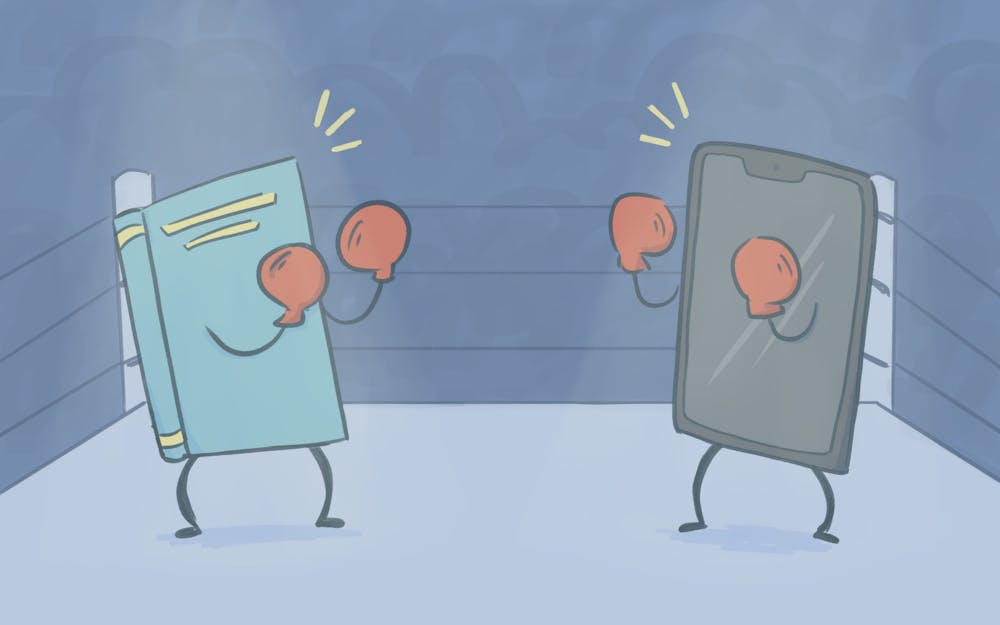
But self-awareness is key, so I invite you to join me in fighting our phone addictions — with a book or two.
It's hardly surprising the wealth of academic literature that ties the health of a person’s attention span with “reading tasks” is quite extensive. It doesn’t take a neuroscientist to know I feel like I can’t focus as well with my phone on my desk. The research on this shows significant correlations between children's visual attention span with “all reading tasks”.
Reading has been “proven to increase your focus, attention span, concentration and to improve memory,” researchers at Hawaii Pacific Neuroscience wrote.
This year, I realized something had to change. I was tired of my phone controlling my free-time, and there were too many good books sitting on my shelf for me never to read them! Third grade me was blowing through at least one book a week, so surely, one book a month for college me would be no big deal. Naively, I made a goal to read 12 books before 2026. I had a rocky start; it wasn’t until March that I finished the first book. Now, I’m doing a little better; so far, I have read eight books and have been working on the ninth since September.
As an (almost) teacher, one thing I always tell my students before we read a book together is that books are either mirrors or windows, meaning they can help us reflect on our own experiences or provide us with insight into someone else’s — and good books have the opportunity to do both.
When I started reading again, I picked up The Alchemist by Paulo Coelho; its a “modern classic” about chasing one’s purpose and how each of our individual journeys towards that purpose are intertwined. I chose this one, chiefly because I have a niche interest in classic literature, but also because this one is quite a short and easy read. After I finished the book, I gave it to my fiancé, a Purdue Engineering student with very little time, and he found the book very enjoyable too.
If you’re looking for a place to start, check out the Monroe County Library. It’s free! One of my personal favorite places to find a good book is the app Goodreads, which recommends books you might like based on books you have already read. It’s also a great way to digitally store books you want to read later. I find myself referring to my Goodreads library quite often when I’m looking for what to read next.
Our phones make it very easy for our lives to revolve entirely around ourselves. The algorithm tailors content to predict exactly what we will like. We follow and subscribe to the people we choose to listen to. Everything is fully customizable to suit our exact preferences. Books force us to experience life in the shoes of someone else.
By reading, we endure the slow build of a plot and pay attention to details that don’t fit neatly into a short video clip. Reading is active, not passive. It asks something of us that our phones never will: focus, patience and curiosity.
In return, reading gives something that scrolling never will: a story that isn’t filtered through algorithms or hashtags. When we read, we remember what it’s like to live beyond our own bubble, to think deeply instead of reacting instantly. There’s no clickbait in a book, no ads trying to sell you something, no one vying for your like or follow. Books don’t ask to be liked, they ask to be experienced.
Maybe it’s time to slow down, pay attention, and give the world, and ourselves, the focus we’ve been missing.
Ainsley Foster (she/her) is a senior studying elementary education



