
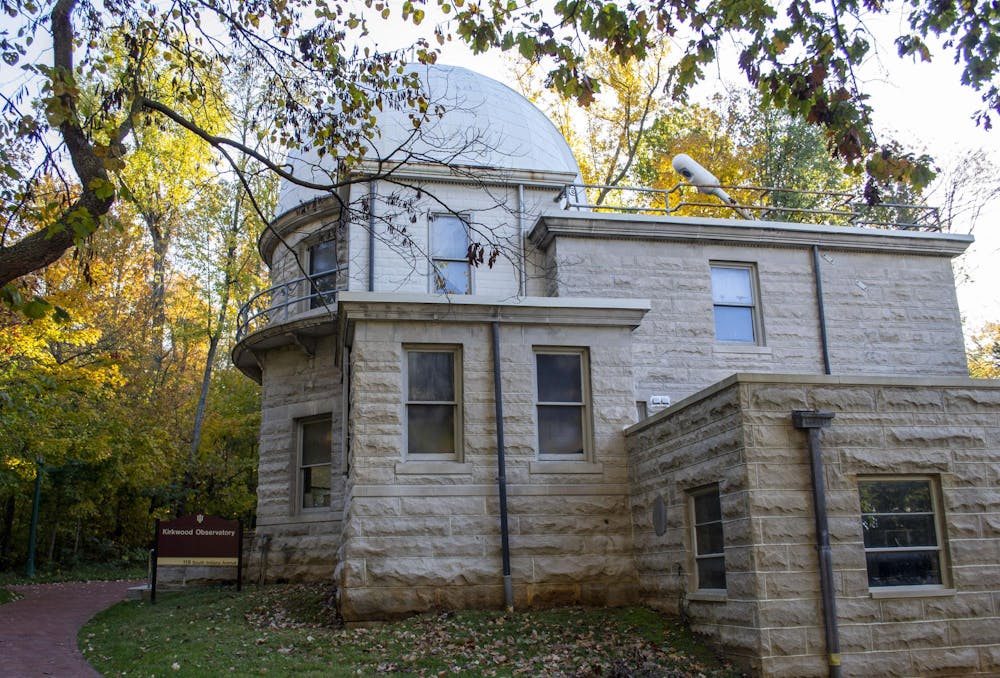
Every Wednesday night as the sky grows dark, the Kirkwood Observatory opens its doors to the public. Available from the end of spring break to the beginning of Thanksgiving break each year, the observatory provides an opportunity for visitors to stargaze in Dunn’s Woods.
The facility was built in 1900 and posthumously dedicated to Daniel Kirkwood, a mathematics professor at Indiana University, in 1901. He is best known for discovering Kirkwood gaps, which are sparse regions within the asteroid belt located between Mars and Jupiter.
Although the observatory was formerly used for research, it is now used for outreach and instructional programs. Visitors can climb a flight of stairs to the observatory’s second floor, which holds a 12-inch refracting telescope for public viewing.
Caty Pilachowski, a professor in IU’s astronomy department, said the refracting telescope comprises two 12-inch lenses of different types of glass separated by the thickness of a postage stamp, which help visualize celestial bodies.
“When you have a glass lens, different colors focus slightly in different positions,” Pilachowski said. “But if you use two different kinds of glass and put them together to make a doublet lens, so two lenses together, then you can correct for that change in what's called the change in refraction.”
According to Pilachowski, this mechanism improves the color response of the telescope and helps light focus at the bottom end of the telescope, which has an eyepiece that provides magnification for viewing planets and binary stars.
“One of the favorite targets for everybody is the moon,” Pilachowski said. “Bloomington city lights are so bright that it's difficult to see a lot of the faint nebulae there and galaxies that we would love to be able to show the public. So, we're pretty much stuck with planets and binary stars and the moon, but it's still fun to look at.”
The observatory also contains a solar lab equipped with a solar telescope and Hydrogen-alpha camera, which are open to the public and used for academic instruction. The Hydrogen-alpha camera displays the outer layers of the sun’s atmosphere, Pilachowski said.
The observatory’s enduring presence has made it a cornerstone for exploratory astronomy in the Bloomington community.
“We get grandparents who come to the observatory and bring their grandchildren, and they tell us that when they were little, their grandparents brought them to the observatory,” Pilachowski said. “We have a long, long history and just deep roots in the Bloomington community. We're proud of the observatory. We're proud that we can continue to share it with the public and we take the best care of it we can.”
The observatory’s proximity to Kirkwood Avenue, a hotspot for IU students, helps attract people outside of the astronomy department. Aida Melgarejo, a Spanish linguistics student, said she came across the observatory on the way to her next class and promised herself that she would visit later.
Melgarejo was traveling with her friend Clara Herrero, a first-year doctoral candidate.
“We were just walking by, and we saw the lights, and we suddenly wanted to get inside, you know, so that's why we came today,” Herrero said.
Despite having limited experience in astronomy, both Herrero and Melgarejo said that they found the observatory interesting.
“I think it's a worthwhile experience for every Wednesday,” Melgarejo said. “I have never had something like that.” Third-year doctoral candidate Anika Goel said she began volunteering at the observatory as a requirement for her graduate program, but she keeps going back because she enjoys talking to others about astronomy and answering their questions.
“It often makes me think about our field in a different light, because the questions we ask in scientific fields (are) different than the questions that the public asks,” Goel said.
While astronomy is increasingly accessible as technology continues to develop, Goel said she believes the observatory provides a unique experience.
“I think a lot of people nowadays have access to advanced telescopes in their backyard that they can buy and look at all of these objects in the night sky, maybe with much better resolution than Kirkwood,” Goel said. “But this is how astronomy started, and this observatory connects us with our history in a way that your new telescopes don't.”
Robbie Mailliard, a senior studying astronomy and astrophysics, said he believes the observatory is a good place for introducing astronomy to the community. He spends his time in the solar lab, where he can study the sun, eclipses and space weather.
“We actually get a very good mix of locals, people coming from out of town and students coming all together,” Mailliard said. “And I do think we have nights where it's really slow, we have nights where it's really busy. We kind of like the ebb and flow of the busy-ness.”
According to the IU Department of Astronomy, the observatory’s solar lab will be open from 1-3 p.m. Nov. 8 and Nov. 15 to view sunspots, dark spots on the sun’s surface caused by intense magnetic fields. Pilachowski said the lab’s Hydrogen-alpha camera will allow visitors to see solar prominences which are eruptive clouds of plasma formed by magnetic fields; prominences appear as bright-red loops protruding from the sun.
Public viewings will continue every Wednesday until Nov. 19 and will resume after spring break.
Due to varying weather conditions and the end of daylight-saving time, the opening timetable will be adjusted accordingly on the observatory’s website.


