
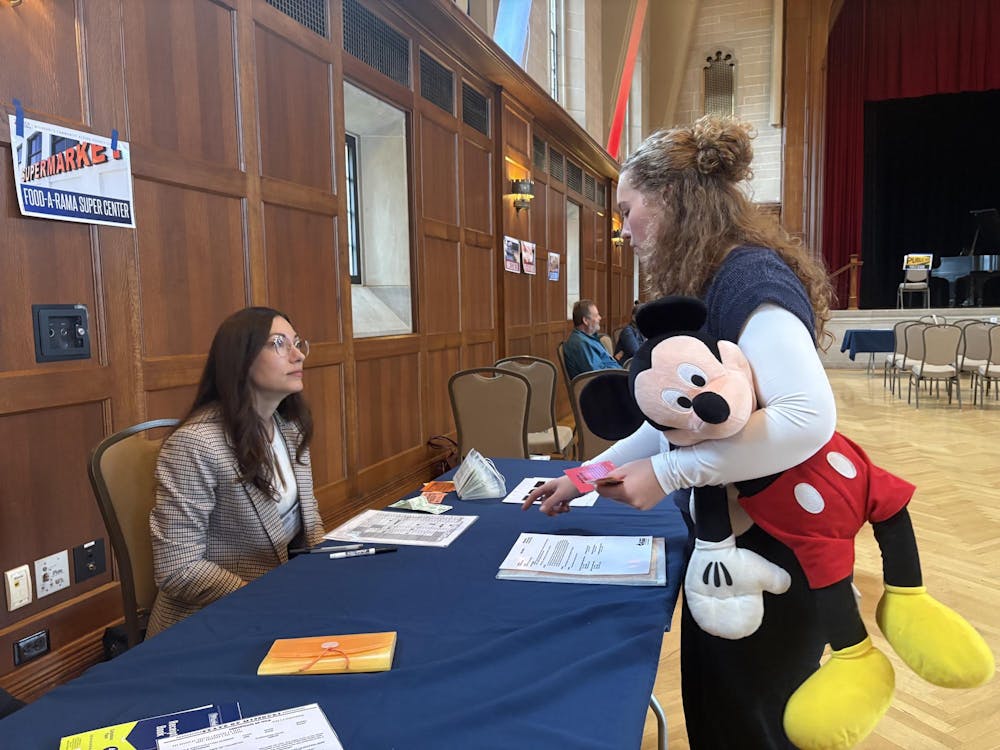
For three hours Tuesday afternoon, Alumni Hall in the Indiana Memorial Union became a town built from tables, signs and volunteers. Each station represented a business or social service — a bank, a childcare center, a grocery store and a pawn shop. Inside, participants hurried between lines, trading tokens, paying bills and struggling to keep their fictional families afloat.
The mock community was for the IU School of Public Health–Bloomington’s second annual Poverty Simulation. The school partnered with South Central Indiana Area Health Education Center and Circles Indianapolis, a community-based poverty-reduction organization, to give IU students firsthand experience of living in poverty.
The event encouraged students to think critically about the decisions families must make when money, time and resources run short. Kathleen Sobiech, director of Public Health Practice, Accreditation, and the Master’s in Public Health program at the School of Public Health, worked alongside both partner organizations to help facilitate the event. She said in an email that organizers wanted the simulation to expose students to the realities faced by people in poverty.
“For anyone working in public health, understanding the obstacles people face, the decisions they make and the consequences that affect their families is essential,” Sobiech wrote.
Around 20 participants worked through four 15-minute rounds, each representing a week in the life of a low-income family below the poverty line. Many quickly discovered that basic tasks — getting to work, paying rent and buying food — required difficult trade-offs.
IU nursing junior Emily Kelly said the experience quickly became overwhelming due to time constraints.
“I’m overwhelmed about all the things I have to do, and the little money, and especially transportation passes right now. It’s a lot,” Kelly said.
Midway through the exercise, she said she grew frustrated when the simulated cash card she’d received at the beginning of the simulation was shredded at the fictional supermarket after she couldn’t show any proof of how she spent her funds.
“I would say I’m frustrated and a little bit angry that, like, they didn’t say that I had to get a receipt, and then they took my money when it was my money,” Kelly said.
Across the room, other students faced similar pressure as they tried to balance bills, transportation and family needs. Senior Tori Spencer said juggling family responsibilities — like getting groceries, co-parenting and managing finances — made it hard to understand and stay on top of everything happening around her.
As students scrambled to keep their households afloat, volunteers from Circles Indianapolis stood behind the tables that brought the simulation to life — playing employers, landlords and even law enforcement officers.
Volunteer Tommie Howard returned to playing sheriff, a role he had previously played at past simulations. He maintained order by sending participants to a fictional jail if they had overdue fees or evictions.
“I have a very strong impact on the community and also a very strong impact on some of the citizens,” Howard said. “But I'm here to help keep craziness down to a minimum.”
Those volunteers worked under the direction of Marie Wiese, executive director of Circles Indianapolis. Wiese said the organization has been active in Indianapolis for nearly 15 years, helping households in poverty by building financial and social stability through community and relationship building.
According to the U.S. Census Bureau, about 12.2% of Indiana residents — more than 820,000 people lived below the poverty line in 2024. That includes about 17.7% of Monroe County residents in 2023.
For Wiese, the numbers underscore the importance of poverty education and community connection.
“So, we’re not your traditional charity where you give money or clothing or food, we give community, we give encouragement, we give social capital,” Wiese said. “Social capital is lending your power in the community to somebody else to help them a, get a job or find somebody that's going to help them meet a need.”
The Poverty Simulation was originally created by the Missouri Community Action Network, which developed the materials from the real experiences of low-income clients. Circles Indianapolis uses those tools for both education and recruitment.
Wiese said she hoped the simulation would challenge participants to rethink assumptions about poverty and leave with greater compassion, sympathy and empathy.
“Really, people just want a home,” Wiese said. “They want enough food to feed their families, a rewarding job. I mean, it’s not asking for millions of bucks or a lavish lifestyle. They’re just wanting the basics. It’s what they’re working for.”


