
Students from various science departments prepared hands-on and family-friendly activities including slime-making and virtual reality scuba diving at Indiana University’s 12th annual Science Fest on Saturday.
In a message addressing Science Fest’s return, Rick Van Kooten, the executive dean of the College of Arts and Sciences, said the festival’s purpose was to give the community an opportunity to experiment with different scientific fields.
Students across all grade levels at IU gathered to showcase their areas of expertise through booths with interactive labs and games.
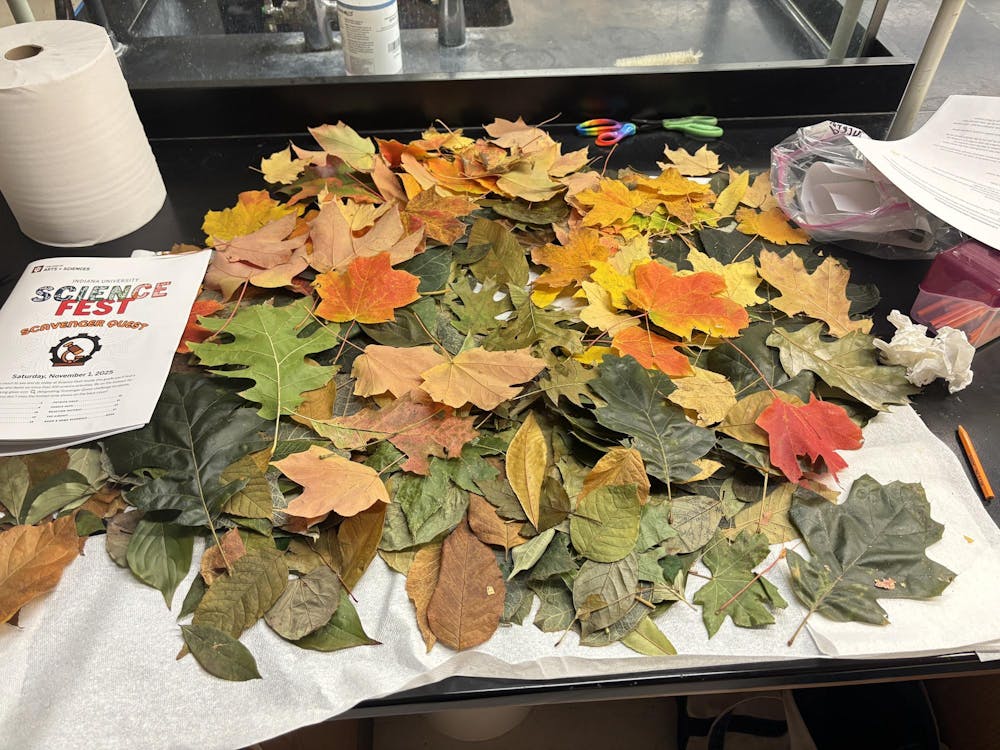
Sam Jacobo, a third-year graduate student studying organic chemistry, helped organize the booth “Chemistry Quest: Revealing the Unseen.” There, visitors learned how to extract various shades of chlorophyll from leaves by using a mortar and pestle. The pigments were then visualized on strips of paper and developed with an alcohol solution to capture the color of the leaf.
Jacobo said he wanted to demonstrate the practicality of chemistry, noting that he was particularly drawn to organic chemistry because its theoretical concepts are universally applicable to everyday objects.
Other students presenting at Science Fest focused on the intricacies of objects seemingly unrelated to science. An overarching theme among students was a desire to make science accessible to the public.
Kingsley Bortey, a fourth-year doctoral chemistry student, described the science behind slime-making in his booth. He explained that slime is created when polymer chains in glue form bonds by interacting with borate ions from Borax, a household cleaning agent.
“Sometimes people hear about polymer and may think that that is something abstract, but Science Fest gives them the opportunity to see it experimentally,” Bortey said. “The beauty of it is to demonstrate to those who are curious.”
Morgan Familo, a fifth-year doctoral student studying evolution, ecology and behavioral studies, was motivated to volunteer at her booth for similar reasons.
“Outreach is kind of the reason we do science; if we do all of the science and we don't try to share it with others and make it accessible to everyone, what's the plan?” Familo said.
In IU senior and research assistant Josey Mentzer’s case, bringing exposure to the underwater sciences program was a priority. Mentzer stressed the importance of Indiana’s maritime archaeology and underwater heritage despite the state being landlocked.
Mentzer’s booth had a virtual reality headset simulating an underwater scuba dive, which brought attention to IU’s expansive resources. The university offers students access to scuba diving courses for introductory exploration and advanced certification programs for research.
Festivalgoers — whether recurring or first-time attendees — highlighted the success of these students’ initiatives for community outreach. Some said the diverse range of STEM activities provided visitors with freedom to explore science at their leisure.
Alexis Roberts, a third-time attendee, decided to celebrate her 10th birthday at the Science Fest, inspired by the uniqueness of each of her visits.
“Every time that we enter, they always have some, like, cool stuff that we get to do,” Roberts mentioned.
She particularly enjoyed the chemistry section of the festival, called the “Reaction Pathway,” for its interactivity.
“My favorite part about that was probably the sugar part where we got to taste-test two different types of sugar,” Roberts said.
The booth she attended used the taste-testing to showcase carbohydrates as key nutrients for the body.
Danika Roberts, who was attending the festival alongside her sister Alexis, said she enjoyed booths that blended creativity and chemistry, particularly the henna lab hosted by Hoosier Henna. She said she liked how Science Fest catered to people of all ages.
“My favorite part is the henna because everybody's really nice, and they are really good at what they do,” Danika Roberts said. “We got to look through books and see like, different designs and what they meant, and that was really fun.”
Eli Bennett, a freshman at Louisville Male High School in Louisville, Kentucky, said he wanted to attend Science Fest because it sounded like an interesting experience. He especially enjoyed the physics area of the festival, where he attended booths involving the mechanics of acoustics and sound waves.
“This would be very helpful for young people that want to learn to pursue these kinds of things,” Bennett said.
In addition to providing education and community engagement, faculty overseeing Science Fest highlighted the acquisition of funding behind the science and research at IU. The university suspended more than 100 academic programs to comply with state budgeting laws this year. Programs within the College of Arts and Sciences, such as atmospheric science, were amongst those impacted.
Despite these cuts, faculty continue to advance research and learning by earning grants from the IU Innovation and Commercialization Office and the federal government.
Alex Georgescu, assistant professor of chemistry, said he wanted to emphasize the $1.8 million federal grant awarded to IU researchers who developed small-molecule, ionic isolation lattices (SMILES), the brightest fluorescent material. SMILES made an appearance at the booth “Fun with Fluorescence,” which Georgescu oversaw.
“I just want them to know more about the different branches of science that we do here at IU, and you know the funding we get and so on, and how it's important to keep our research going,” Georgescu said.


