
While many know the popular depiction of “Frankenstein" from the 1931 Universal Pictures film, my main exposure to the story was when I read the original book by Mary Shelley in high school. After reading such a masterpiece, seeing the monster depicted as a viridian Halloween monster seemed mildly insulting to Shelley’s work.
However, I believe Guillermo del Toro has revived the Shelley story into something truly remarkable with “Frankenstein,” released Nov. 7 on Netflix.
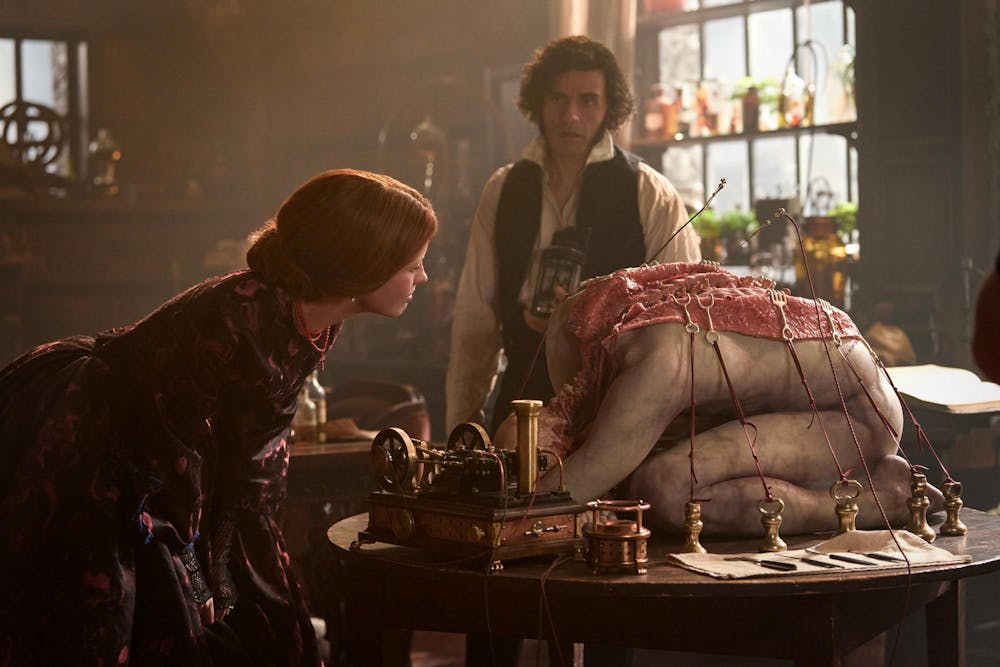
The first 20 minutes immediately captured my attention with its impeccable production design, costuming and score. I was enchanted by the billowing crimson veil of Victor Frankenstein’s (Oscar Isaac) mother (Mia Goth) as she and Victor stood on the steps of their estate. And of course, the costuming and design of the Creature (Jacob Elordi) was truly incredible.
The set design of Victor’s tower was also remarkable. It was the exact mid-point between believable and wildly fanciful. While del Toro presented a more accurate and grounded version of the adaptation, he still leaned into the fantasy and gothic darkness of the story.
But the gorgeous visual gateway of the production led to an even more beautiful story. While far more accurate to the 1818 gothic sci-fi novel, del Toro makes many changes that I think suit the story.
Primarily is the character of Elizabeth, also played by Mia Goth. Shelley’s Elizabeth is mainly a pawn shoved around in the story and used as emotional collateral for Victor. However, in del Toro’s film, Elizabeth is charming, has far more agency and is central to the depiction of the Creature’s humanity. She is the first person in the film who talks to the Creature and treats him as a person.
Elordi as the Creature is infatuating. I think del Toro leans far more into the human side of Victor’s Creature. He is indeed violent, but only when provoked. When he is with someone who cares for him like Elizabeth or the blind man he encounters (David Bradley), the Creature is gentle and emotionally intelligent.
And although the Creature appears to be the monster, Victor Frankenstein is the one who is called into question by his loved ones and the audience. After Victor attempts to kill the Creature and believes he is successful, Elizabeth is cold and furious. His brother William (Felix Kammerer) even calls Victor a monster directly to his face after realizing all the wickedness he has created.
Victor and the Creature are two hands of a single clock. They revolve around one another, forever connected at their core. Their stories are the same, obsessed with their own humanity. The Creature is tortured by a life he’s forced to live; deliberating whether he can truly be a human. And Victor is tortured by the life he’s forcibly given to the Creature; deliberating whether he can truly be human after playing God.
This brings me to the second great diversion del Toro made from the original. In the end, after Victor and the Creature have shared their stories, they finally understand one another. The Creature forgives Victor for the life he’s been given, and Victor encourages him to live that life to the fullest. And instead of trying to end it all like he does in the novel, the Creature walks into the sunrise, hopeful for life.
Guillermo del Toro’s “Frankenstein” is perhaps one of the best films I have seen this year. Its themes are heavy and authentic without feeling like it needed to be overly realistic. I am always impressed by writers and directors who can pull off a unique vision for such a classic story. In a way, it reminded me of my favorite movie, Greta Gerwig’s “Little Women.” Clearly not with its themes or its emotional impact, but simply by a creator daring to have a distinctive voice when telling such a beloved tale.


