
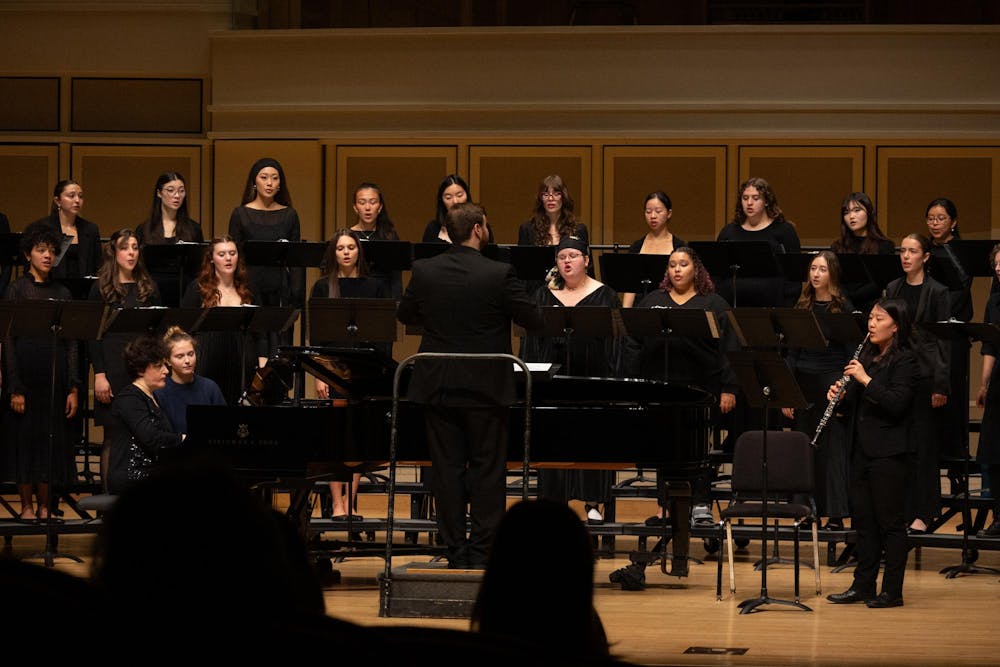
Jacobs School of Music choral ensemble Pro Cantare performed its fall concert at Auer Hall Tuesday evening. Over the course of about 45 minutes, the ensemble performed 10 songs making up a program titled “Echoes of a Living Soul.”
The group is an all-treble ensemble consisting of about 30 singers, with a fairly even split between sopranos and altos. Director Ryan Block, a first-year doctoral student in choral conducting, is the director of Pro Cantare for the fall semester. He began constructing the concert program over the summer.
Block said “Echoes of a Living Soul” broadly encompasses the music he believes expresses core emotions of the human experience.
“I wanted it to be music that kind of exists in the question of how we hear longing and desire and things that have happened in the past that we can no longer get back to,” he said.
The concert opened with the hymn “O virtus sapientiae” arranged by Katerina Gimon, a contemporary Canadian composer. The piece was sung entirely a cappella, opening with a small group of eight singers. The song’s Latin text, soaring high notes and chants filled the concert hall with a haunting resonance.
Following “O virtus sapientiae,” South Korean contemporary composer Hye-Young Cho’s “Evocation” was a soft and sweet contrast to the concert’s opening piece. Sung in Korean, its text translates to “Unable to forget, you recall your love/Life passes away, though in pain/One day you may be able to forget.”
Freshman second soprano Christina Li said she was heavily involved with music before coming to college, but the rigors of competitive piano diminished her passion for music. She originally set out to join Pro Cantare in an effort to meet new people but found the experience rekindled the love for music she had believed to be dormant.
“All the songs embody a different emotion and how your soul can feel alive, especially in ‘Evocation,’” she said. “I feel like this song just really hit me because I loved music, but then I hated it, and I feel like this one just made me realize I really do love music.”
The piece “Will There Really Be a Morning?” offered one of the concert’s more heartfelt musical moments through a perspective of childlike bliss, wonder and innocence. With poetry by Emily Dickinson and arranged by Craig Hella Johnson, the performance encompassed a feeling of human longing.
Freshman alto Sydney Rosplock had years of choral experience prior to college. Because many of the conductors she worked with have used the same pieces, several of the songs in this program were familiar to her. She said “Will There Really Be a Morning?” has been a recurring favorite throughout her choral experience.
Rosplock said the piece aligns with her love for lyrical, poetic music.
“I really love Emily Dickinson, and the poetry is beautiful,” she said. “It’s probably one of the best pieces we sing as well. I might be biased because I really love this piece, but we’ve done a really good job with it.”
Another poetic piece in the program was “There Will Come Soft Rains” arranged by Kevin Memley with words by poet Sarah Teasdale. It featured an oboe solo and body percussion, with the singers snapping their fingers at the end of the piece to mimic the sounds of soft rain.
In a sharp tonal pivot, the ensemble then performed “Dum spiro spero,” a Latin piece by Daniel Brinsmead. Offering a drastic change in pace from the poetic piece it succeeded, the piece was frantic and quick-paced in tempo. It also featured body percussion in the form of rhythmic clapping.
Block said this piece is a favorite among the students due to its stark contrast.
Off Night Productions staged a live storytelling event featuring migrants and asylum seekers.
“It’s like sonic lightning and thunder, and the piano parts are all over the place and the way they sing it is very in-your-face,” he said. “I think they just really like the change of pace it brings.”
The final piece in the program is Brandon Boyd’s “Until I Reach My Home,” which ended the concert on an upbeat, energized note. The gospel-inspired piece featured a stunning solo from soprano Ava Sims. Its performance brought the night to a spirited, soulful close.
Although the concert hall was only halfway full, the audience appeared completely attentive and captivated by the singers. Li expressed gratitude for the audience’s attendance and appreciation for music.
“Music is not just for the musician, music is also for the audience,” Li said. “That’s why people bow at the end of the songs. They don’t only acknowledge the people who worked hard to perform, they also acknowledge the people who are there, willing to listen.”


