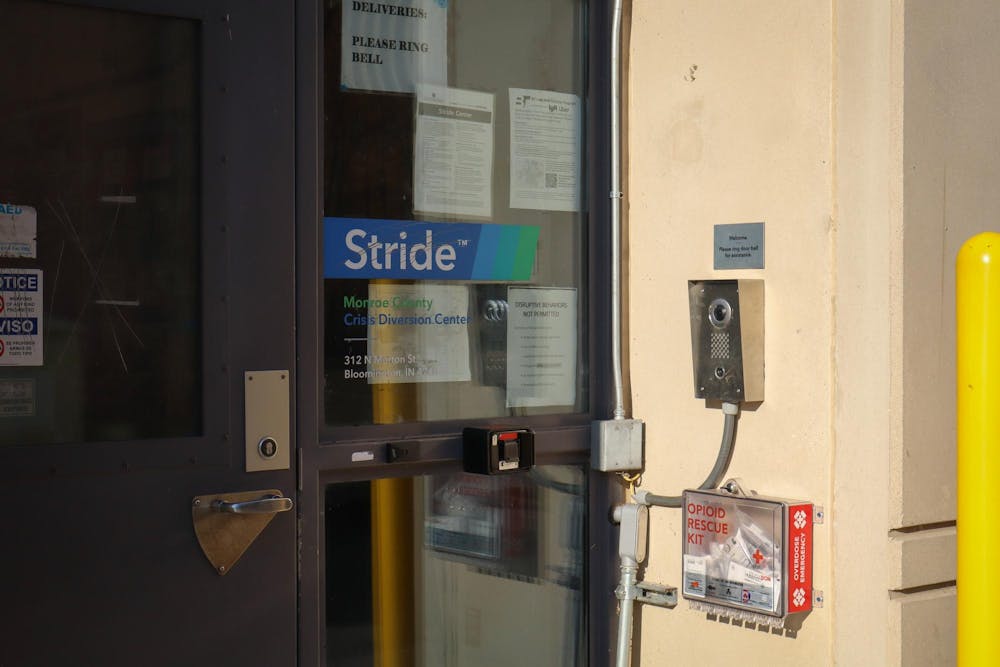
Eighty-five-degree early fall heat seeps through the door and windows of the small-but-functional entryway to Stride Crisis Center. Tia Magee, the Bloomington program manager, fans herself with a pamphlet that reads, “With treatment, there is hope.”
Stride Crisis Center is a 24-hour, seven-days-a-week crisis support service for individuals dealing with mental health and substance use in Monroe County. It serves as an alternative to calling 911 for non-violent crises.
“We act as people’s safety plan,” Magee said. “We help keep them safe, help talk about coping skills, distress management, different things like that to keep them out of the hospital and stabilized in the community.”
Stride was founded by a coalition of over 40 organizations, mainly government agencies and nonprofits. Linda Grove-Paul, vice president of adult services at Centerstone, the nonprofit health system that runs Stride, said the center fills gaps that lead to people not getting the care they need.
“You go to the emergency room, and you're medically assessed, and they may make mental health referrals, but you're not getting treatment immediately,” Grove-Paul said.
In addition to the Bloomington location, opened in August 2020, Stride operates crisis centers in Richmond and Columbus, Indiana. Grove-Paul said about 1,500 people a year use Stride’s services in Bloomington.
What does Stride do?
When developing the Bloomington center, the Stride team began by asking the Monroe County Prosecutor’s Office where it saw the greatest need for an alternative to arrest. The office determined Bloomington needed better solutions for non-violent mental health and substance use crises. Through funding from local law enforcement and health organizations, as well as from its parent organization, Centerstone, the center became that alternative. It provides crisis de-escalation and intervention services, acute care and case management.
The center also connects individuals to different treatment facilities including options for sober living, detox centers, community resources or shelter options.
Stride offers immediate access to mental health and substance crisis services. Individuals are allowed to stay for 23 hours upon arrival. There are always two center employees in the building and more if the mobile team is on site.
If an individual in crisis doesn’t want to come in person to Stride, or has no transportation, the mobile team drives directly to them.
There is no expectation for individuals seeking support to be sober, and any adult 18 or older can receive help immediately.
“We meet people where they are,” Magee said. “If they come in and disclose certain histories, then we try to find resources based on the issues that they present with.”
Magee said she remembers a person experiencing homelessness with severe medical issues who Stride had been helping for years. Last year, Stride helped him obtain housing.
“It’s definitely a reminder of why we do the job that we do,” Magee said.
How does Stride work with the community?
The Bloomington center, located at 312 N. Morton St., was a former overflow site of the Monroe County Jail. The county still owns the building but allows the Stride Center to use it at no cost.
Grove-Paul said Stride helps alleviate pressure on first responders, allowing officials to refer individuals in crisis to the center when they need help instead of arresting them.
In Monroe County, 75-80% of jail bookings on any given day involve individuals with mental illness or substance use disorders. The Stride Center sees this as a clear indication that people in crisis might not need jail time but rather professional support.
Grove-Paul said she hopes more visibility will allow Stride to increase the number of individuals who use its services, especially students.
“I think campus is probably the main place we really want to make sure that we do get the word out, because a lot of people are dealing with a lot of issues, it's a big time for transition,” Grove-Paul said. “And so, knowing you know that you can call a number, and somebody can respond to you, I think is really a game changer.”
Indiana University Police Department Public Information Officer Hannah Cornett said in an email that access to Stride is essential for first responders to provide compassionate assistance to those in need.
To increase visibility throughout the city, Stride launched an awareness campaign in mid-September which will run through the end of May 2026. The center hopes increased awareness will lead to more members of the community using Stride’s services.
The campaign includes a billboard, digital Facebook and Instagram ads, Bloomington Transit bus wraps and advertising in public spaces, such as public restrooms.
Marsha Lovejoy, global public relations senior manager at Cook Medical, is running the campaign along with the team at the center.
Cook is the main entity funding the campaign, but support from the City of Bloomington, Bloomington Police Department, Monroe County Sheriff’s Office, IU Health and the Monroe County Board of Commissioners has been crucial in executing the campaign, Lovejoy said.
Lovejoy and her team noticed a low level of public awareness about the center during the first five years of Stride’s operations in Bloomington. The campaign, with the slogan “See someone struggling, call Stride,” is meant to change that.
The team is developing packages for local businesses facing frequent challenges from people requesting help from them. The package includes a sticker for storefront windows featuring the campaign slogan and Stride’s phone number.
Stride will be present at different community events, including the upcoming Out of the Darkness Walk hosted by the American Foundation for Suicide Prevention on Oct. 19.
In the first full week of the awareness campaign, Lovejoy said, there was a 100% increase in Stride mobile deployments, meaning trained professionals were sent directly to individuals in need.
“When someone's in a crisis, call Stride,” Lovejoy said. “Stride can help the person and the family through the situation, get them connected to the appropriate resources for their needs and hopefully get them moving in a better direction.”
Individuals in crisis can go to the Stride Center in person or call 812-650-4878.