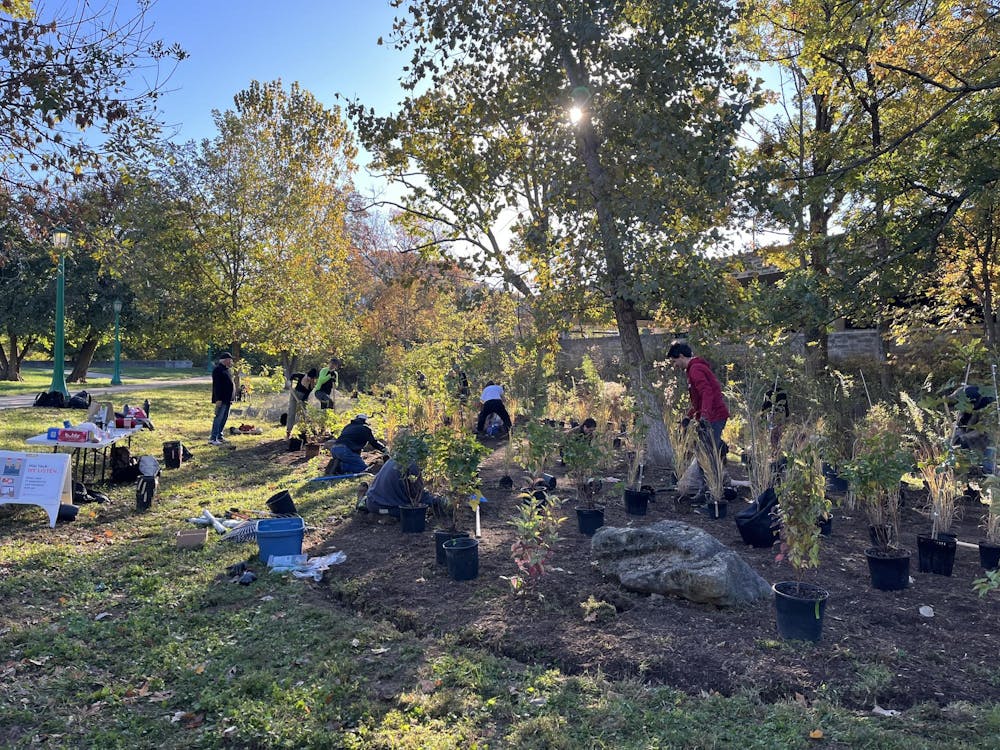
From 9 a.m. to noon Friday, about 30 people with shovels and gardening gloves dug holes and planted greenery along the stream by the East Parking Garage.
Environmental policy students, Indiana University arborists and student volunteers with ReWild IU, a campus club that restores natural spots on campus, planted about 96 trees and an assortment of shrubbery and grass along the 200-foot planting bed north of the creek, which flows into the Campus River.
ReWild President Ethan Iversen said the area will help prevent stormwater pollution and erosion along the stream while serving as a communal area for students to enjoy. A $5,000 grant from IU’s Office of Sustainability funded the planting bed, money that also paid for a small trail, a path to the streambank and a clearing where Iversen said ReWild hopes to later add a picnic table or a bench.
Student volunteers with ReWild were joined by School of Public and Environmental Affairs Professor Jon Eldon and students from his Terrestrial Habitat Analysis class, which hosts field days for students to participate in projects around campus, like invasive plant removals or assessments of the campus woodlots.
IU senior Mira Shortt and sophomore Sarah Reifschneider attended as part of Eldon’s class and chatted while digging holes for an assortment of 3-foot nursery saplings in temporary pots. Shortt said tough soil and the chilly 38-degree weather made for slow work.
Three IU landscaping arborists assisted the student attendees.
Arborist Greg Lammers said planting new trees is especially important because the campus maples, which make up a large chunk of IU’s canopy, are increasingly suffering from the effects of climate change, which has increased Indiana’s average temperatures and shifted weather patterns.
Mike Girvin, IU’s landscape coordinator, stopped by on his day off work to show appreciation for everyone helping with the planting. He said that when Landscape Services plants native trees, they try to plant species that can survive the increased heat.
Attendees planted about 40 bald cypress, 40 burr oak trees, and 16 persimmon trees, which are all resilient to warmer climates. They also planted six species of native shrub and patches of switchgrass.
Iversen said the trees’ root systems should help absorb stormwater before it reaches the riverbank, reducing erosion along the riverbank from rain or severe storms.
Girvin said he’s worked at IU for almost 20 years and attended IU in the 70s. He’s seen the campus’s changing climate bring increasingly severe rains.
“We get a 100-year flood about every two years here,” Girvin said.
Girvin said the new patch of vegetation’s root system would help stabilize the banks by binding together soil and absorbing runoff, preventing sediment from washing downstream. Loose sediment can stop up water flow and contribute to flooding.
Stormwater runoff from sidewalks or pavement can also contribute to an excess of nutrients, causing algae blooms in freshwater sources like the Campus River.
Iversen said the planting should also reduce pollution in the Campus River tributary by filtering out pollutants through the plants’ root systems before they reach the stream, while the switchgrass will absorb heavy metal contaminants from the soil.
By about 10:30 a.m., almost all of the trees, shrubs and grasses in the left half of the mulch bed had been planted. On the right side of the lot, Shortt was digging a hole for her third tree of the day. She said tough soil and cold weather made the work difficult, but digging got easier with practice.
“There’s still a lot of rocks,” Shortt said. “I don’t think I’m gonna make a career out of this but I’m definitely learning.”
Olivia O’Connor, ReWild’s social media coordinator, said she hopes ReWild will find funding to put down a park bench or picnic table in the clearing at the center of the planting bed.
“It could be a big morale boost for students, especially since for IU, one of our biggest appeals is how pretty the campus is,” O’Connor said.