Editor's note: All opinions, columns and letters reflect the views of the individual writer and not necessarily those of the IDS or its staffers.
“Make America Great Again” – four words that have completely shifted the modern political climate. What began as a simple campaign slogan for Donald Trump has become something far bigger than anyone could’ve imagined. It’s grown to be an identity, a rally cry and a tale for the man who seemingly cannot be moved.
The slogan was simple, something that was vague enough to make sense but explicit enough to rally behind. Donald Trump announced his presidential campaign in June 2015, to which many thought he wasn’t serious about running. It seemed like a marketing stunt. Reporters at the scene noted that it seemed like many of the attendees were paid to be there. The thing was: he was serious.
His messaging was blunt, emotional and divisive. He promised a border wall funded by Mexico, a temporary travel ban on Muslims and a hardline approach to immigration and trade. The political establishment dismissed him, but the voters didn’t. Millions of Americans, especially those from working-class backgrounds, rural areas and those disillusioned, saw him as their voice and a new type of candidate. The positions that would’ve ended other campaigns instead became fuel for his.
The strategic choices he made amplified his movement. He campaigned in swing states and nominated Mike Pence, the former governor of Indiana with an evangelical appeal, as his running mate. Trump didn’t campaign as a politician; he campaigned as an outsider who wanted to dismantle the system from the inside. This helped amplify his reach into staunch conservatives and helped move his ideal demographic closer.
Despite scandals that would’ve normally ruined a campaign, such as mocking a disabled reporter, the Access Hollywood tape and countless offensive remarks, his support stood firm. It came to a head when he controversially beat Hillary Clinton in the 2016 election, launching MAGA from a slogan to a worldwide force.
Trump’s first term didn’t dilute the movement; it enhanced it. He rolled back Obama-era policies, reignited tensions abroad; while trying to water down others, and used impeachment as a rallying cry instead of a scar. Each controversy fed into the story his supporters believed: that he was under attack simply because he didn’t play by the traditional rules.
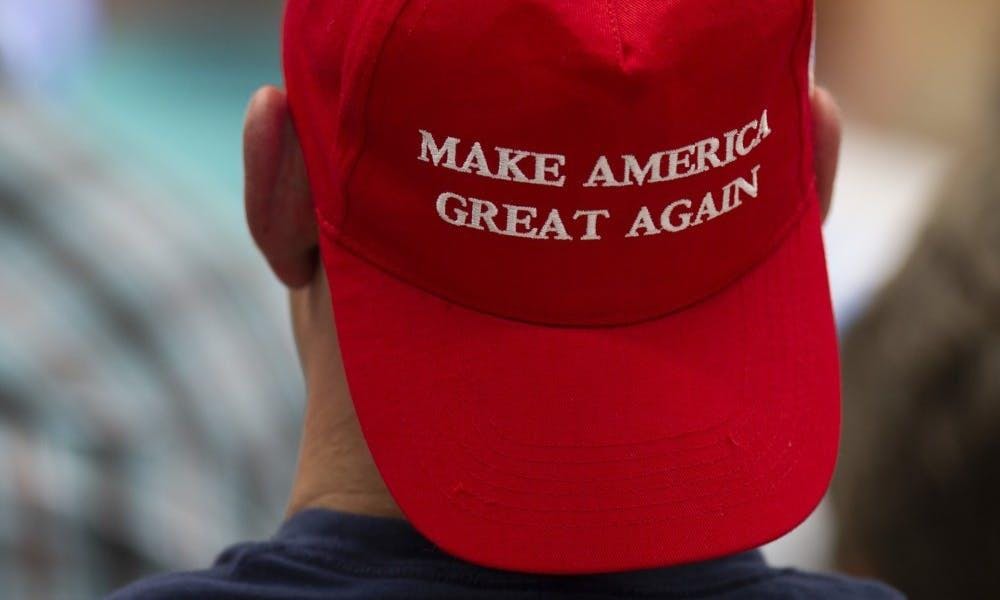
His fans didn’t treat him like a typical president; they treated him like a figurehead. They used hats, shirts, rallies and social media to show their support for him wherever they could. They pledged their allegiance to something beyond the country, but to an individual. Looming threats of illegal immigrants taking their jobs, inevitable inflation and the ire toward traditional families helped Trump stay afloat, as to them, he could fix those things.
Even as he faced two impeachments — one for trying to use Ukraine to interfere with the 2020 election, the other for the January 6 Capitol riot — his base held firm. For them, every attack from the media or opponents wasn’t proof of wrongdoing; it was proof of persecution.
Trump would eventually stumble by losing the 2020 presidential election to Democrat Joe Biden. Yet his loss wasn’t the end of MAGA; instead, it became their defining moment. Rather than conceding to Biden, Trump claimed the election was stolen, a sentiment he echoes from the White House today.
Conspiracy spread faster than facts, and his supporters leaned on him more than ever. “Stop the Steal” rallies emerged nationwide, and the phrase became a trending topic on social media. It culminated on January 6, 2021, when Trump told his supporters to “take our country back.” What followed wasn’t a sudden attack; it was the manifestation of years of rhetoric and loyalty.
His second impeachment didn’t end the movement; it energized it.
Even after leaving office, Trump remained the nucleus of the movement. His words were used by conservative politicians, media figures; and candidates desperate for his base. His endorsement became political gold. Such as in the case of 2022 Pennsylvania gubernatorial nominee, Doug Mastriano, a high-risk pick who won the Republican primary due to Trump’s endorsement. Republicans who once denounced him have backtracked to secure a seat at the table, JD Vance being one of them, who now serves as vice president after previously condemning him.
Internationally, politicians modeled themselves after Trump, proving MAGA had crossed borders as a political strategy.
You’d think convictions, scandals and associations would shatter his momentum. Trump was found guilty of 34 felonies in New York. He’s faced public accusations of close ties to Jeffrey Epstein. His past and present are filled with scandal. Yet nothing seems to stick, at least, not to his followers.
That takes us to today, where Trump has been elected for his second non-consecutive term after defeating former Vice President Kamala Harris. His first nine months have been marked by scandals stemming from his harsh deportation policy, an unqualified cabinet and his approach to international relations. Yet, he’s still standing because of the power he’s amassed from both the government and his followers.
The durability of MAGA is rooted in the ideas of nostalgia for old America, distrust of institutions and unwavering loyalty. Trump didn’t just lead a movement; he built an identity people don’t abandon, even when facts or morality demand it. Its persistence shows that today’s politics focus on identity and loyalty, rather than policy. Even with the cracks, the movement isn’t dying; it’s just shifting.
His supporters don’t follow him like a politician. They follow him like a tribe, a team, a belief system. Every indictment is proof he’s fighting for them. Every scandal becomes a loyalty test.
And that’s why he persists. He’s made moderates into conservatives. He’s turned how moderates are seen in politics, and his movement has changed how candidates are picked. Ideology is not bolted down anymore; it’s on wheels, and it goes wherever it takes them and us.
Jacob Fry (he/him) is a junior studying political science.