
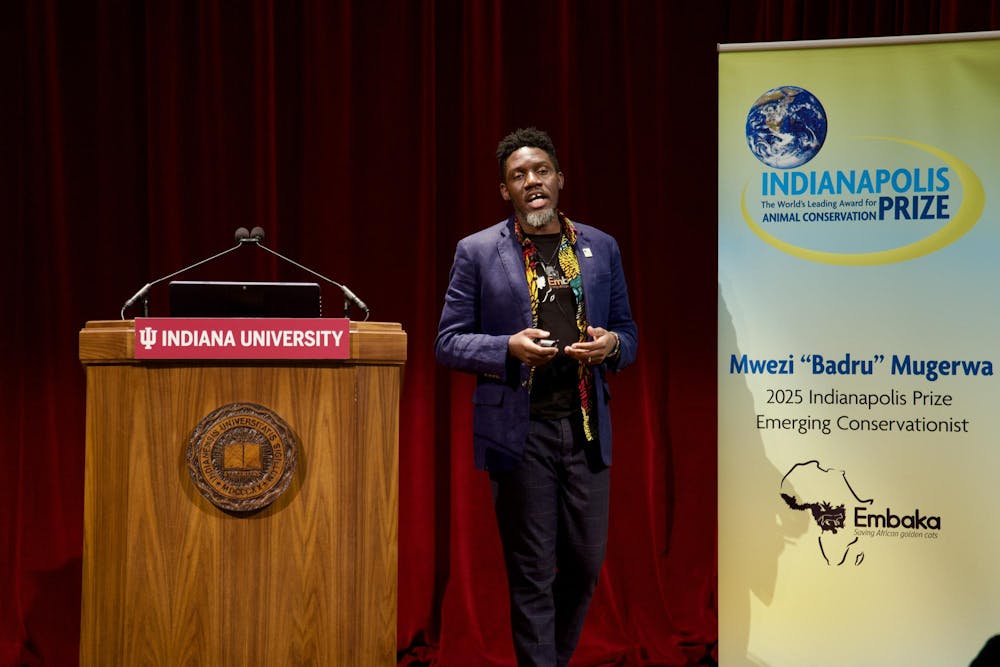
Award-winning conservationist Mwezi “Badru” Mugerwa spoke to about 50 people at Franklin Hall on Wednesday about his work to protect the vulnerable African golden cat.
Mugerwa’s presentation was arranged by the Indianapolis Zoo. In March, Mugerwa was announced as the 2025 winner of the Indianapolis Prize’s Emerging Conservationist Award, which is awarded to impactful conservationists under 40 years old.
Indianapolis Zoo President and CEO Robert Shumaker said the Emerging Conservationist Award was created two years ago to boost young conservationists at critical moments in their careers.
“We wanted to catch them at that crossroads, give them the momentum, give them the lift, give them the support, give them the visibility,” Shumaker said.
Mugerwa founded the grassroots conservation group Embaka, which organizes community-based conservation projects and hosts the African Golden Cat Conservation Alliance, a network of conservation efforts across multiple countries.
These groups work to protect the African golden cat, an elusive spotted cat that lives in forests in west central Africa and along its west coast.
IU Environmental Resilience Institute Managing Director Sarah Mincey and IU President Pamela Whitten introduced Mugerwa. Whitten called Mugerwa a “visionary.”
In an hour-long presentation, Mugerwa spoke about how his conservation projects involve communities in the protection of the African golden cat.
African golden cats have lost nearly half their habitat to human activity and are vulnerable to extinction from habitat loss, shrinking food resources and hunting.
Mugerwa spoke about how he worked with communities around Uganda’s Bwindi Impenetrable National Park to decrease the threat of bushmeat hunting, which targets wild animals for food.
Mugerwa said while many Ugandan hunters avoid hunting carnivores due to custom, African golden cats are often accidentally killed by snare traps.
Mugerwa’s organization created programs that provided livestock to replace food from bushmeat. People who received livestock agreed to pass the offspring to their neighbors, sustaining the practice.
Mugerwa also spoke about his camera traps, which gather information about the African golden cat’s habits and population density.
Embaka conservationists collaborated with big cat conservation group Panthera to use artificial intelligence algorithms that identify wild cats caught on camera traps, improving the speed and accuracy of research efforts.
During a Q&A session after the presentation, Mugerwa said he worked with community members, including former poachers, to understand where to place camera traps.
“I did a bad job initially camera trapping the species, because I didn't really place the cameras to get, you know, to get a decent amount of data on the camera traps,” Mugerwa said. “I had to go back to the hunters, and they showed me where they thought, I'll be able to collect, you know, good quality data."
Mugerwa said efforts to conserve wildlife should always take local communities into account.
“I learned very quickly, you cannot separate animals, wildlife and people, because if you think about it, the threats we work to address, there are threats that are brought to the wildlife by people,” Mugerwa said.
Mugerwa also founded the African Golden Cat Conservation Alliance and serves as the president of Africa Region of the Society for Conservation Biology.
He said people in Indiana and across the world should try to spread awareness about conservation.
“Conservation is a global cause,” Mugerwa said. “Whatever we're doing in Uganda or in these 18 other countries, it also benefits the rest of the world. So people in Indiana definitely need to be part of this conversation.”



