
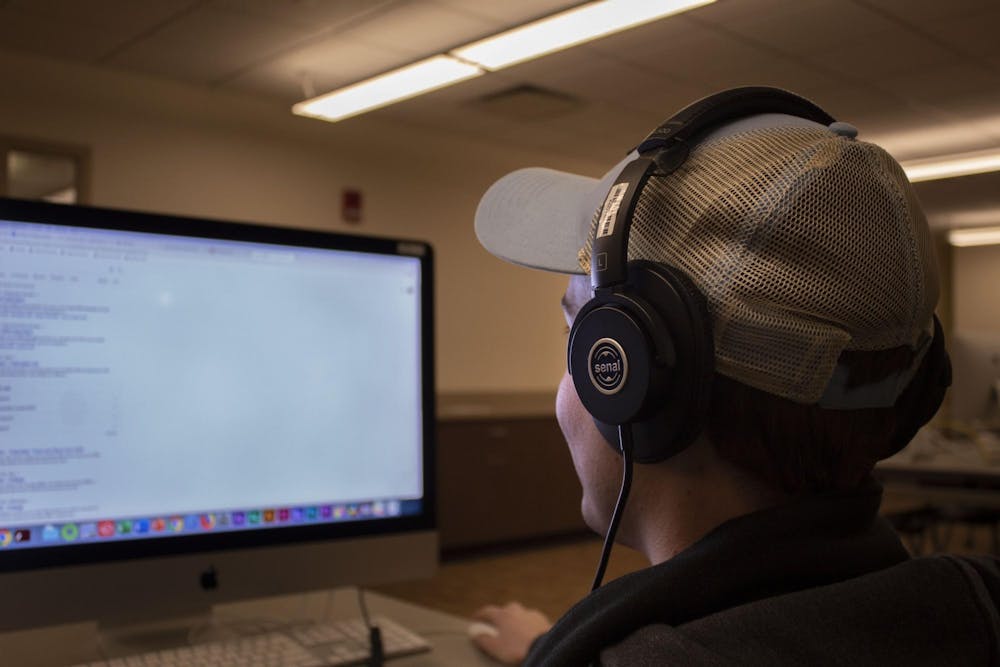
Indiana University’s classroom technology checkers used to perform regular inspections on classroom equipment. After budget cuts, the university eliminated the room checker program and dismissed student workers who held those positions in July.
Now, professors and students say they are experiencing technology malfunctions that disrupt class.
IU senior Niko Brooks, a former classroom technology checker, said they received an email from IU July 15 notifying them the position was eliminated due to “significant reductions in budget."
The student workers would each check around 20 classrooms per week, Brooks said, inspecting projectors, document cameras and microphones to ensure they functioned properly before classes began.
The university would not answer how many people were fired. Brooks estimated up to 10 were, but the Indiana Daily Student has not been able to independently verify this estimate.
In the fall semester following their termination, Brooks said they witnessed technology failures in two of their classes, usually projector problems.
“Professors build their entire lesson plans around being able to use the technology,” Brooks said. “It’s definitely having an impact.”
Cody Kirkpatrick, a senior lecturer in the Department of Earth and Atmospheric Sciences, said he canceled a class this semester after a projector failed 10 minutes into the session.
“Because I am so reliant on that technology, I was not prepared,” Kirkpatrick said. “I did not have a contingency plan to proceed with class.”
Kirkpatrick said both projectors in his classroom have had problems this semester.
“When there is unreliable equipment, it affects everyone,” Kirkpatrick said. “Valuable instructional time and students will get distracted or frustrated too.”
IU spokesperson Mark Bode, said the university remains committed to classroom technology.
“Maintaining reliable classroom operations continues to receive the highest level of attention and support,” Bode said. “UITS teams are dedicated to keeping learning spaces fully operational with regularly updated technology and quick response times to address any equipment issues that arise.”
Teresa Mackin, deputy director for media relations, declined to speak about Brooks’ dismissal, citing university policy not to comment on personnel matters.
Kirkpatrick said maintenance staff replaced a broken projector within a couple of days after he reported it broken, but broader staffing issues of changes created delays.
“Reassignment of frontline staff has led to confusion and slowness in getting responses to some parts of campus,” Kirkpatrick said. “It can now take a week or more while everyone writes back and forth to figure out who is supposed to respond.”
Moriah Reichert, a fifth-year doctoral student in religious studies, echoed Kirkpatrick’s concerns. She has worked as an associate instructor every semester of her graduate program, helping with discussions for large lecture courses for up to 175 students.
Reichert said eliminating the inspection team creates additional burdens for instructors, who already spend little time teaching in consistent classrooms.
“We kind of rely on arriving whenever our section time is and it just working,” Reichert said.
Reichert said associate instructors often teach back-to-back sections with classes scheduled in the same room immediately before, making it impossible to arrive early and test equipment.
“If there were an issue, I would have to go hunting on the IU website then to try to figure out who we would even call,” Reichert said. “If the projector isn’t going to be reliably available, I might choose not to have discussion around a video clip, not because it’s not the most appropriate thing for us to be talking about, but because if it's not working, it's not going to be worth my limited time in class to resolve the tech issue.”
Reichert said the shift from preventative maintenance to reactive repairs may force instructors to adjust their teaching.
“There are lots of ways that we kind of trust that the tech is going to work,” Reichert said. “If it’s only being attended to when there are instructors flagging a problem in the room, I think that might adjust how I plan to teach sections.”
Brooks said the cuts to the technology checker program shouldn’t have been made.
“It feels so unnecessary, we had solutions in place,” Brooks said. “It’s frustrating because it’s preventative work, so it’s somewhat invisible work, and I think that’s what led to us being one of the programs that they felt could be eliminated.”


