
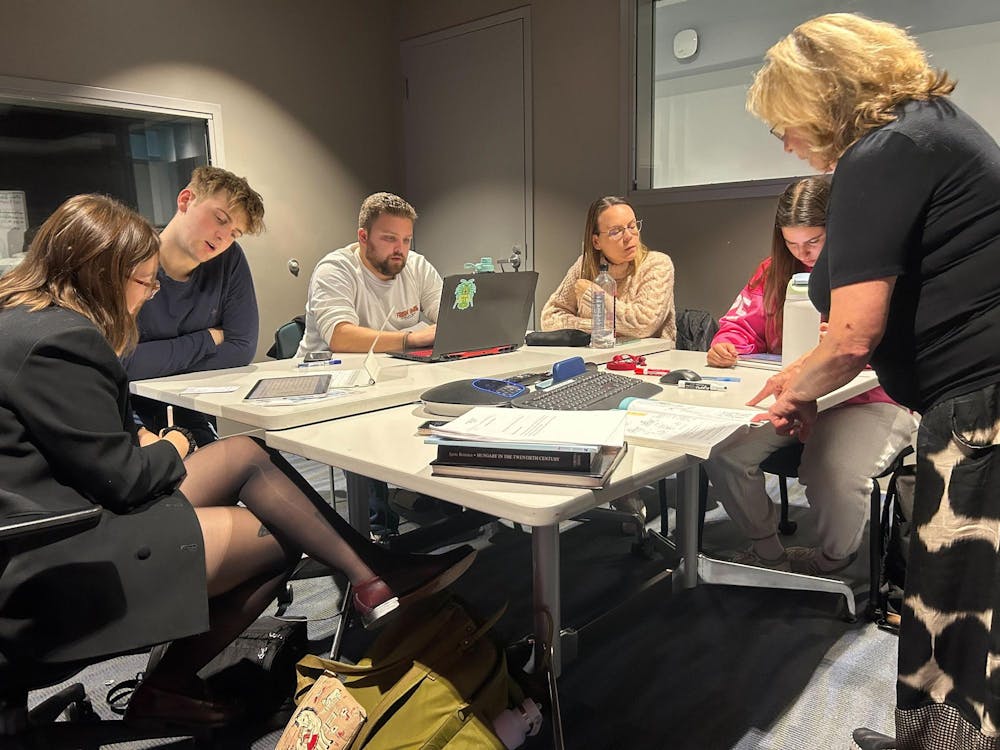
Three students conversed in Estonian under fluorescent lights Monday in IU’s Global and International Studies Building. A fourth student from the University of Arkansas tuned in via Zoom.
Long-distance students frequently attend classes virtually in IU’s rare language departments solely because IU is the one of the only universities to provide them.
Senior lecturer and Estonia native Piibi-Kai Kivik guided her students through a conversation about Halloween words and traditions in the Estonian language. Though the class is titled Intermediate Estonian, Kivik taught nearly exclusively in the language. The class nodded along in understanding as she spoke, even if they didn’t yet have the tools to respond in kind.
Kivik, who wrote her doctoral thesis on second-language conversations, navigates her classes through dialogue exercises. Though memorization is important to learning any language, her students learn through experience and immersion.
“I think conversation is a primal mode of interaction, but also learning,” Kivik said, “and I believe very strongly in sort of contextualized learning of language.”
The future remains unclear for instructors like Kivik who teach less-taught languages. Though the languages fall under the Central Eurasian Studies umbrella, there has been further discussion of consolidating language programs.
IU included CEUS as one of many programs to be taught out toward elimination or consolidated to comply with House Enrolled Act 1001 earlier this year. The bill called for any undergraduate programs in public universities with less than 15 graduates per year, or graduate programs with less than 10, to be eliminated or merged.
Down the hall from Kivik, seven more students — one on call from Chicago, another in Los Angeles — chuckled. Senior lecturer Valeria Varga had just translated the words for “Breast Day Ever” into Hungarian after senior Bianca Temesvary brought up her sorority’s fundraiser for breast cancer awareness.
Later, the class shifted focus to discussing Harmonia Caelestis, a series of classical Hungarian compositions from the 18th century. The topic wasn’t part of the syllabus; a student who studies classical music brought it to class. Varga wants her students to learn how to talk about what they’re interested in, not just what’s in the textbook.
Both classes are tight-knit and the students familiar with each other and their instructor, all seeking greater mastery of a rare language.
Only about 16 million people across the world speak Hungarian or Estonian fluently. They both belong to a small language family usually referred to as the Finno-Ugric or Uralic group. Outside of Estonian and Hungarian, Uralic languages are only natively spoken in Finland, the far north of Sweden and Norway and various communities across Siberia in Russia.
Uralic languages are written with Latin characters, but their pronunciation and grammar structures are nearly alien to English speakers. Vowel sounds like ö and ü don’t exist commonly in Romantic languages like English or Spanish; Estonian and Hungarian speakers use different mouth shapes and tongue placements than most students are accustomed to.
The grammar structures, especially in Hungarian, can also be confusing to non-speakers. Hungarian phrases use suffixes to denote tense, mood, place and other defining factors of a sentence, a process known as agglutination.
Varga and her teaching assistant, fellow Hungarian Henriett Papp, laughed as they brought up the most extreme example — the longest word in the Hungarian dictionary, “megszentségteleníthetetlenségeskedéseitekért.” It translates roughly to English as, “for your multiple continuous unholy deeds,” and is almost never used in regular conversation, but serves to exemplify the agglutinative process. Everything after “szent,” meaning “saint” or “holy,” is used to modify or add to the word.
“Every Hungarian knows that without stopping,” Varga said. “Am I right, Henny? Let’s do it again.” The two recited the colossal word in unison three times in a row.
Of the students in Estonian and Hungarian classes Monday, the majority came or transferred to IU at least in part due to its impressive and obscure language offerings.
Ryan McCrea, a 23-year-old graduate student pursuing a master’s degree in the Russian and Eastern European Institute, originally transferred to IU from Texas Tech University due to its robust Russian language program. He was swayed by a mini lesson taught by Kivik at the Language Fest in September.
“I thought, okay, if I'm going to go work in the federal government or something, which is the normal career path after getting just an MA, I'm like, okay, I probably might want an adjacent language, something that's Eastern European,” he said. “So I’m like, Estonian’s close, right? No. Not even close.”
And it’s not all business for some language learners. REEI doctoral student Brittany Janosi was pleasantly surprised to learn about the Hungarian program after she transferred from the University of Connecticut. Most of her family is Hungarian, she said, and learning the language brought her closer to home.
“I decided to pursue that because I've always wanted to formally learn the language,” she said. “I only grew up speaking it. I never learned how to read or write it.”
IU also boasts the Summer Language Workshops program, an eight-week intensive course dedicated to achieving basic proficiency in a language. McCrea said IU is known among academics as a top school for language learning in large part due to the summer programs. Estonian and Hungarian were offered last summer and will be two of the 25 languages offered in 2026.
Despite its reputation, IU has put several small languages on the chopping block in response to the state legislation. In addition to CEUS, many programs containing smaller languages like India Studies and Middle Eastern Languages and Culture are on the teach out toward elimination list.
“We're very much struggling with the idea that the university both wants to offer the less commonly taught small languages and also puts pressure on individual instructors and the departments to show unrealistic enrollment numbers,” Kivik said.
But some faculty, like Varga, remain cautiously optimistic about the future of her program.
“I'm kind of scared, because this program is everything for me,” she said. “But now I try to be positive a little bit, because number one, I feel that the School of Global and International School cares about us. It became very obvious that they don't want to get rid of us. And when I feel that, I'm open to changes.”


