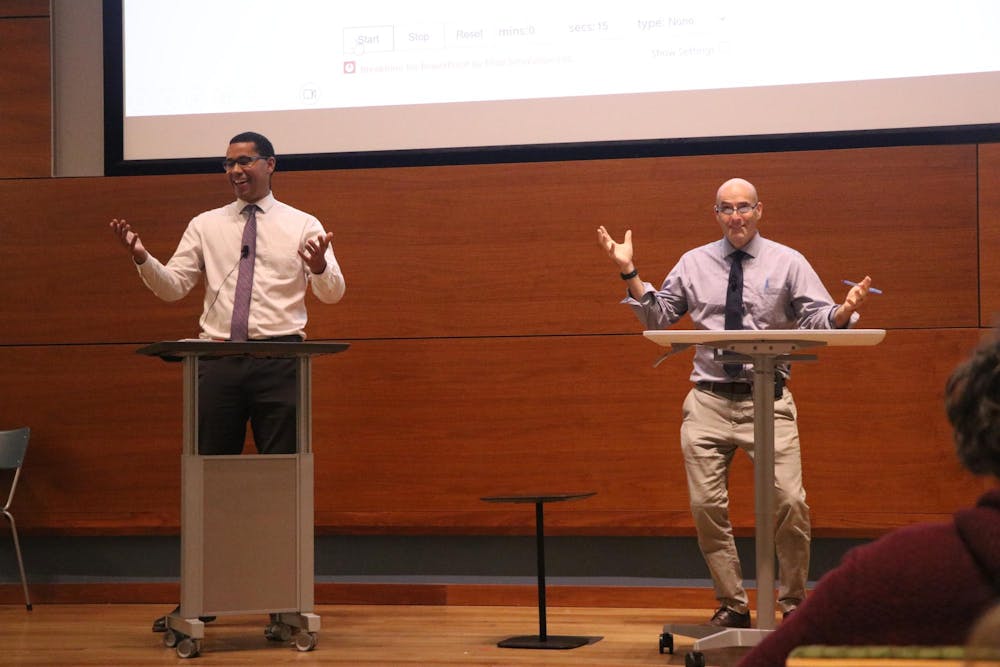
Two deans debated the effects of technology on world peace to a crowd of about 90 people Tuesday during "The Great Faculty Debate,” an event organized by student leaders at the Hamilton Lugar School of Global and International Studies.
Executive Associate Dean of the HLS David Bosco and Isak Nti Asare, assistant dean for undergraduate education and student affairs, discussed whether technological advancements including AI, surveillance technology, social media and satellites would contribute to world peace.
Student ambassador Makenzie Smerud said the event was a test run for HLS student leadership, who hope to hold more faculty debates in the future.
Attendees lined up along the hall of the Global and International Studies Building 30 minutes before the event for a buffet dinner. Katherine Ntiamoah, HLS director of policy engagement and strategic partnerships, brought her 3-year-old son and 5-year-old daughters.
HLS senior Faith Shands, who interns with Asare, said colleges everywhere should strive to bring debates back to campuses.
“It is so important for college campuses and just students in general, to be able to openly debate both sides of an issue without it resulting in polarization,” Shands said.
During the debate, Asare and Bosco took turns answering questions posed by the HLS student ambassadors, who acted as moderators. Bosco took the side against technology, arguing that technology will fail to bring world peace. Asare argued that if humans use technology carefully, it will bring advancements to help improve society.
The questions included an initial response of a minute and a half for each speaker and a 30-second rebuttal period for one speaker per question.
Asare and Bosco discussed topics related to technology’s impact on world peace, including the threat of cyberattacks, the use of warfare technology in Ukraine and Gaza, the International Criminal Court’s use of satellite data or video and the destabilizing impact of political polarization and privacy on social media.
“It was awesome, it was so educational,” Teagan Tingley, a cybersecurity and global policy major, said. “I actually have a class with Isak, and so, like, a lot of the concepts that were talked about in that class, I saw used in the debate today.”
Throughout the debate, Bosco and Asare frequently agreed with each other, conceded on key points or joked with each other and moderators.
Bosco said the debate was a great opportunity to demonstrate healthy civic engagement.
“We were able to show like, how do you have good conversation, you know, about things where you might have some agreement, might have some disagreement,” Bosco said. “And I think it was a really good model, for, you know, just intellectual engagement on something of huge importance, right?”
After a round of questions from attendees, the moderators wrapped up the debate with a ‘lightning round’ of quick questions about casual topics like children’s television, cornbread and Taylor Swift.
HLS senior Chase Nattkemper said the debate was a valuable opportunity for students to learn about critical topics like the AI industry’s influence on politics from some of IU’s most intelligent faculty.
“I think it helps students think critically about this, and I think it motivates students go out make sure that there's change, especially in our political system,” Nattkemper said.