
Excitement filled the Buskirk-Chumley Theater on Thursday night, as fans of musician Janis Ian flocked to see a screening of “Breaking Silence,” a documentary about her life and artistic career.
Backstage during the screening was Ian herself.
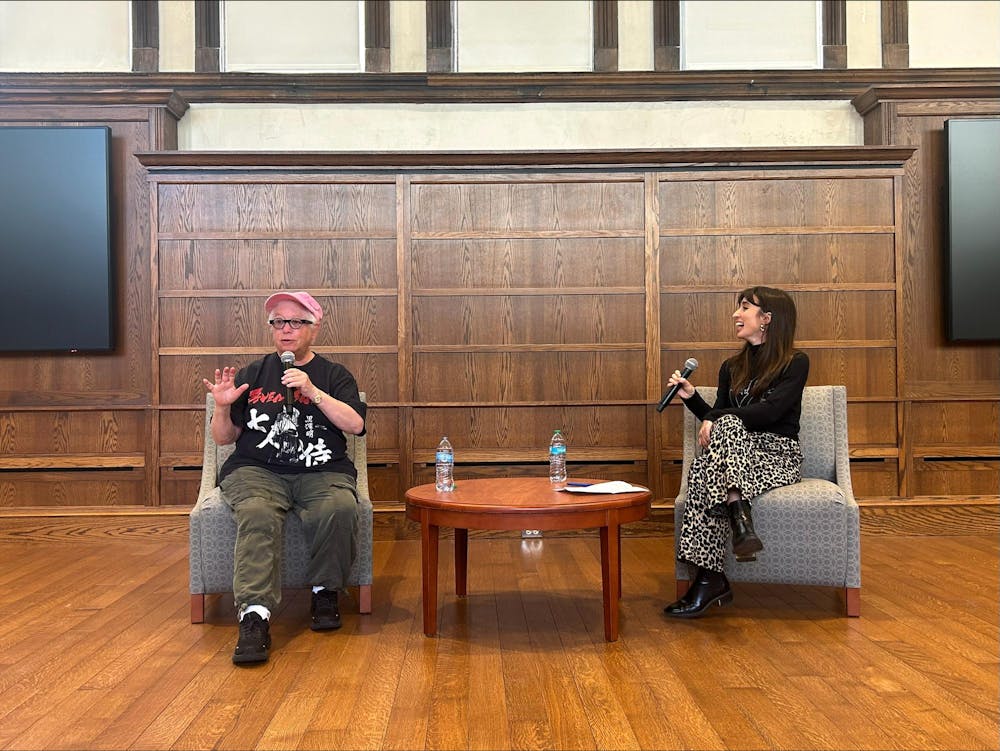
At noon, Ian sat for a moderated conversation at Maxwell Hall, hosted by the IU Arts and Humanities Council. Before a crowd of about 30 people, Ian answered questions posed by IU law student Kayla Behforouz, discussing the transformative power of art, the evolution of the music industry and the link between politics and folk music.
The conversation continued for about 40 minutes before Behforouz opened the discussion to the room, inviting audience members to ask Ian any questions they wished.
“Usually as a writer, wherever you don’t want to go, that’s where you’re supposed to go, and when you don’t go there, you do your talent a disservice,” she said in response to a question about her creative process. “Your talent knows better than you do. So you follow the talent.”
In an interview with the IDS, Ian gave advice to aspiring writers and creatives. She spoke about how inspiration doesn’t always strike when convenient, and artists must be able to work with their talents and artistry.
“Inspiration is great, but you have to be able to write regardless,” she said, “so you call it up. You call it up, and then you work with what you’ve got..”
At 7 p.m. Thursday, about 350 spectators gathered at the Buskirk-Chumley Theater for the screening of Ian’s documentary “Breaking Silence,” directed by Varda Bar-Kar. Featuring on-screen testimonials from Ian’s folk music peers including Arlo Guthrie and Joan Baez, the film premiered at Doc NYC in November last year. Since then, Ian has made appearances at various institutions around the country to accompany screenings of the film.
The screening event was sponsored by Bloomington Roots and the Stone Age Institute. Nick Toth and Kathy Schick, co-founders of the latter organization, both came across Ian’s music when she first debuted in the 1960s with “Society’s Child,” which was controversial for its time as it was about an interracial relationship. They both resonated with the explicit social consciousness Ian displayed in its lyrics.
After following her career for decades, Toth and Schick now maintain a personal friendship with Ian. Schick said her personality and values are reflected in her music.
“She’s a very natural, honest human being. So I think that’s layered into the music and lyrics and what she chooses to write about, and the perspective she takes,” Schick said. “I feel she’s a very compelling artist.”
The documentary opened with a clip from Ian’s 1967 performance of her hit song “Society’s Child” on composer Leonard Bernstein’s show, “Inside Pop: The Rock Revolution.” At age 15, the performance was her first appearance on television.
Ian’s voice then spoke over the footage, and she began telling her story: “Music is about telling stories. This is mine.”
The beginning of the film detailed Ian’s upbringing by Jewish activist parents, which shaped her sense of social and political awareness. Her break into the music business came when she received the opportunity to record “Society’s Child,” which released amidst the Civil Rights Movement in 1966. The song catapulted Ian into both success and controversy.
The song’s lyrical content caused Ian to be blacklisted from several radio stations and harassed by audience members when she performed it live. This insight into Ian’s early career set her up within the film as an outspoken protagonist, determined to speak for what she believed was right.
The documentary then explored each creative era in her life, with each one often framed through album release cycles, relationships and moving to different cities. Audience members were also provided insight into the writing and recording processes of several of Ian’s most beloved hits, including “Stars,” “At Seventeen,” and “Fly Too High.” As she underwent various personal and mental struggles throughout each time period, Ian remained committed to improving her musical artistry.
The film also emphasized was her gradual status as a queer icon and outspoken proponent of LGBTQ+ rights, another central aspect of Ian’s story. She came out as gay in 1993 with the release of her album “Breaking Silence,” which was groundbreaking during a time that lacked queer female representation in media.
The film concluded with a look into Ian’s current life, as well as her struggle to adjust after losing her singing voice due to vocal cord scarring. Despite this, the documentary ends on a hopeful note, with Ian committed to living a fruitful life as a writer and creative.
After the screening, Ian sat for a Q&A session hosted by Amy Oelsner, a local musician and founder of Bloomington’s Girls Rock chapter. Ian answered questions about songwriting advice, advice for young musicians and her experience recording her final album from home amid the COVID-19 pandemic. Audience members were then provided a chance to ask Ian their own questions.
Two microphones were set up in front of each side of the stage. Members of the audience quickly formed lines behind each one, eager to pose their questions. Some attendees explained that they had traveled for hours out of state to see Ian, while others said they had grown up listening to her music. One man shared an anecdote about attending summer camp with Ian 62 years ago.
“Thank you so much for coming, we appreciate you so much,” one attendee said. “I feel like we’ve aged together, because I was listening to you in college.”


