
When Jenna Bowman, co-owner of Morgenstern Books and Café, founded the Bloomington Book Festival last year, she wanted to put Bloomington on the literary map.
With the festival’s second iteration this weekend, the event is doing just that. The festival took place Friday through Sunday at several local venues, including The Dimension Mill, Morgenstern Books and Café and the Buskirk-Chumley Theater. The organizers also closed Madison Street for the event, inviting local bookshops and food trucks to join the celebration Saturday.
“This is a very new festival,” Jenn Cristy, vice president and director of the Bloomington Book Festival and marketing director at Morgenstern Books, said. “This is our first time shutting down a street and having a beer tent and everything. It’s going well, and hopefully next year it’s just going to get bigger.”
The festival featured a range of programs — from local author showcases to discussions with nationally- recognized writers. One highlight was a sold-out Friday event with John Green at the Buskirk-Chumley Theater.
Other events included the Local Author Fair, “Poetry on Demand” sessions with Christy Prahl, a “True Crime” panel featuring journalists Áine Cain and Kevin Greenlee and children’s book readings and activities.
Bob Bledsoe, the festival’s author relations board member and director of the Indiana University Writers’ Conference, said the festival’s programming came together through collaboration and creative exchange.
“It’s always a matter of brainstorming — let’s bring a true crime writer. Let’s bring a young adult author,” he said. “It’s about tossing around ideas, inviting people and seeing whose schedules will work.”
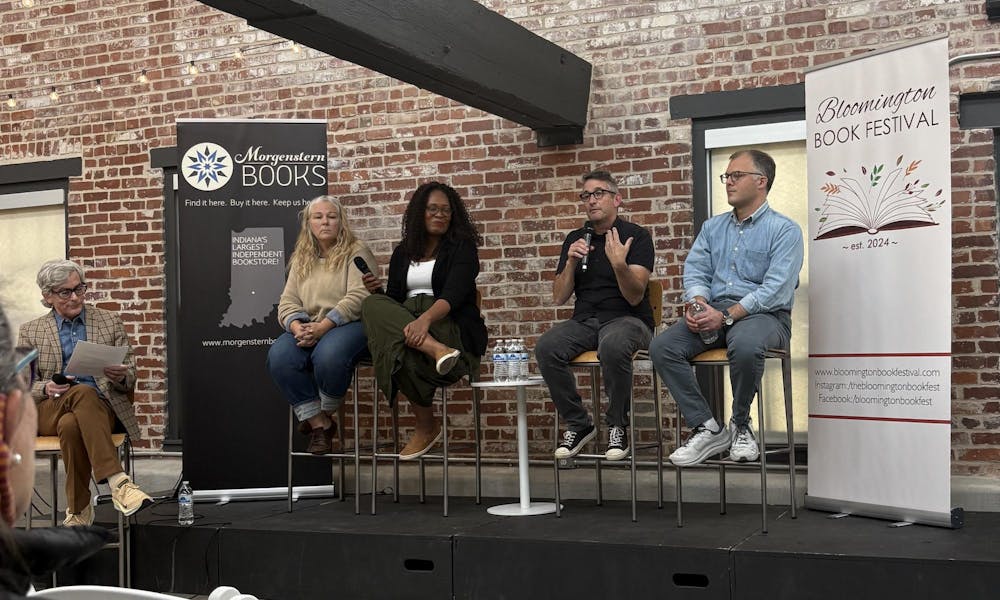
Among the featured sessions was the “Life of a Book” panel Saturday The discussion brought together publishing professionals to explore the life cycle of books — from concept to publication and beyond. Participants included Gideon Pine, an agent at Inkwell Management; Jenna Bowman, co-owner of Morgenstern Books; Ashante Thomas, acquisitions editor at John Wiley & Sons; and John Hastie, sales representative from Penguin Random House.
The panel addressed the emotional and professional realities of working in publishing. Speakers emphasized the need for patience and perspective, noting that some books take years — sometimes nearly a decade — to find recognition, often through viral attention on social media platforms like TikTok.
“For one book, it was published in 2017, and it sold just about nothing, and then one day in 2021, somebody influential read it and spread the world. And now it’s at about a million copies. You never know what’s going to happen,” Hastie said. “Sometimes I feel like it’s more about letting good things happen than trying to control them.”
Panelists also examined the evolving landscape of nonfiction publishing, highlighting the growing importance of audience engagement.
“It’s not just about how many followers you have, but also how many active readers are willing to support and pay for your work,” Thomas said.
They also discussed successful cases of subscription-based publishing and its relationship with traditional legacy publishing models.
As the festival marked its second year, there was a sense of anticipation for what’s ahead.
“I’m curious to see which authors will come next year,” Lina Chen, an Indiana University Kelley School of Business student, said. “I hope to take part in more events throughout downtown during the next festival.”
Bowman said she hopes there will be more community engagement and curiosity in the future.
“It’s really about getting out there and seeing what the community looks like in the literary world,” she said. “Step out of your comfort zone and see that there’s still a world that’s thriving. Don’t miss it.”
CORRECTION: This article was updated to include a missing paragraph.


