
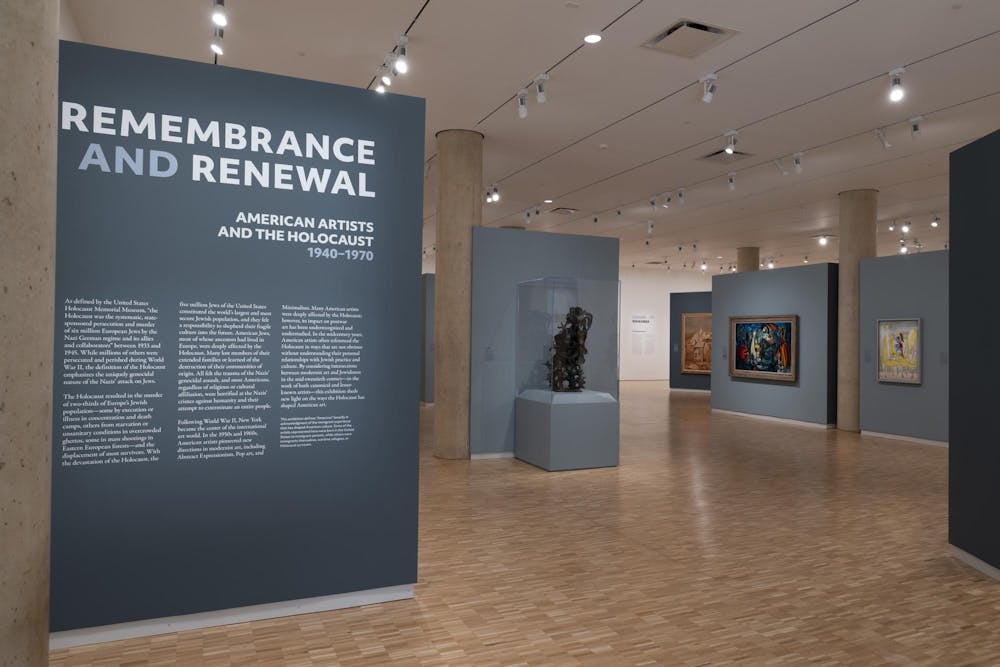
The Sidney and Lois Eskenazi Museum of Art opened the “Remembrance and Renewal: American Artists and the Holocaust 1940 -1970” exhibit Sept. 4. It is the first collection in the world to focus on the impact of the Holocaust on midcentury art pieces from America, said Jennifer McComas, curator of European and American Art at the museum.
“There have been some art exhibitions at other institutions that address art that emanated from the Holocaust, but not any exhibition that has focused specifically on this mid-20th century American context,” McComas said.
McComas spent about five years putting the exhibit together, with three dedicated to research. The exhibit is a collection of 60 pieces of art created by American artists, with some being immigrants. The pieces come from various mediums, ranging from books to photographs showing the Holocaust’s influence on artists.
“The exhibition has many loans from other collections across the nation, so this is a really rare opportunity for visitors to see works that are usually geographically separated from one another,” McComas said.
The museum, in conjunction with Yale University Press, put together a gallery book with additional essays reflecting on the pieces. They explore on a deeper level how American artists responded to the Holocaust and its long-term impact.
Alvin Rosenfeld, an IU professor of English and Jewish Studies, briefly visited the exhibit Sept. 10 during a lecture presentation hosted by McComas. He encouraged students to attend the exhibit with a level of mindfulness about the art they are seeing.
“They shouldn't just go, rush in and rush out, but really linger a while, enjoy what's there, if enjoy is the right word when we're talking about the Holocaust,” Rosenfeld said. “But take it in. Think about it. Give themselves a chance to respond both emotionally and intellectually to what they see.”
McComas wanted to bring these pieces together to tell a part of the story of the Holocaust that doesn’t get much attention.
“With this exhibition, my interest was to examine the era from a different perspective and to look at the ways in which artists in the United States were responding to the events taking place in Europe and how they expressed their feelings through their different artistic media,” McComas said.
At McComas’ lecture, she and her team displayed and examined some of the pieces through the intended artistic perspective.
“It shows that artists in several different artistic media have felt compelled to represent their own approaches to feelings about understandings of the Nazi persecution and mass murder of the Jews,” Rosenfeld said.
Senior Grace Chapman visited the exhibit on opening day for an assignment in her Spanish Composition and Conversation class that required students to observe the art and write about their thoughts.
“I feel like it’s very modern,” Chapman said. “A lot of the other exhibits here showcase a lot of history from hundreds and hundreds of years ago, but this being so near to our time is really cool to see.”
The exhibit offers viewers an opportunity to express their feelings about the showcase with a commentary book outside the room, which McComas said the museum does on a case-by-case basis.
“I think it depends on the type of exhibition,” McComas said. “For a show like this which is on a very serious topic, I thought it would be nice to provide a place for visitors to offer reflections. Maybe they’re needing to process some thoughts that arise during the exhibition.”
Five pages of the commentary book contain comments from viewers, leaving their thoughts about the exhibit and its message. These were some of the comments:
“History Repeats itself.”
“I am proud to be Jewish.”
“Such a powerful and moving exhibition.”
“This gallery served as an important reminder of the horrors of the Holocaust and a fascinating display of the themes of death, despair, prayer and hope in art following the genocide.”
“I am appreciative of the time, research, and effort that went into producing this exhibit.”
The exhibit will be open on the first floor of the museum in the Henry Radford Hope wing until Dec. 14.



