Editor's note: All opinions, columns and letters reflect the views of the individual writer and not necessarily those of the IDS or its staffers.
Rovers on Mars have made exciting finds and sensational headlines since bellbottom jeans were fashionable. Recently, the Perseverance rover discovered a “potential biosignature” on the red planet, raising the question: if we’re moving up and out, are we leaving our problems on Earth to worsen?
While “potential” and “biosignature” sound dramatic and scientific, they are far from certain. When misconstrued as anything more, this headline serves as fodder for President Trump’s flood the zone approach — a maelstrom of new legislative actions and social media posts to distract people from the unreleased Epstein files and overwhelm them into complacence.
Because what does the Trump Administration love more than revoking human rights? Distraction.
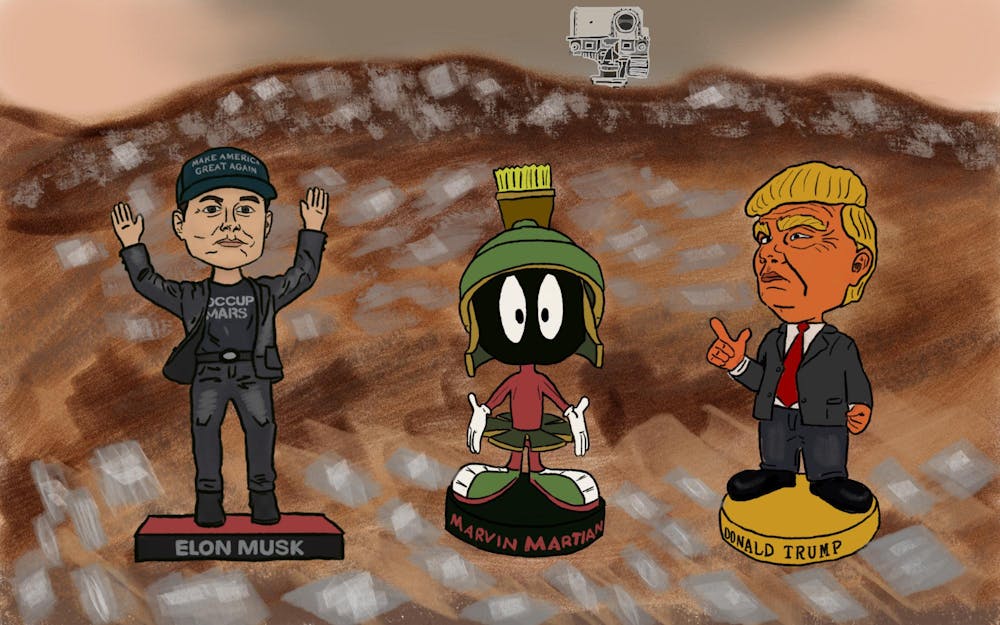
It is no coincidence, then, that he appointed Elon Musk, the CEO of SpaceX, to be the head of the U.S. Department of Government Efficiency — created by Trump to slash federal spending. They share a common love of speed above all: in his first month, Trump signed 46 executive orders and Musk fired hundreds of federal employees and cut diversity, equity and inclusion contracts in the position while racing to become the first trillionaire, no matter the cost — i.e., needless SpaceX worker injuries and unethical Neuralink animal subject deaths.
Musk’s boyhood idolization of America’s "cool technology” and upbringing in South Africa’s wealthy, segragated Pretoria suburb has grown into a dream of colonizing Mars, now that he’s already colonized his own city, Starbase, a launch site in Texas.
Musk’s goal for his Mars colonization program “is to become a space-faring civilization and a multi-planet species,” as an alternative to “some doomsday event”: in other words, the world hunger he refused to solve, the rise of eugenics he’s posted in support of, the climate crisis his fossil-fuel-guzzling supercomputer drastically worsens.
A graduate school dropout turned entrepreneur, he fearmongers to finance a plan B when it’s plan A — our planet Earth — that needs funds and policies passed. Some, like Sara Webb from the Center for Astrophysics and Supercomputing of Australia’s Swinburne University of Technology, have called Musk’s a “noble goal,” but for whom?
“I think the probability of establishing a self-sustaining civilization is very high,” Musk said at the 67th International Astronautical Congress on Sept. 27, 2016. “Not everyone wants to go... but enough would want to go, and who could afford the trip, that would happen.”
NASA’s sell-out collab with SpaceX
Musk’s money, however, proves palatable to the taste of the public, even NASA. Since the Cold War’s Space Race ended, a shrinking budget has led NASA to turn to commercial contracts, including in 2006 with Musk’s SpaceX, allowing the company to supply cargo and crew to the International Space Station. Similarly, the president’s budget for Fiscal Year 2026 ratcheted up NASA’s budget, allocating over $7 billion for exploration to the moon and $1 billion to Mars.
Interestingly, NASA’s previous director Bill Nelson expressed relief knowing Gwynne Shotwell, rather than Musk, is makes decisions for SpaceX. Nelson further exposes Trump and Musk’s puppeteering of NASA with his complacent remarks after Trump gave his job to billionaire Jared Isaacman, ex-employee of Musk.
“I am optimistic because of the relationship that Musk has with Trump that NASA will get the funding that it needs because Musk will be advocating,” Nelson said in an interview with CBS News.
This nepotism was brushed off, conveniently, before the Trump administration issued the Aug. 28 executive order for NASA’s transition to intelligence, investigative or national security work; “No mention of that science and exploration stuff,” ex-NASA scientist Keith Cowing wrote in a blog post for NASA Watch.
While Trump increases funding for NASA’s spy era on one hand and defunds food stamps and conservation efforts on the other, we must question our priorities. Is it really life itself that Trump and Musk value, since they care so little about current life on Earth?
The search for extraterrestrial life
The life on Mars argument has been around since 1971, when Mariner 9 first found evidence of water in Mars’s past.
On Sept. 11, NASA announced the most direct evidence of life on Mars, ever. Last year, in one of these ancient riverbeds, the Perseverance rover collected sedimentary rock samples containing a combination of minerals that might have resulted from reactions to produce energy for growing microbial life.
The prominent theory for the current life on Earth is that it evolved from early microbes. However, these minerals could also have been produced without the presence of life, so this finding neither proves nor disproves anything. It’s just more evidence. The search for life on Mars must be measured and account for all confounding variables so as not to confuse indigenous life with life on Earth, like contamination from space missions.
Meanwhile, Musk’s settled on a launch schedule, picked out sites for colonization and drawn up plans for Mars’s first city like a new bride.
It should feel suspicious that NASA, now a spy agency controlled by the Trump administration but bankrolled by Musk’s SpaceX, is forcing a public revelation of life on Mars while Musk has been both preemptively planning for Mars colonization and ham-fistedly contributing to Earth’s collapse. Our hand is being forced by both sides for a plan B accessible to the few.
Carl Sagan famously said that “life is the hypothesis of last resort.” It’s a lazy and bad scientist who hopes for an outcome, rather than forming a hypothesis based on known variables: that’s the true scientific method.
Odessa Lyon (she/her) is a senior studying biology and English, pursuing a minor in European studies.