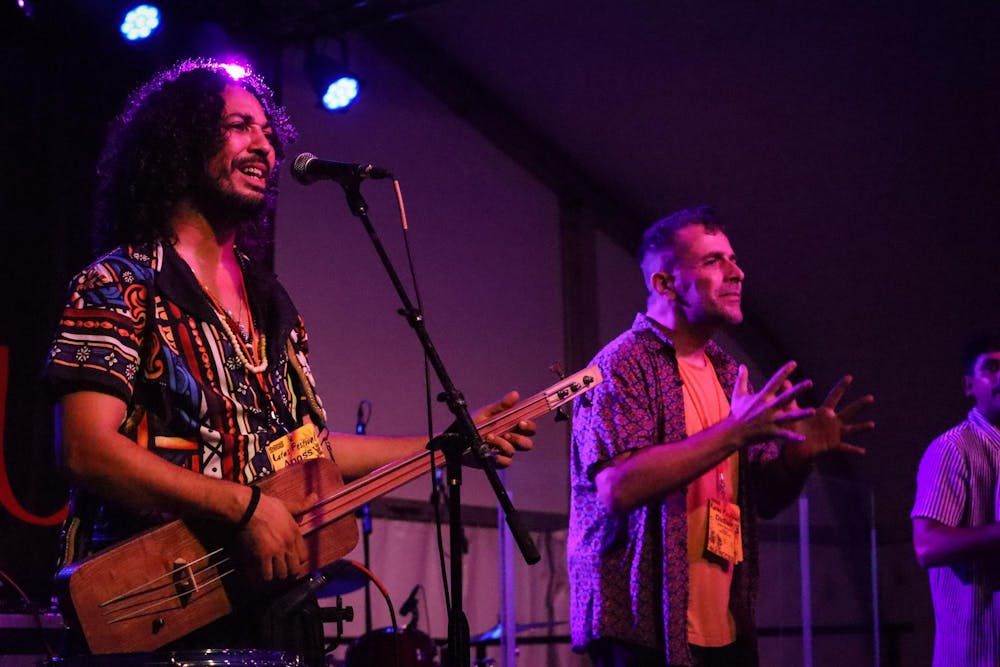
With musicians from Canada to China, the annual Lotus World Music and Arts Festival returned for its 32nd year. Spanning four days, the festival hosted musicians from around the world to expose Bloomington to other cultures.
The festival began with opening shows from Krista Detor Band and Terrance Simien & the Zydeco Experience. Both are from the United States, and Krista Detor typically plays around Bloomington without her band.
“You don’t get to see Krista with her whole band very often, so that was great to have a larger band,” Cindy Beaulé, WFHB disc jockey and former volunteer coordinator for Lotus Festival, said. “Usually when she plays in town, she plays by herself.”
Terrance Simien & the Zydeco Experience, a band from New Orleans, was the other group to open the festival on Thursday. Beaulé said they were a “very danceable” group that connected with the audience through throwing Mardi Gras beads into the crowd. They often do this during their performances to create a lively atmosphere similar to the Mardi Gras celebrations in New Orleans.
Puuluup, a duo from Estonia, was among the artists who performed Friday and Saturday and was one of Beaulé’s favorites. As a big fan of Nordic music, she was satisfied with this year's lineup which included musicians from Finland, Sweden and Estonia.
While many artists performed both Friday and Saturday, some performed just one day of the festival. Krista Detor and Terrance Simien exclusively performed during Thursday’s opening performance, while House of Waters and Yeison Landero performed Friday only.
Saturday's performances began at the Sixth Street tent at noon with Teho., a Finnish duo that mixes traditional Finnish fiddling with other styles such as bebop and western swing. They were followed by Zimbabwean band Dan Kusaya & the Chimurenga Inspiration. This was Kusaya’s third time performing at Lotus fest, but his first time with a full band.
Kusaya’s performance was lively and interactive, with dozens of audience members dancing along to the music.
“It’s my favorite weekend of the year, I just love sort of marinating in these world cultures,” Amira Sabbagh, longtime Lotus Festival fan, said. “I’m a little bit of a dance freak, so I just get up there and when I hear the music I gotta move.”
After Kusaya’s set, Costa Rican band Matixando took the stage in matching shirts. Their band formed in Costa Rica but is now based in Bloomington. Consisting of 11 members, they combined many different instruments including four types of drums. Lead singer David Dávila González encouraged audience members to dance, saying, “it is not a crime to dance.”
While the first round of performances took place at the Sixth Street tent, three separate workshops were held at the Waldron Arts Center to teach attendees different styles of dance. Performer Nidia Góngora held a rhythm workshop focusing on Colombian Pacific music. There was also a swing dance workshop and a salsa workshop led by the Ritmos Latinos Indiana group.
“When we’re teaching people that haven’t danced before, we usually start with kind of what are the basics for salsa, what are those steps you can do if you’re just dancing by yourself, and then we put it to music, so how do you put these steps to a song,” Ian Herrman, salsa teacher for Ritmos Latinos Indiana and salsa workshop instructor, said. “Since salsa is a partner dance, we demonstrate how you dance it with a partner, we connect, we talk through the different steps you do together and then we put that to music as well.”
After the first round of performances and workshops ended at 4 p.m., the festival picked up again at 6 p.m. with artists performing throughout all the venues, including the Buskirk-Chumley Theater, the Sixth Street tent, the Waldron Arts Center and First Christian Church.
Shelley Morningsong and Fabian Fontenelle were the first to perform at the Buskirk-Chumley Theater on Saturday evening. They are a Native American married duo whose performance highlighted tradition, heritage and connection. Morningsong takes traditional dance rhythms and writes contemporary songs to them that her and Fontenelle perform.
“We’re all connected, we’re all related, we come from so many different places but yet I know we have so much in common and I love it,” Morningsong said between songs during her performance.
Through their performances, they shared about the Zuni people, which Fontenelle is a part of, and how their ancestors are believed to have emerged from the bottom of the Grand Canyon — which they even had a performance about.
Back at the Sixth Street tent as the sun went down, attendees began to crowd together to hear Togolese artist Dogo du Togo and the Alagaa Beat Band. With rhythmic tunes and strong beats, their performance added yet another opportunity for attendees to dance. At least 100 people joined the audience for the performance.
As Dogo du Togo was rocking the Sixth Street tent, Cathy Fink, Marcy Marxer and Chao Tian performed for the crowd at the Buskirk-Chumley Theater. Grammy award winning artists Fink and Marxer collaborated with Chinese classical hammered dulcimer player Tian, creating a combination of traditional Chinese and Appalachian music. They highlighted the unexpected similarities between these two types of music.
In the past they’ve had bigger bands, more performances and more venues. It’s changed in recent years.
Although this year's festival included four venues and a diverse group of performers, this wasn’t one of Lotus’s biggest festivals. Organizers struggled to get visas and find performers to come to the festival, according to Lotus Education and Arts Foundation Artistic Director Tamara Loewenthal. Some longtime festivalgoers noticed the difference.
“I think part of the issue might be that some international artists are maybe not so keen on coming to the United States to perform, wondering if they might not get back to their own country,” Charlie Bowman, a fan since 2012, said. “I hate to say that, but I think that may be the reality right now, but I just hope that (Lotus Festival) will continue.”
Despite these setbacks, Bowman said people who have never been to the festival are missing out. The festival has brought a sense of community and culture to Bloomington for decades.
“You’re missing out on so much variety of musicians and types of instruments that you’ve never heard of before,” Bowman said. “And the musicality, it’s amazing, it really is.”
Saturday's performances came to a close at the Sixth Street tent with Colombian musician Nidia Góngora, who also lead one of the dance workshops. Performing traditional Afro-Colombian music, specifically music from her town of Timbiquí, where she grew up on the Pacific side of Colombia. The Timbiquí music represents sounds that come from the jungle and the sea using instruments like the Marimba de Chonta, which sounds like rain, and the Cununo drums that represent thunder.
Her performance closed the night with an energetic set that got everyone dancing. She interacted with the audience often, clapping along with them to beats and even inviting four audience members onto the stage to dance with her near the end of her show. She seemed to be a crowd favorite of the festival, with the audience beginning a thunderous chant for one more song as the band left the stage.
“I mean in general it’s just broadening, and it’s always good to broaden your own horizons,” attendee Amira Sabbagh said. “I personally don’t want to stay stuck in my own little shell of a world; I want to expand because it’s interesting and the world is a big and curious place and I’m a curious person.”