

It took about 18 miles for Benny Hickok to realize exactly why the race earned the designation as Indiana’s “toughest trail race.”
For starters, the trails guiding racers through the Owen-Putnam State Forest that November in 2006 weren’t trails for people at all. The paths were meant for horses, which, over the years, had torn up the terrain. Add in the recent rain and nearby springs, Benny found himself slipping and sliding through ankle-deep mud during the entire first course loop.
It also didn’t help that his friend — the one who convinced him to try out the long-distance sport in the first place — failed to show up, leaving Benny to attempt his first ultramarathon, the OPSF5050, alone.
He had run long distances before, including road races like Cincinnati’s Flying Pig Marathon. But this 50-kilometer race (approximately 31.1 miles) was different. It was freezing cold. His IT band started to flare up. And he could just go home. So, with 13 miles left in the race, Benny took a seat. He decided he was ready to stop.
“What the hell are you doing?”
Benny heard the voice of his wife, Cheryl, loud and clear. It was strange — his wife wasn’t even next to him at that moment (and would “never talk to me like this”), Benny said. But there her voice was in his head, urging him to get up.
“You’ve spent all this time training for this, you’ve got this day to yourself, spending it away from family and you’re just going to give up?” Benny imagined Cheryl telling him. “Just go get it done. Just get out there.”
She was right, of course.
So, with the help of ibuprofen and a shot of Captain Morgan, Benny got back on his feet and took off. Just another 13 miles to go.
***
Over the past decade, ultramarathon running — running distances longer than the traditional 26.2-mile marathon — has skyrocketed in popularity. According to the International Association of Ultrarunners and RunRepeat, participation in these long-distance races increased by 1,676% from 1996 to 2018, with women and runners from all age groups participating more than ever before.
Running has become more popular and accessible to a wider range of people over the last several decades — “You only need a pair of shoes to start,” as many popular running social-media influencers will tell their viewers. Still, Olympians and sponsored athletes often dominate road running, whether it’s the traditional 5K, 10K or half and full-marathons on asphalt or concrete. Professional runners, who often trade 9-to-5 jobs for full-time training, regularly take home top awards for shorter trail races.
But a community of ultrarunners in Indiana — including runners from Bloomington — are bucking that trend. Across the state, some of the most well-known ultrarunners are cardiac nurses, corporate managers and researchers (Bloomington City Council member Matt Flaherty even took home second at one of the country’s most competitive ultras, though he declined an interview for this story).
“We have some seriously elite runners in this area, which is crazy to think about,” Benny said. “But if you’re going to be stuck in the Midwest, (Bloomington) is a training playground for some of these people.”
***
For Benny, 52, running has always been a family affair. A native of Massena, New York, some of Benny’s earliest memories of the sport were with his dad, who would run from their family home to the General Motors location where he worked three miles away. Benny started running with his dad when he was 10.
When he started running road and trail races in the early 2000s, he even got his girlfriend — now wife — Cheryl involved in the sport. The two are now nurses.

(Left) Brian Spice and (middle) Benny Hickock stand a the finish line for the Arkansas Traveller 100. Benny said he met the man on the right "on the trails" but didn't remember his name.
As the Hickok family grew, so did their collective love of the sport. One of their sons, Cael, ran a 50-kilometer race before he graduated from Bloomington High School North in 2024. Cael and his older brother Liam have both helped pace Cheryl through two of her past races.
However, the training required to compete in ultras doesn’t always fit easily into a working parent’s life. While training, Benny quickly found out the importance of a good headlamp, recalling often having to run outside either at 3 a.m. or late at night after putting his kids to bed.
It’s running in those moments alone when the mental strength needed to complete a race or workout is more difficult than the physical, he said.
“Your body’s gonna keep on telling you, ‘You shouldn’t keep up,’” Benny said. “You know, and your mind, you just gotta just tell your body to be quiet.”
In 2024, Benny decided to create his own trail running company, WooHoo Trail Fun LLC, and start his own ultra race, a 100-kilometer race called the MoMoFo Trail Run. With the help of his family and friends, he hosted the first race last June. The second race is planned for June 6-7.
Over the years, Benny has completed 14 ultramarathons with different distances and scenery. Each time he crosses the finish line, he feels a sense of disbelief.
“Who would look at some of us and think, like, ‘Really? That person can run 100 miles?’” he said. “That’s the beauty of this. You can’t just look at the physical vessel. It’s what’s, you know, up in their headspace. What their ‘why’ is.”
Benny said the most memorable part of a race is the struggle. By this standard, no race was more memorable than the Cruel Jewel 100, a 104-mile foot race through the North Georgia mountains, which Benny completed in 2019. The year Benny ran it, a reroute meant the race ended up being 113 miles. Racing against a 48-hour cutoff, Benny and a few friends pushed through two nights without sleep. To stay awake they told jokes and mimicked farm animals, and at one of the aid stations Benny said he needed a beer.
“It sucked so bad and we’re all like, ‘We’re never going to do this again,’” he said. “Of course, but now we’re all like, ‘Maybe we should do it again.’”
***
At 62 years old, ultrarunning has taken Tom Fifer all over the world. He ran his first ultramarathon, the 50-kilometer Norris Dam Hard Trail Race in Norris, Tennessee, in 2012. He’s run in Scotland, and he even completed a group race through part of Madagascar.
But even after all these adventures, Fifer still finds himself drawn toward a trail at Eagle Creek Park about half a mile from his home in Indianapolis. He leads a group run at the park each Tuesday for the Indiana Trail Running Association — one of the staples of Indiana’s thriving ultra community.
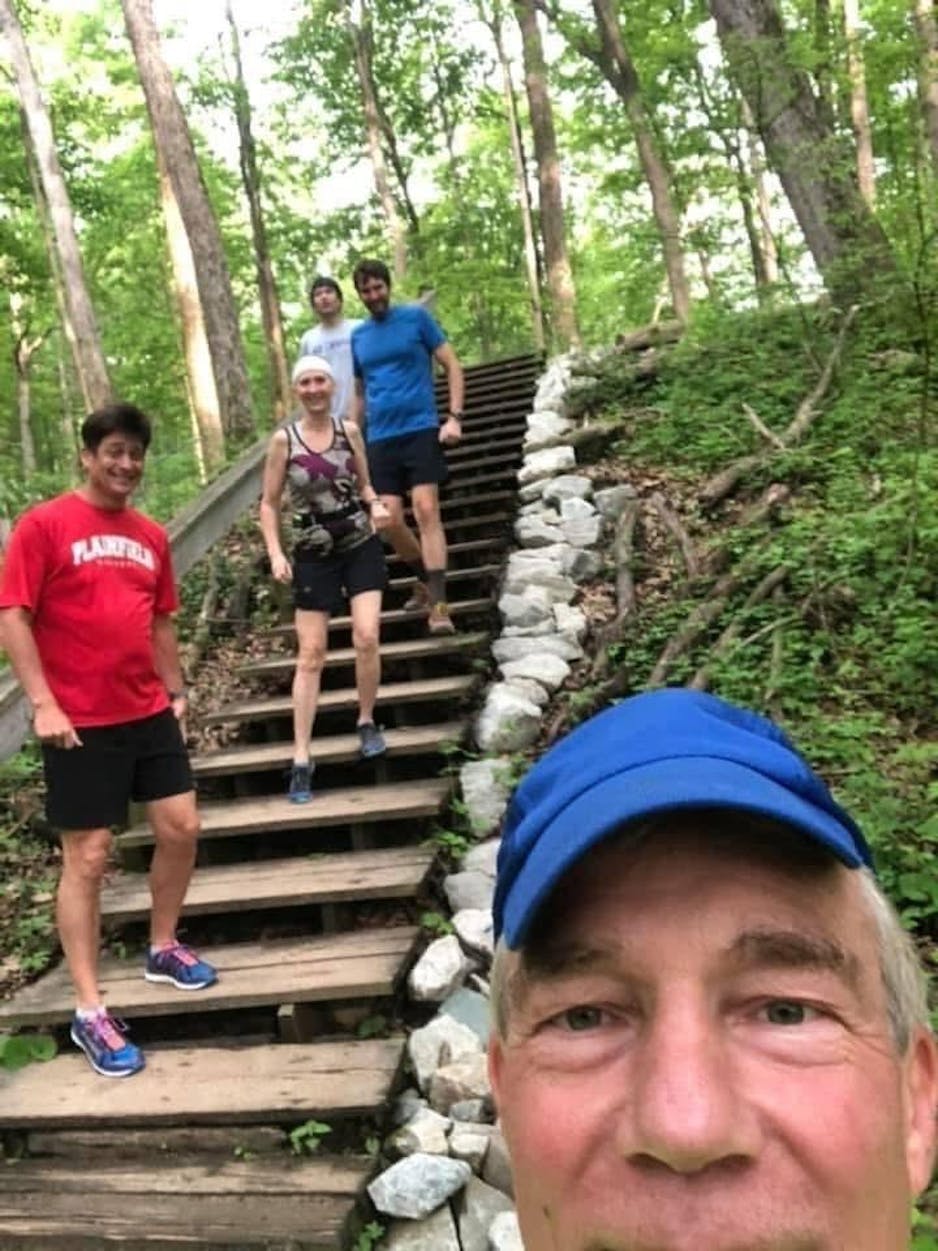
Tom Fifer (right) leads a group of runners during his weekly Tuesday night workouts. Fifer ran his first ultramarathon in 2012.
Fifer said he didn’t grow up as an athlete and could barely run five miles by the time he graduated college. But once he started running with ITRA, he found a strong social network of other runners to keep him going.
“Everybody you meet in these races are just really good, you know, great outlook, positive attitude, just enjoy life type thing,” he said.
While he loves running with other people, Fifer said he often prefers to run by himself (or at least as the only human in his group). He enjoys bringing his bernedoodle, Cooper, on runs at the nearby park, though he admits Cooper’s “not the best running dog right now.”
Training on his own helps prepare him to take on the isolation that often comes with running ultras. During long races, especially 100-mile races, he often finds himself running by himself at night, which can cause him to mentally spiral. To keep going, he has to remember his family is waiting for him at the finish line and that he “can’t let them down.”
In 2022, Fifer ran a 100-kilometer ultra through Zion National Park. Toward the end of the race, he was running through the night, only the tunnel vision of his headlamp ahead to guide him. He thought of the same motivation he relied on for so many other races: the thought of his family waiting for him at the next aid station. Hours later, when the sun finally rose above the canyons, he finally saw wife, Lori, and his kids, Ali, Zach and Kassidy, waiting for him and knew he could keep on going.
***
Sean Bowman’s relationship to running has changed a lot throughout his life. Growing up in Brown County, Indiana, he ran cross country — and was good at it, too, earning a spot to run cross country and track at Indiana State University from 2004-08. The focus then was always on running fast.
When Bowman, 40, decided to attend IU for graduate school years later, earning his master's in 2013 and doctorate degree in 2017, that changed. During graduate school, he battled with depression and anxiety, leading to an extended period of substance use and addiction, he said.
But that’s only where his ultra story began.
“I decided ‘Hey, you know what? I’m going to be putting down substance and these things, and I’m going to take back up running,” he said.
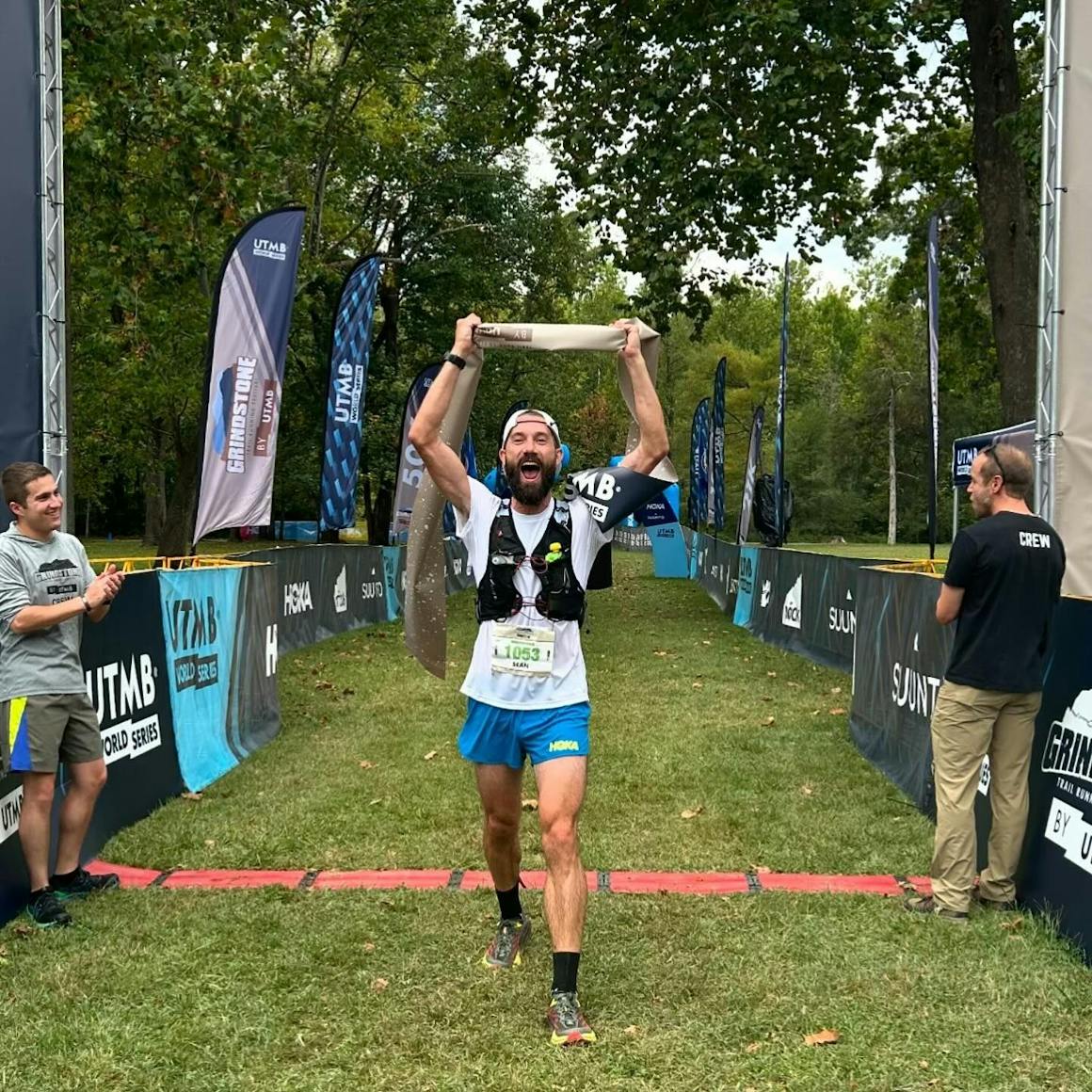
Sean Bowman wins the Grindstone Running Festival by UMTB 100K on Sept. 20, 2024, in Natural Chimneys Park, Virginia. Bowman picked up running in 2018 after about a decade off.
He had taken about a decade off running before he picked the sport back up in 2018. And this time, speed wasn’t the ultimate goal. He wanted to see how long he could go. As he started to regain his endurance and strength, he developed a passion for being outside on the trails, for exploring new places and trying new adventures. He found calmness in the sport.
“We’re always surrounded by people, and we’re always surrounded by, you know, with the media and technology,” Bowman said. “For me, it’s like running in nature and running on the trails is a way to not escape, but just to experience life in a more solitude state. It’s a time to reflect, it’s a time to carve out for yourself with no interaction with people.”
Unlike Fifer and Benny, Bowman didn’t finish his first ultra race, the Indiana Trail 100. He said he didn’t train well for the race, leading to a flare up in his IT band about 50 miles into the race. Though it was a humbling experience, Bowman said, he decided to train for the same race the next year, determined to finish the course. But when the COVID-19 pandemic hit and cancelled the 2020 Indiana Trail 100, he had to wait another year.
Finally, two years out from his first ultra, Bowman was ready to try again — this time well-trained for the task. He ended up winning the whole thing.
It wouldn’t be his only win.
He also won the 100-kilometer race in the 2024 Grindstone Trail Running Festival. He took home first place finishes in 2023 at the 50-kilometer Tecumseh Trail Challenge and 50-mile Dances with Dirt Gnaw Bone in Nashville, Indiana. He also placed 10th at the Leadville Trail 100, a 100-mile course through the Rocky Mountains known as one of the country's most competitive ultras.
“The goal is to finish, that’s the number one goal,” he said. “Yeah, you can run fast as a secondary, but if you go in the race saying, ‘I want to run fast,’ you’re probably not going to finish the race.”
Bowman said it's important for runners taking on an ultra to remember why they’re doing it — he looks back on these motivators when he’s hurting during a race or in a dark place.
This August, Bowman will travel to Chamonix, France, to compete in the prestigious Ultra-Trail du Mont-Blanc. The 106-mile race circles the Mont-Blanc summit and leads runners through Italy, Switzerland and France. Runners will attempt to run more than 32,000 feet of vertical gain during the race — higher than Mount Everest’s summit’s elevation.
Bowman expects it to be a gruesome test of his endurance. But when he hits those moments in August when he wants to slow down, walk or even quit, he will think about his family. About his sobriety and his faith. And about a life without ultras, where all it might not have existed.


