In August 2024, the City of Bloomington conducted a heat mapping campaign to measure temperature fluctuation in different parts of Bloomington.
Volunteers used cars outfitted with heat sensors to collect data as they drove through the city three times throughout the day. Climate Action Planning Analytics Strategies and the National Integrated Heat Health Information System used the data to create an urban heat island map.
Dana Habeeb, assistant professor at the IU Luddy School of Informatics, Computing and Engineering, said the urban heat island effect occurs when city temperatures are higher than surrounding rural areas.
“This is basically due to how we are designing our cities,” Habeeb said. “We're displacing natural vegetation, such as trees and grass, and replacing it with impervious surfaces, such as roads, buildings and parking lots.”
CAPA developed five driving routes for the volunteers. These were based on gathering data from places with diverse land use and cover, as well as places of interest the organizers identified as relevant to heat, such as schools, community centers and playgrounds.
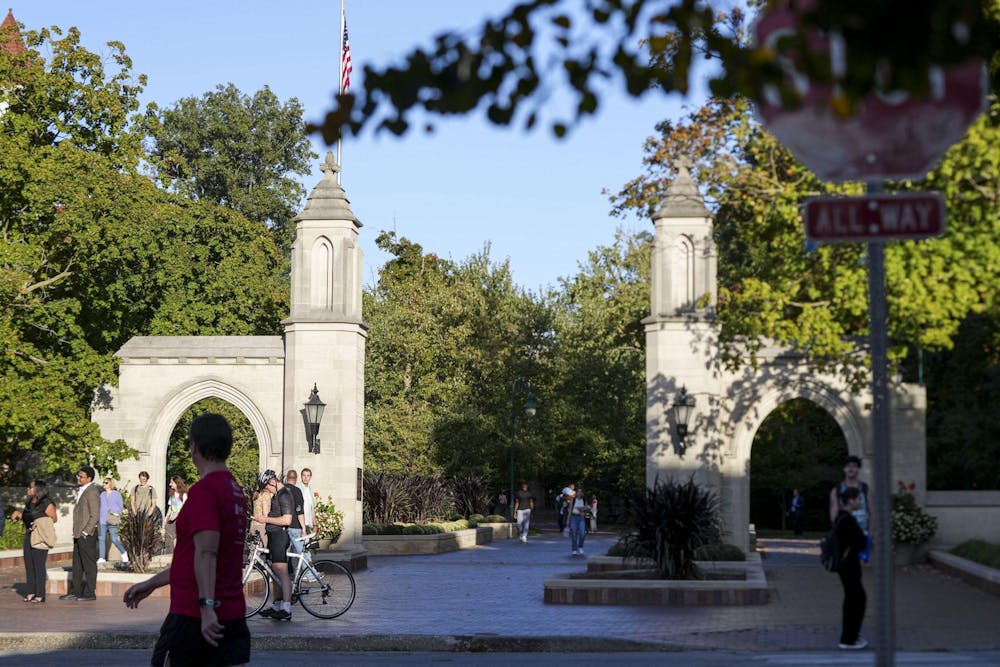
This heat could be felt on campus. The Indiana Memorial Union, Franklin Hall and Sample Gates were among the hottest parts of the city. The route went around the corner of Fourth Street and Indiana Avenue and in the afternoon, where the temperature was 92.5 degrees.
The hottest part of the city during the afternoon route was the corner of South Walnut Street and West Third Street at 93.5 degrees. At the same time, the area near Griffy Woods Nature Preserve was as low as 81.1 degrees.
The area surrounding the intersection at West Third Street and State Road 37 was also dark red on the interactive map, indicating high temperatures, with an average of about 92 degrees. CAPA created the interactive map, integrating the data from the mobile heat sensing campaign and remotely sensed data from the Sentinel-2 satellite.
2023 and 2024 were the two hottest years on Earth, according to the National Oceanic and Atmospheric Administration. If yearly carbon emissions continue to increase at the same rate they have since 2000, global temperatures are projected to reach as much as 10.2 degrees warmer by the end of the century.
Long term exposure to extreme heat could cause chronic kidney disease, associate professor at the IU School of Public Health Zachary Schlader said. He said extreme heat makes the human body more vulnerable to other environmental exposures such as air pollution.
Bloomington’s Climate Action Plan describes the city’s goal to reduce extreme heat exposure by planting shade trees in areas identified as having high heat island impact.
In March, Canopy Bloomington, a local environmental nonprofit, used a $50,000 grant from the city’s Sustainability and Economic Development office to plant almost 70 trees in the Crestmont neighborhood and create “cool corridors.”
The group plans to continue planting trees in the fall in the Near West Side neighborhood and at the Early Learning Center and Faith Lutheran Church.
The range of extreme heat throughout Bloomington is not equally distributed. The mobile heat sensor campaign found over 12 degrees of difference in temperature in different parts of the city during the afternoon route.
Habeeb said there are three options for cities to manage heat: mitigate, adapt and respond.
“We can do things like green infrastructure interventions and that's basically bringing back natural vegetation, especially trees and irrigated areas as well,” Habeeb said. “All that goes to help to reduce temperatures in our built environment in the local area.”
The city’s Climate Action Plan states that some community members, including children, older adults, low-income individuals and people of color can be more vulnerable to the effects of climate change, such as extreme heat.
To adapt, Habeeb said access to air conditioning is key. The "Stay Cool Bloomington" initiative designed an air conditioner distribution program to give low-income residents access to air conditioners. The program was first instituted in 2024 and is set to continue this summer.
“Stay Cool Bloomington” is specifically aimed at people with medical conditions that increase their risk of heat-related illnesses. Some of these include heart disease, mental health disorders and poor blood circulation, according to the Centers for Disease Control.
Some medications can also increase heat sensitivity. These include diuretics, beta-blockers, Selective Serotonin Reuptake Inhibitors (SSRIs) and antipsychotics among many others. Those in need must apply for the grant online or at a township trustee’s office and do not need to provide medical information or prescription to participate.
Last summer, Monroe County created cooling stations at fire stations throughout the city for four days of extreme heat in June.
“The heat mapping is partially about where it is the hottest and then the other part is where the vulnerabilities lie,” Schlader said. “That's why that's a really important project is (because) you're now able to know where to put resources on particularly those hot days.”
Schlader said knowing where the vulnerabilities are would help determine the places in Bloomington it would be most effective to have a cooling center. Placing one in a higher-income neighborhood, he said, wouldn’t be as useful since most houses in those areas likely already have air conditioning.
He said people experiencing homelessness, specifically, “cannot escape” the heat. Other people who are more at risk of extreme heat include those working in construction or agriculture, he said.
By 2050, urban heat islands in Bloomington will expand “significantly” and almost all developed parts of the city will experience extreme heat conditions, the summary report predicted.