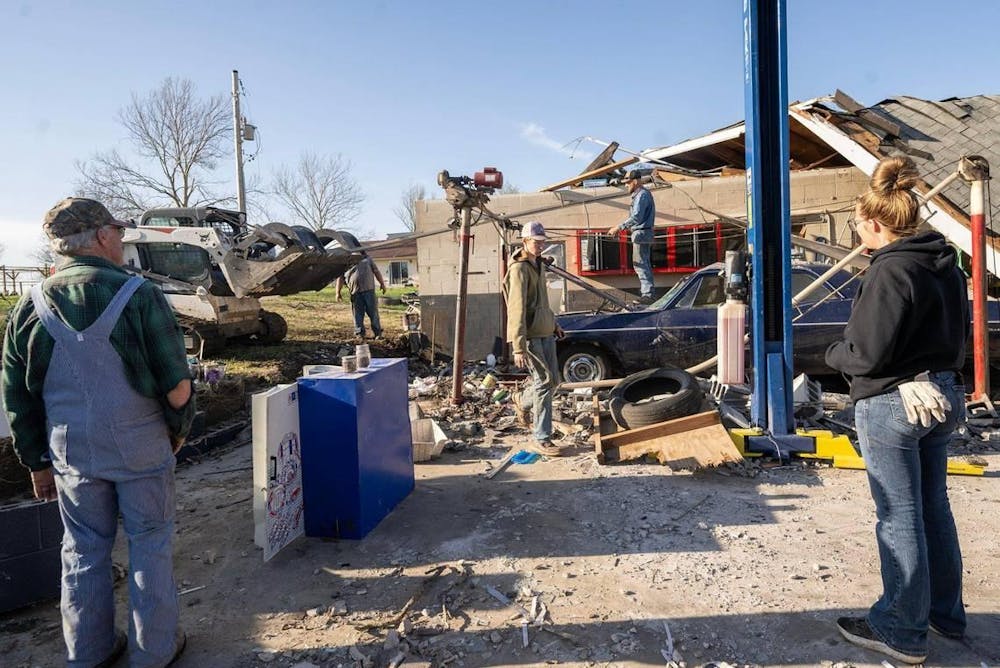
Indiana has already experienced 43 tornadoes since January. A storm on April 2 spawned 21 tornadoes — in a single day — while historical weather data indicates that the state usually experiences about 22 tornadoes in an entire given year. The storm also arrived early into Indiana’s tornado season, which usually sees a mid-May peak.
Extreme weather events are becoming more disruptive as global temperatures rise. Hurricanes have become more severe, threatening life and property. Over the past decades, heat waves have become longer, more frequent and more intense. Disastrous flood risk has also grown.
Could we also expect shifts in tornado behavior in the face of climate change?
The answer: maybe.
“This tornado season has been eventful, but that will wax and wane over certain years depending on patterns like El Niño,” said Ethan Choo, co-president of IU’s Student American Meteorological Society chapter. “Climate change takes a longer time to rear its head in the data, because we need data that’s old enough to pick up the signal of how things are changing.”
Choo said attributing this year’s uptick in tornado activity to climate change could require many more years of data collection to identify patterns and aberrations in the numbers. Still, Bridget Wisdom, the student meteorological society’s co-president, said the unusual frequency and timing of Indiana’s 2025 tornadoes have been noticeable.
“Tornadoes are rare to begin with, so they’re harder to correlate to climate change,” Wisdom said. “But particularly for March and April, I was shocked by how many tornado warnings were going off around here. I thought that was unusual.”
Four key atmospheric ingredients are needed for tornadoes to form: moisture, instability (warm, moist air that rises), lift (which causes air to rise) and wind shear (a change in wind direction, speed or height that will increase wind strength and promote rotation). In the right combination at the right time, these ingredients produce thunderstorms with tornado-forming capacity.
Tornado formation is dictated only by the presence of these ingredients, not by a particular time of year. As a result, if the months of the year with conditions to bring these ingredients together change, expected tornado seasons are likely to change, too.
“Spring is a prolific season for severe weather because you have the combination of high winter winds, which create bigger weather systems, and the moisture that rises as weather gets warmer,” Choo said. “As bodies of water stop getting quite as cold, assuming you still have winter winds, that will start to extend the season earlier, possibly into February or January.”
Cody Kirkpatrick, senior lecturer in IU’s Department of Earth and Atmospheric Sciences, said climate change could also impact the geographic range where tornadoes occur.
“It takes a long time to recognize this change, but researchers have noticed over the last couple of decades that our long-held idea of Tornado Alley, where most of the tornadoes in the U.S. develop, is shifting eastward,” Kirkpatrick said.
Kirkpatrick said the Great Plains, historically the United States’ tornado hotspot, has gotten drier, meaning its air has less of the moisture necessary to produce major thunderstorms. Additionally, higher temperatures in regions like the Midwest create more humid conditions by evaporating more water off the ground. As the area with this warm, moist — that is, tornado-friendly — air has moved east of the Great Plains, so has the country’s tornado range.
“These hazards are happening in places that haven’t had these sorts of issues,” Kirkpatrick said. “Having these sorts of climate changes in, say, the northeast, where tornadoes and thunderstorms are a very rare thing, people are less familiar with the risk and they might not know what to do or how to respond.”
The U.S. has a robust weather radar infrastructure. Its radar network spans all 50 states and allows meteorologists to evaluate high-resolution, detailed data on the scope and nature of anticipated weather events. Although there are gaps in radar coverage in parts of the country, the U.S. is generally equipped to detect and observe tornadoes even in regions that don’t expect them.
Preparing people against new risks is the bigger priority.
“I don’t think many people would expect tornadoes as much in earlier seasons and different places,” Wisdom said. “As weather becomes more severe, people need to know what’s going on and that we are seeing these shifts.”
Kirkpatrick also emphasized infrastructure changes as extreme weather evolves.
“Local governments will have to respond and make communities more resilient to these sorts of hazards,” Kirkpatrick said. “People should reach out to folks in local government to find out what’s being done in their communities to prepare.”
Information about tornado safety is available on the Indiana Department of Homeland Security website.