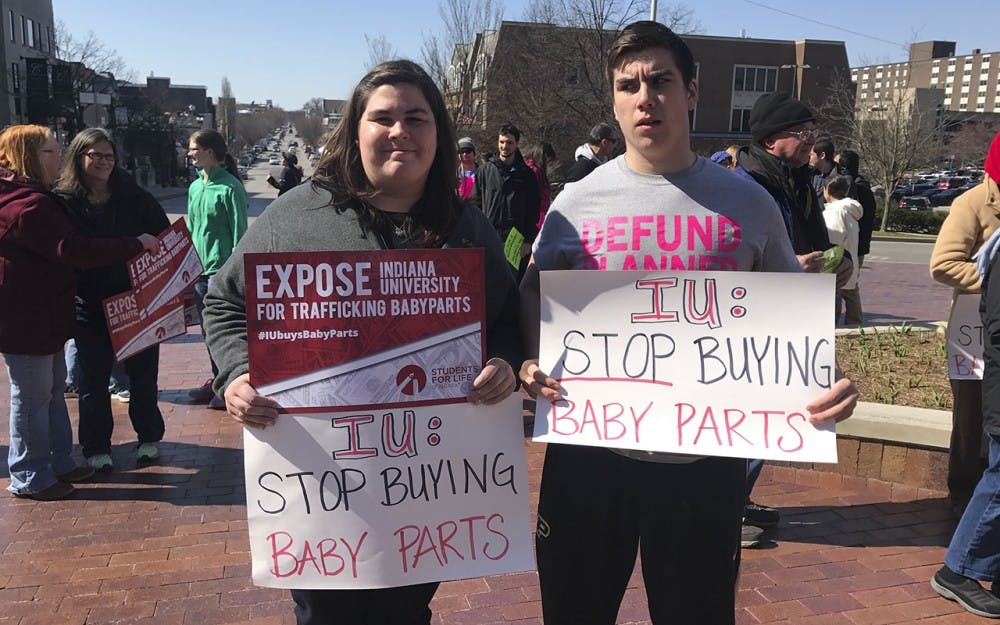
Students for Life of America and IU Students for Life rallied at the Sample Gates on Saturday afternoon to protest a request for injunction that the University filed last May in response to Indiana House Enrolled Act 1337. Among other actions, H.E.A. 1337 prohibits the transfer or acceptance of fetal tissue remains, which are used in medical research.
Signs provided for the event by Students for Life of America read “Expose Indiana University for trafficking babyparts,” and some protesters brought other handmade signs saying “Human Beings Aren’t Test Subjects” and “IU says it needs brains? Why not use the ones they’ve got,” which they displayed to passing cars and pedestrians on Indiana Avenue.
The plaintiffs in IU’s case argued the statute’s restriction on fetal tissue is unconstitutionally vague and deters research and interstate commerce, “which is not outweighed by any benefit of the Enrolled Act.“ The legal and factual basis in the complaint explains how IU and the primary researchers for the School of Medicine’s Stark Neurosciences Research Institute do not use intact fetuses, which are regulated differently.
Saturday’s rally opened and closed with prayer and featured six speakers, including Students for Life at IU president Jenna Fisher, a representative from Students for Life of America and two IU professors.
“My Indiana University, my IU, is misrepresenting what it means to be a Hoosier and conducting research that is both unethical and illegal,” Fisher, a sophomore studying Community Health, told the crowd.
The disputed fetal tissue is purchased from the University of Washington’s Birth Defects Research Laboratory, which sources material from aborted and miscarried fetuses. The tissue is used to derive mixed cell cultures that aid in the current federally funded study of Alzheimer’s disease.
About 40 people, including families with small children, were in attendance despite posts from the opposition on the event’s Facebook page that varied from mocking the groups’ statements and requesting unbiased evidence to asking the organizers not to come to Bloomington.
Fisher asked the crowd to imagine a financially strained woman taking her 2-year-old child to a clinic and paying them to handle her burden by terminating it. Fisher then said the crowd should imagine the toddler being dismembered and its parts sold off for research.
“This is happening right now, except the children are smaller, weaker and more vulnerable than the toddler in this hypothetical situation,” she said.
The national debate on the use of fetal tissue for medical research was catalyzed in 2015 by a series of videos by the Center for Medical Progress which purported to show top Planned Parenthood executives haggling over the prices of fetal tissue. Laurel Spencer, president of Advocates for Life at IU’s Maurer School of Law, opened her speech by saying these videos jolted the country into reality.
“I don’t know that much about those videos, if they were edited or just cut, but I think there was real evidence presented there,” Fisher said after the rally.
Despite its name, the Center for Medical Progress website describes the organization as “a group of citizen journalists dedicated to monitoring and reporting on medical ethics and advances.” The group’s representatives posed as biomedical executives looking to purchase fetal body parts, but the videos were found by private research company Fusion GPS to be selectively edited to skew facts and statements.
The Texas grand jury tasked with investigating the allegations made by the Center for Medical Progress cleared Planned Parenthood of wrongdoing and indicted the producers of the video on felony and misdemeanor charges, which were later dropped.
Fisher said the perceived benefit from using aborted fetal tissue for research makes society more accepting of abortion procedures, which she called a horrendous wrong. The University’s involvement in this research makes it guilty of propagating an abortion industry, she said.
“Indiana University does not buy fetuses or fetal body parts,” University spokesperson Margie Smith-Simmons said in an emailed statement. "The university periodically acquires fetal tissue samples (with each sample weighing approximately 1/4 ounce) provided by National Institute of Health-approved laboratories, with consent from the mother, for our groundbreaking research to find cures for a wide range of diseases such as Parkinson’s Disease, cancer, blindness, diabetes, Alzheimer’s Disease, as well as other devastating neurological diseases.”
Eric Rasmusen, a professor in the Kelley School of Business, said if the IU researcher in question, Debomoy Lahiri, wanted to stay out of jail, the University could request the University of Washington not send remains derived from aborted fetuses.
“Why doesn’t IU just tell them to give you miscarriage parts, not abortion parts, and save us all the money we incur by filing a lawsuit, especially when Planned Parenthood is already suing, so IU’s participation is not all that important for the objective Planned Parenthood is seeking?” Rasmusen said.