
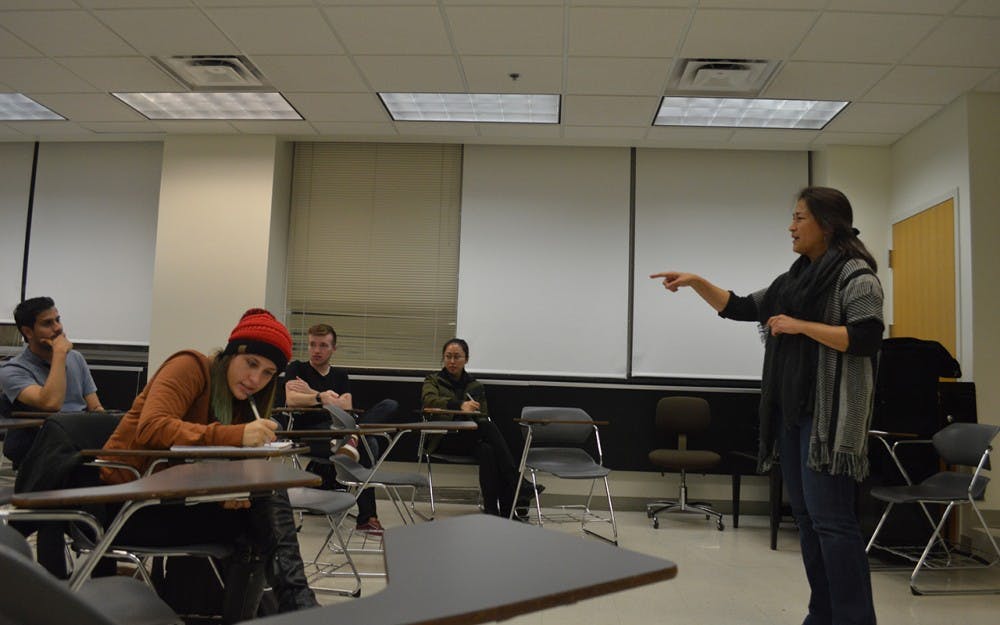
On the chalkboard in the front of a room in the Simon Music Library on Wednesday night, Amy Osajima drew a large rectangle. She told the listening audience that she was going to make a list of all the things the world owes them. She proceeded to leave the rectangle blank.
Osajima is the director of marketing for IU’s Department of Theatre, Drama and Contemporary Dance. The focus of the event, titled “Nobody Cares About You: Marketing in the Arts,” was building individual brands as artists and how that can be achieved effectively.
The event was organized by New Voices Opera, an organization that puts on two brand-new operas in Bloomington each year.
“It’s really that nobody cares about you yet,” Osajima said.
She said the key factor in marketing art, both as an artist and as an art administrator, is relevance. Without it, new audiences are hard to attract. Osajima said people primarily go to shows to see family or friends who are involved with the production. The difficult part is expanding a fan base from there.
“As artists, you’re all special snowflakes, but you’re special snowflakes in a snowstorm,” she said.
She said there is one main way to market yourself as special: make more friends.
“Artists need to understand not everybody is going to love what you do, all of the time,” Osajima said. “The trick is to find those people who will really be invested in you and really love what you’re doing.”
She asked those in attendance how they would overcome the reputation of a genre like opera, which she said is known for being elitist and somewhat boring.
The answer was simple: give people a reason to come. If art is not made relevant to a specific audience, people may not have an interest in it.
“Marketing is connecting people with the things that make them happy,” Osajima said. “It’s not just selling stuff.”
Osajima split the room between artists and arts management students. She asked the artists to discuss their crafts with the management students and tell them their personal process.
After a few minutes, she regained their attention and asked whether the management majors would be interested in going to a show by their respective artists.
The answer was a resounding yes.
She said although relevance and brand building are key to a show’s success, most administrators have to think about these things after the fact. Normally, shows are presented as part of an establishment’s curriculum, and the attraction of the audience is something that needs to be worked on before it opens.
“They should consider it, but it doesn’t preclude them doing any particular show,” Osajima said.
Her job is attracting people who will get the most value out of productions. She said at the end of the day, plays are written by people. Even though an audience may feel removed by an artist’s work, she said the relevance will keep them coming back for more.
“That’s the reason people come to shows — because they’re interested,” Osajima said. “They will only be interested if they think that it’s relevant to them.”



