
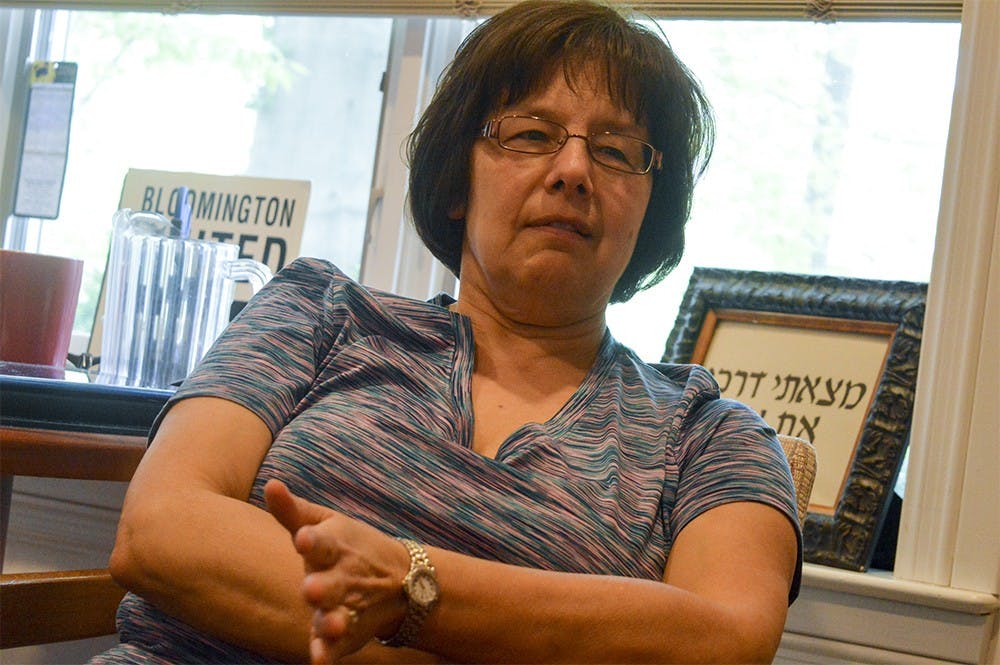
Sue Silberberg was driving down the road with her two children more than 20 years ago when they saw a man walking alongside the asphalt.
Silberberg told her children he was her friend and a rabbi.
“But Mommy, he can’t be a rabbi,” her daughter, Talia, said. “He’s a boy.”
Silberberg has been the head rabbi at the Helene G. Simon Hillel Center in Bloomington since 1989. She said her children had become so used to female rabbis that they didn’t realize men could have the position as well.
“When something becomes what you grow up with, it’s normal,” she said.
Silberberg earned her undergraduate degree in social work from IU and went on to Reconstructionist Rabbinical College in Philadelphia to become a rabbi.
All through history, Jews were on the forefront of integrating women and treating them equally, if not better, than the surrounding societies, she said.
“Our community could not function without the presence of women,” said Sue Swartz, president of Congregation Beth Shalom in Bloomington.
Swartz said she never saw a female rabbi while she was growing up, but when she was in her 20s, the norm shifted.
At Beth Shalom, the rabbi is a man, but the president is a woman, and they have women serving in every other aspect of the congregation, Swartz said.
“Now young girls have role models who are both male and female,” she said. “It makes a big difference in how you relate to your leaders.”
Not every congregation and denomination is as liberal as theirs, Swartz said. In traditional orthodoxy, women have very limited ritual assignments, but that is changing too, she said.
Sexism isn’t a Jewish issue, Swartz said. The issue is societal in nature, she said. She admitted that looking at who runs the major Jewish institutions would uncover some gender imbalances, but that is no different than any other institution.
“Women are pretty much fully integrated into society,” Silberberg said. “For religion to be a place where that’s different, it doesn’t make sense.”
Even though Jews maintain certain basic beliefs, Silberberg said the core of their beliefs is about struggling with the text and interpreting the teachings. She said a major teaching encourages Jews to be involved in change and to make the community what it is.
They should struggle with the traditions and think about how to interpret them, she said.
Swartz said leading a faith-based life and being an unabashed leftist aren’t conflicting lifestyles for her. She said she has found open-minded people in religious institutions and closed-minded ones in supposed progressive circles.
“When you open to women, gays and lesbians, and non-European Jews, your commentary becomes richer and you see the story through different lenses,” Swartz said. “It’s not watering down, it’s creating a richer and more inclusive space.”
Swartz said it’s easy to blame a major social issue on one group of people.
Gale Nichols occupied the position of president of congregation for Beth Shalom 20 years ago.
Nichols is now the director of student services and global services at the Kelley School of Business. She said she hasn’t seen any changes in Judaism in the past 20 years because women have always been represented well.
While their first president may not have been a woman, Nichols said it didn’t take long for women to lead the congregation.
She has seen female equality in many other communities, even modern orthodoxy, Nichols said. However, she said she wouldn’t dare tell other communities how to operate.
“Each of us brings our own special gift and perspective we can share with the community and worship,” she said.
Nichols said she is happy to belong to this community because she has had the freedom to worship how she wishes and to be involved in many different ways. In some communities, such as very traditional orthodox communities, she said she would be restricted from some opportunities such as singing or leading sermons in front of men.
Female equality in Judaism comes from the religion’s respect for women and its acknowledgement of the knowledge women can share with the community, Nichols said.
“For many decades, there has been a lot of progress towards egalitarianism, and that’s a good thing for all of us,” she said.
While not being able to speak for the whole world, Silberberg said she feels her congregation doesn’t have a gender issue at all. Individuals may be sexist and have those beliefs with them, Silberberg said, but now there are generations that have grown up with women rabbis and are used to it.
“I struggle but not because I’m a woman,” Silberberg said.



