
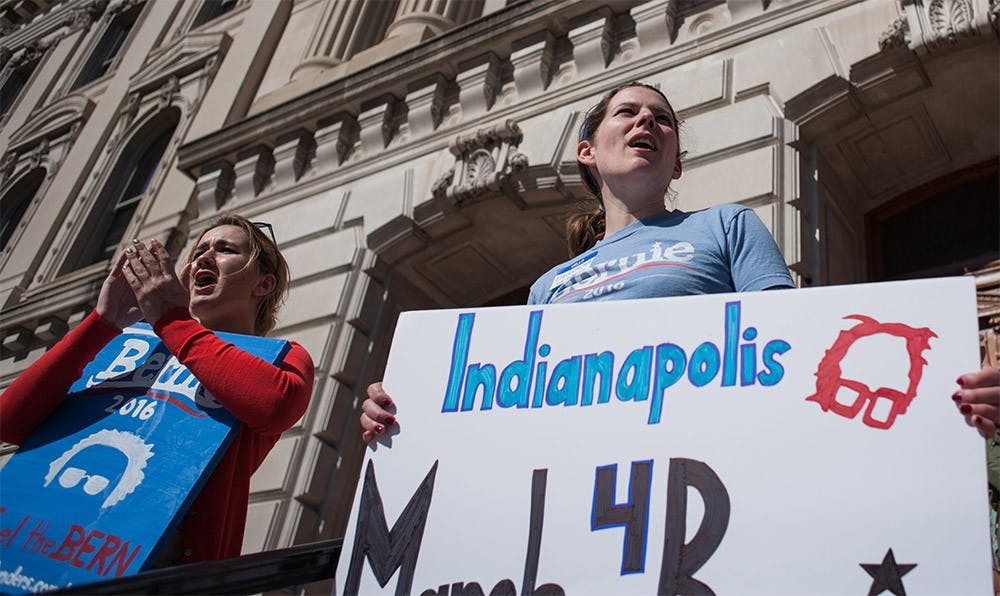
Standing on the steps of the Indiana Statehouse, an IU freshman engaged the young and the old.
“Currently six Super Tuesday states are ‘Feeling the Bern,’” Stanley Njuguna yelled. “Let me hear you say, ‘Revolution!’”
“Revolution!” yelled the crowd.
Njuguna, a future law and public policy major wearing a “Feel the Bern” T-shirt, explained in his speech why the Bernie Sanders movement will not lose momentum.
“What we are is an enduring paradigm shift that will reconstruct the definition of what is possible within our democratic process,” he said. “One last thing to say for the opposition: Here. We. Come.”
“Revolution!” the crowd yelled, before chanting: “Bernie, Bernie, Bernie!”
About 300 gathered in Indianapolis on Saturday afternoon as part of “March For Bernie 2,” a series of marches taking place simultaneously in more than 70 cities.
Organized by the official Bernie Sanders campaign, these marches, along with weekend phone banking, were a last-ditch effort to garner support from Democrats in Super Tuesday states, who vote tomorrow.
Sanders and fellow Democratic candidate Hillary Clinton have been neck and neck in the polls. Political analysts have wasted no time analyzing which candidate has secured certain demographics.
The Indianapolis marchers, mostly white but varying in age and gender, were diverse in their representation of the issues at the heart of the Sanders campaign.
A few elderly couples wanted expansion of veterans’ benefits and social security. A young girl, holding her father’s hand, waved a neon orange sign asking for a $15 minimum wage. A 35-year-old woman from Broad Ripple, Indiana, made four signs for the march, including “Cat Ladies Love Bernie,” “LGBT for Bernie” and “Legalize It.”
“Bernie hasn’t changed his stance in 30, 40 years,” said Jen Rabourn, crafter of the LBGT, marijuana and cat ladies signs.
Many times during former president Bill Clinton’s administration, Hillary “flip-flopped” on issues that should be of great importance to young people, such as policy surrounding incarceration rates and gay marriage, Rabourn said. But most millennials were small children back then.
“If they grew up during that time, they have no memory of all of that,” Rabourn said. “If they did have those memories, like I do, that might sway their opinions.”
A grassroots movement that is constantly gaining momentum is hard to quantify, Njuguna said. But no other candidate has the kind of grassroots movement Sanders has, he said. Because of the IU group’s efforts, almost 200 IU students have recently registered to vote, and some may also be “feeling the Bern,” Njuguna said
However,the group has met plenty of other students who don’t care about the national election, Njuguna said.
“I’m not sure where the apathy comes from,” he said during the march. “Some people say politics doesn’t work for them. Well, the reason politics isn’t working for them is because of campaign finance and because of low voter turnout.”
Five other IU students marched with him Saturday, including IU junior Daniel Olsson, who said the IU group spends a few hours each week trying to register voters with IU College Democrats.
“Most people are either Bernie supporters or just on the fence about supporting Bernie,” Olsson said, adding if Sanders wins the nomination, IU College Democrats will endorse his campaign and help the IU group’s efforts.
Politics can become a rabbit hole, but it doesn’t have to be that way, Njuguna said.
“We sort of view Washington and what’s going on with our local political leaders as something that’s over the horizon, not something we can actively be engaged with,” he said.
But the 2016 election is crucial to defining students’ futures, Njuguna said.
“The next president of the United States will have the opportunity to appoint five Supreme Court justices,” he said. “The way your constitutional rights are going to be interpreted for the rest of your life is going to be determined with this election.”
When he talks with most students, they usually see that he makes good points, Njuguna said.
At the very least, he tries to get them registered to vote.
“We are going to fail, like, massively as a generation if we continue to vote at the same rates that we are voting right now,” he said. “We have to take control of our nation’s politics.”



