
The 2010 Supreme Court case decision lifted the limits on independent organizations to contribute to campaign funding.
The decision has been debated ever since, and the U.S. Senate will make a decision whether or not to amend to override the decision today.
Cobb of the Move to Amend campaign , which is dedicated to broadly amending the Citizens United decision , argued on the side of amending the Court’s ?decision.
His argument was that campaign financing was a constitutional question and not a political law question, he said.
“We’re talking about whether a corporation has the rights of a person,” Cobb said.
He was met with cheers and applause from part of the crowd.
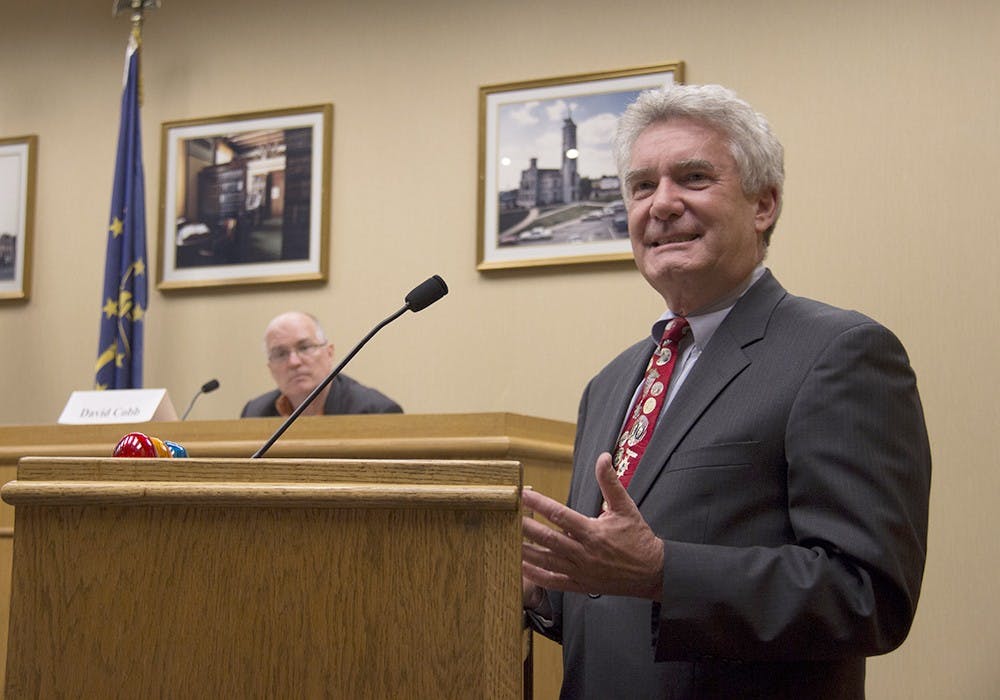
Bopp, a lawyer in the Citizens United case and IU alum , defended the Court’s decision.
“When we’re talking about corporations, we’re talking about a very convenient vehicle that allows people to organize, to work together,” Bopp said.
The Civil Leaders Center, Maurer School of Law American Constitution Society, the SPEA Law and Public Policy Program and Move to Amend South Central Indiana put on the event.
Former Fort Wayne mayor and SPEA professor Paul Helmke moderated the ?debate.
“The Citizens United decision has had a profound impact on how political campaigns are being financed,” he said.
This will be only the second or third election cycle since the decision, he said.
“It’s something I do think people should know what’s happening and why and figure out in their own minds what they think about it,” Helmke said.
Emma Wesslund is a junior majoring in theater and political science who attended the debate.
“I think campaign finance reform is a very important issue because it affects the discourse of our country,” she said. “Issues like this that can make people discouraged and feel like they don’t have influence can keep them from voting.”
Whether campaign contributions decided elections was a question asked by one of the panelists.
Cobb said that, according to studies, money matters.
“It is the single best predictor of who is going to win an election bar none,” he said.
Bopp rebutted that money doesn’t win elections, but votes do. And campaign contributions correlate to votes, he said.
“There’s a lot of forms of support, and an important one is money,” Bopp said.
Helmke said in his experience big money is what sometimes scares people out of politics.
“We need to figure out some way to deal with this issue,” he said. “It’s hard, maybe, to come up with a solution, but we want more people to get into politics, not less.”



