Edward Snowden is now out of reach of American prosecution, but the leaker’s actions continue to incite discussion from supporters and critics, including those at IU.
Students, faculty and community members discussed Edward Snowden and the National Security Agency’s surveillance program at the panel discussion “Can You Hear Me Now?” Friday evening.
Even as Snowden continued to leak new disclosures, the Russian government granted him asylum in early August to legally live in the country for as long as a year.
Secret documents provided by Edward Snowden in recent weeks confirm that the NSA has cracked most encryption and installed backdoors to facilitate surveillance, a disclosure that has raised additional security concerns.
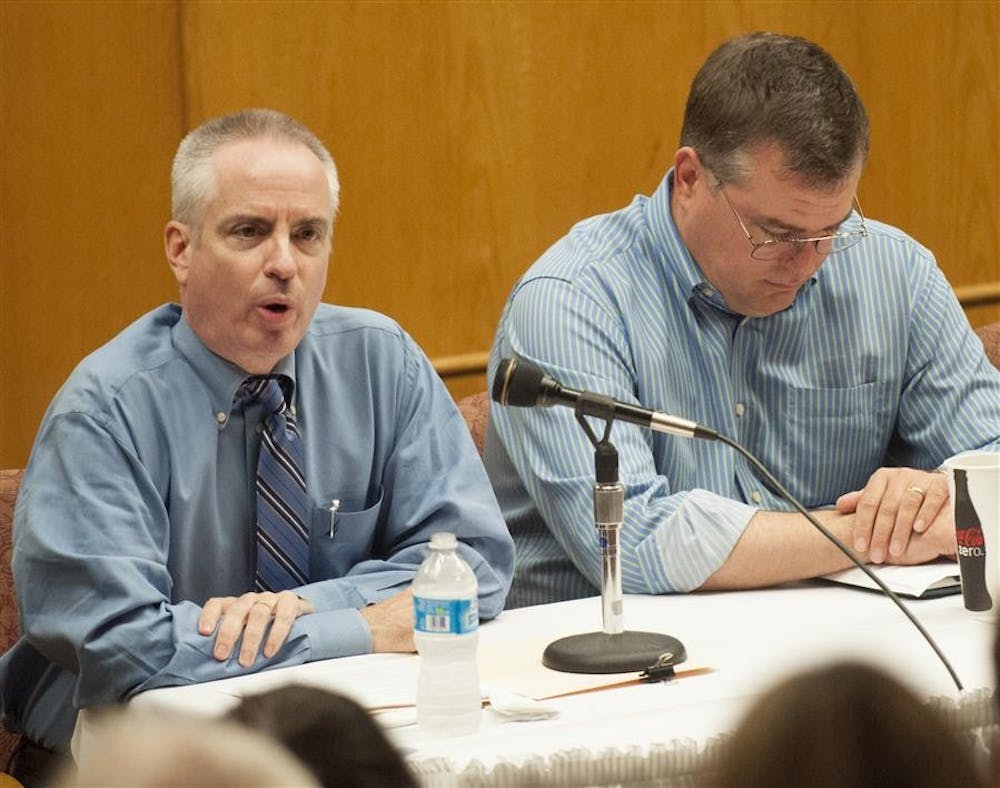
IU faculty experts and researchers shared differing perspectives on the topic at Friday’s discussion.
History professor Nick Cullather began the discussion by examining the history of the fight for a “balance” between civil liberties and security.
He referenced examples such as the separate but equal philosophy and “don’t ask, don’t tell” to assist his argument that the government’s attempts to afford people civil rights while ensuring government security is changing.
Cullather applied this historical view to the Snowden case by discussing security clearances and the battle between loyalty and suitability.
“Bad people can be legal,” Cullather said. “The country is divided by those who know but cannot say and those who can say but do not know.”
Law professor Fred Cate said the NSA’s anti-encryption efforts compromise American security, according to the release.
In August, Cate contributed to a brief to attack the constitutionality of the NSA’s actions.
At the panel, Cate discussed security law and the domestic effect Snowden has had on America.
Cate cited section 215 of the Patriot Act and said it “empowers secret orders.”
The section defines the FBI’s access to records and items to assist in investigations involving terrorism.
The act specifically details applicable records and items as “tangible things — ” “books, records, papers, documents and other items.”
Cate argued the act is vague regarding cyber and digital records and items.
“They can spy on everyone,” Cate said. “One might hope that sequestration has slowed that down.”
Cate also referenced the time the NSA’s director lied to Congress by saying the NSA was not spying on American citizens and that the FBI’s Internet was “going dark.”
“Either the FBI was not being truthful, or the NSA hadn’t told them about it,” Cate said. “Those are the choices ... Neither one is comfortable.”
Law professor David Fidler spoke third at the panel sponsored by the School of Global and International Studies’ Center on American Global Security, the School of Public and Environmental Affairs, Maurer School of Law and the Department of Political Science.
Fidler discussed four categories of disclosures — targets located outside of the United States, espionage, the U.S. cyber defensive and the encryption of digital data.
He applied these categories to the state of our foreign relations with countries after Snowden’s information release, specifically China and Germany.
“Our response was, ‘Everybody spies.’ That’s a nice piece of American exceptionalism,” Fidler said. “This is not a good development from the point of the U.S. dealing with other countries.”
Political science professor Bill Scheuerman was the fourth panelist and examined the case from the perspective of a political theorist, questioning whether or not Snowden is a criminal, adding that Snowden’s actions have been nonviolent.
“He has expressed a fundamental respect for the law,” Scheuerman said. “It’s the U.S. government who is making a mockery of the rule of law.”
Finally, former Rep. Lee Hamilton represented SPEA as he gave his perspective on the issue.
While he agreed with the other panelists regarding Congress’s lack of action, he did not hold the same sympathy for Snowden.
“The government believes that expensive surveillance is necessary to protecting government safety,” Hamilton said. “Those checks are solely within the Executive Branch. They say ‘trust us’ .. But the NSA is misleading the U.S. courts.”
Freshman Marshall Gardner, who attended Friday’s panel, said he came to the event “looking for a different opinion.”
“Most of what I knew I got from the Internet,” Gardner said. “I found that they were in agreement with most of what I had heard, which is a little bit scary. They didn’t think much was going to change.”
Hamilton said he did not have a positive view on the likelihood of progress for people like Cate, who are working to tear at what the NSA is doing.
“Once you give government power, government does not relinquish that power,” Hamilton said. “The polls show it. The American people do not seem to mind too much.”
Follow reporter Hannah Alani on Twitter @alohalanii.
Faculty experts discuss NSA surveillance program at panel
Get stories like this in your inbox
Subscribe