In 2012, Henryville, Ind. was struck by an EF-4 tornado causing extensive damage to the community and killing at least three people. It was on the ground for more than 50 miles, destroying Henryville Elementary School and Henryville Jr./Sr. High School.
Due in part to extensive training by first responders, such as the Emergency Management and Continuity team and others, the number of fatalities was far less than it could have been.
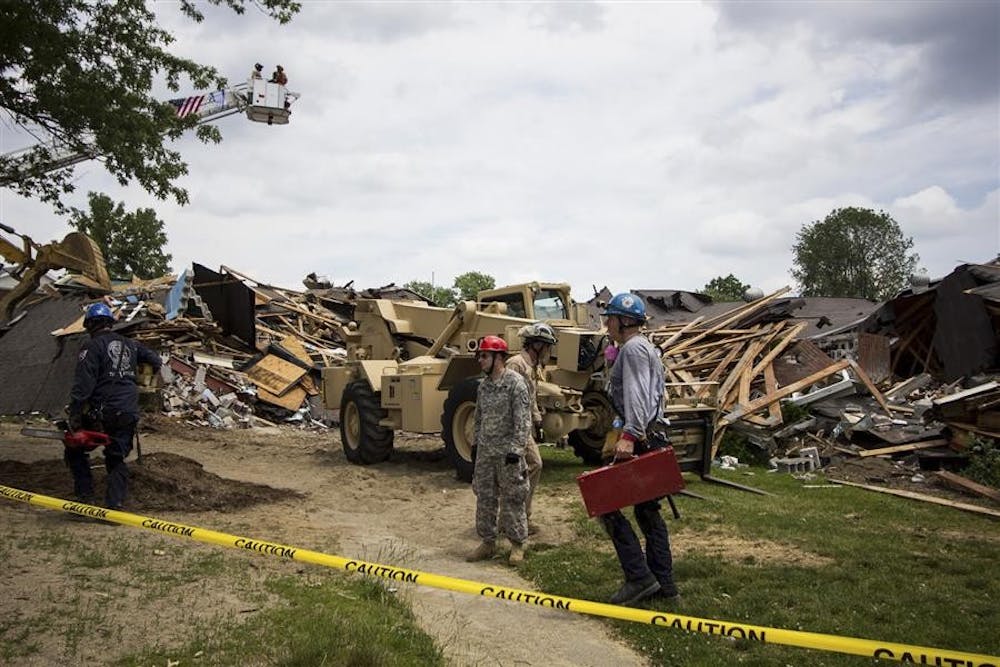
On June 12, the city of Bloomington welcomed 250 airmen and soldiers with the Indiana National Guard’s premier disaster response team along with an assortment of civilian and military disaster response teams to conduct search and extraction training called United Front II, similar to the one used by the Henryville tornado’s first responders.
“Every incident that we respond to, every exercise that we participate in makes us a better team and more capable to respond,” said Diane Mack, emergency management and continuity of IU director.
The exercise that was practiced on Wednesday revolved around an EF 5 tornado with 200 mph winds striking the IU campus. This scenario, which is similar to the one that struck Joplin, Mo. in May 2011, is highly relevant to Indiana as over 50 EF 5 level tornadoes have struck Indiana since 1950.
“We would hope and pray that something like this would never happen, but I think we all know as Americans that in our nation natural disasters are pretty prevalent,” said Major General R. Martin Umbarger, adjutant general for Indiana.
This tornado exercise was used for more than natural disaster purposes, it was also used to simulate war scenarios with the arrival of the the Israel Home Front Command National Search and Rescue Unit.
“The major U.S. threat is nature disaster, major Israel threat is war,” said Major General Eyal Eizenberg, commander of the Homeland Defense Force.
He said that the scenario of collapsed buildings and the need of first responders is a similar concept to that of the U.S.’ natural disasters.
“We have something to learn and something to teach,” he said.
The goal of the exercise is to share valuable search and extraction tactics, techniques and procedures among the different organizations including: National Guard Bureau, Indiana National Guard, Indiana Task Force One, Indiana State Police, Bloomington Fire Department, United States Marine Corps, Chemical Biological Incident Response Force and ZAK’A, an international humanitarian organization.
“In the Guard, we often times say we are always ready and always there, one of the ways we have to accomplish that though is realistic training and challenging exercises,” said Major General Gerald Ketchum, director of Domestic Operations and Force Development with the National Guard Bureau.
With the help of three Israeli engineers, the Indiana National Guard was able to prepare site preparation and staging at the defunct post office in downtown Bloomington, IU Wrubel Computing Center and Phi Kappa Psi fraternity house.
The training consisted of collapsing the buildings, stabilizing the collapsed structures, placing the mannequin, cutting steel, breaching and breaking walls and concrete, lifting and hauling rubble, marking hazards and retrieving “victims” or mannequins.
“The skills and knowledge that we have gained in that last 24 hours or even the last months as we have planned this would allow us to respond to this in a united front,” said Bloomington Fire Department, Chief Roger Kerr.
As crews used ladders that against the rubble to extract “victims,” individual skills came together collectively to train and learn as a solitary unit.
Thomas Morrison, vice president for capital planning and facilities for IU, said that the event was about learning and education.
“In the long run, this will benefit not only IU and the local community, but the state, the nation and certainly around the world.”
National Guard takes part in rescue drill
Get stories like this in your inbox
Subscribe