“I call architecture frozen music,” German playwright and poet Johann Wolfgang von Goethe once said.
If this is so, IU’s campus is a concert and limestone is the melody, IU vice president emeritus Terry Clapacs said.
Clapacs was one of the longest-serving vice presidents in IU’s history and supervised the development of over two-thirds of what is now IU.
Clapacs, who is working on an upcoming book, spoke at City Hall on Friday as part of the Rosemary Miller Lecture series. He titled his lecture “Limestone: The Tie That Binds.”
“It’s not only a tie that bonds buildings on campus, but a tie that bonds Monroe County and Bloomington and IU together,” Clapacs said.
The uniform look of IU is one of the reasons everyone likes the campus, Clapacs explained. There are two factors which create this consistency.
First, the landscaping, which is consistent throughout campus in its beauty.
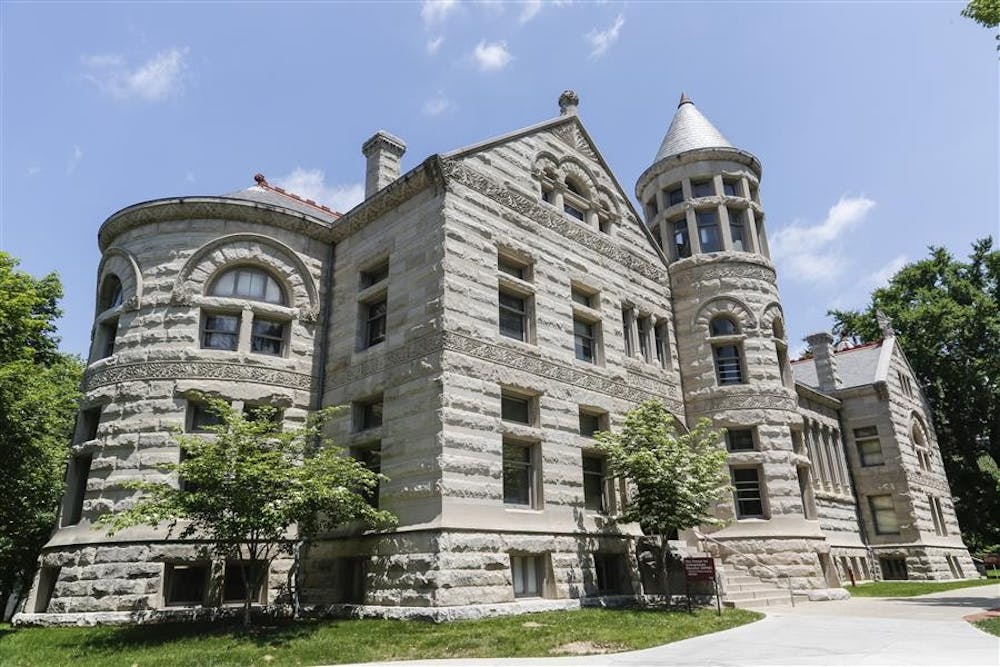
Second is the building vocabulary, Clapacs said. The majority of IU’s buildings around campus are limestone, and if they aren’t, limestone has influenced the design and appearance of the building.
Limestone is a sedimentary rock composed mainly of the minerals calcite and aragonite, which are different crystal forms of calcium carbonate.
There is an abundance of limestone in Monroe County because the area was largely unaffected by glaciers.
“For the most part, it was never glaciated, which was fortunate for us,” Clapacs said.
Part of Clapacs’s lecture also focused on the previous campus that held IU.
Serving as the IU campus for 60 years, the Seminary Square campus met its end in a fire. Science Hall, which housed the school’s library, was struck by lightning. People took this fire as a sign that campus was in the wrong place, Clapacs said. This area is now a park in Bloomington.
When the Board of Trustees had to decide whether to move the campus to Indianapolis or stay in Bloomington, Bloomington received the majority of the vote, and the trustees purchased 20 acres on which to rebuild the campus.
IU’s first limestone building, Maxwell Hall, was built in 1890. Clapacs said this building is his favorite. He is commissioning a painting of the building which will include his dog.
“I think the University got it right the first time out of the box,” Clapacs said.
An interesting detail that brings the previous campus into the current one is the Rose Well House.
The Rose Well House had originally been a part of the Science Building from the old campus, and was kept in storage for many years, Clapacs said. It was intended to be where the Sample Gates are today, but did not allow enough free flow of students. It now sits slightly away from the Sample Gates and Kirkwood Avenue.
Two buildings on campus are not quite as favorable to Clapacs as the rest.
Ballantine was described by President Herman B Wells as one of his three mistakes, Clapacs said.
“Ballantine is limestone, but completely out of style with the rest of campus,” Clapacs said.
The IU Art Museum also stands out to Clapacs.
“I’ll tell you what I think about the Art Museum,” Clapacs said. “I love the building itself. As it stands alone, it’s lovely in many ways.”
However, he said in conjunction with the other buildings around Showalter plaza, it does not fit so well.
“The Showalter Plaza centerpiece is the IU Auditorium, and the angle coming out of the art museum distracts the eye of someone coming into the circle,” Clapacs said.
These buildings do not take away from IU, however.
“The beauty of this campus is not something that’s new,” Clapacs said. “It’s a place that’s easy to love and it’s a lot of what we all have spent our lives trying to do.”
The life story of limestone
Retired administrator recounts histories of campus buildings
Get stories like this in your inbox
Subscribe