
Year after year, reports issue a startling truth. Turns out the U.S. isn’t great at science. Or math, either. Compared to other countries, we’re not doing so hot. Perhaps not even lukewarm.
Simply comparing our attitude toward school explains a lot.
Most Americans don’t treat primary and secondary schooling like a full-time job.
Homework doesn’t even become a serious concern until high school and even then can be avoided by the most skilled of attendees.
Sometimes tissue boxes are traded in for points, and playing Tetris on your calculator suffices for participation in math class.
Though some students do work hard, they are lauded as overachievers.
Cue East Asia, where a full day of school is followed by hours at cram school. Kids have to take exams to get into public high school, which prepares them for the examination hell they brave to get into college.
For many children in countries like China, South Korea and Japan, going to school is their job. Studying for hours upon hours is not overachieving, but expected.
School days are longer and they’re also filled with more facts.
East Asian students are expected to shut up and listen to the experts.
When I sat in on a friend’s international law class at Tokyo University of Foreign Studies, the professor talked nonstop for the entire hour.
No class participation was encouraged or expected. Why should he consult the students when his was the knowledge the class was thirsty for?
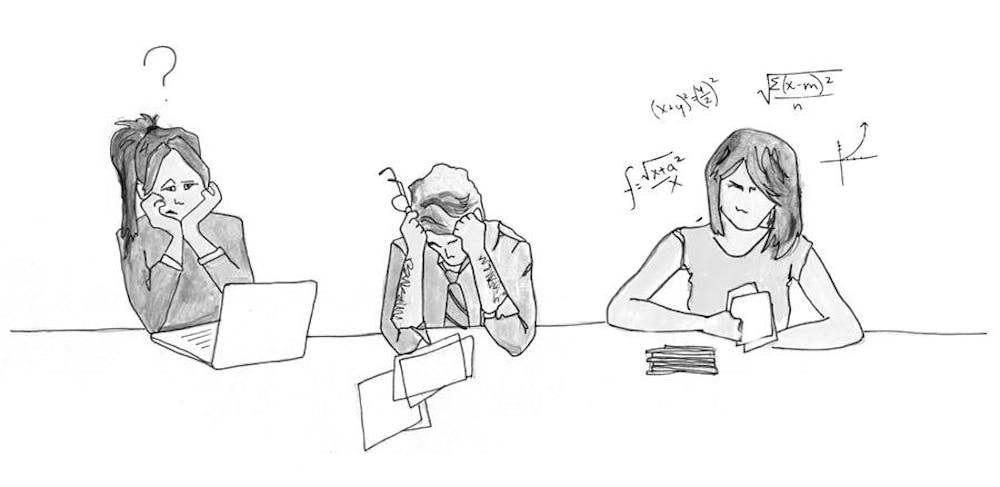
While East Asian schools overwhelmingly teach through memorization and straight lecture, schools in the U.S. miraculously ask what students think. American kids are expected to think critically, voice their own opinions and come up with creative solutions to problems.
It is clear that neither school system, Eastern or Western, is better than the other.
Both offer valuable skills, the former emphasizing work ethic and raw data, the latter fostering social skills and critical thinking.
While East Asian students continue to perform well on tests, Americans still lead the way when it comes to innovation, and the U.S. is still the biggest economy in the
world.
But students from East Asia are increasingly reaping the benefits of both systems, coming to the U.S. with a backlog of facts and a willingness to work hard, using our education system to learn the skills that are necessary to become a successful entrepreneur or business tycoon — not to mention the improved English that comes with living in a small town in the Midwest for a few years.
Meanwhile, China and Japan are the second- and third-largest world economies respectively, but U.S. students continue to ignore those countries in favor of places in Western Europe when deciding where to study abroad.
So next time you’re snickering behind an East Asian student’s back about their English skills, know that they’re gaining the skills they need to rule the world.
— casefarr@indiana.edu
The best of both educational worlds
Get stories like this in your inbox
Subscribe



