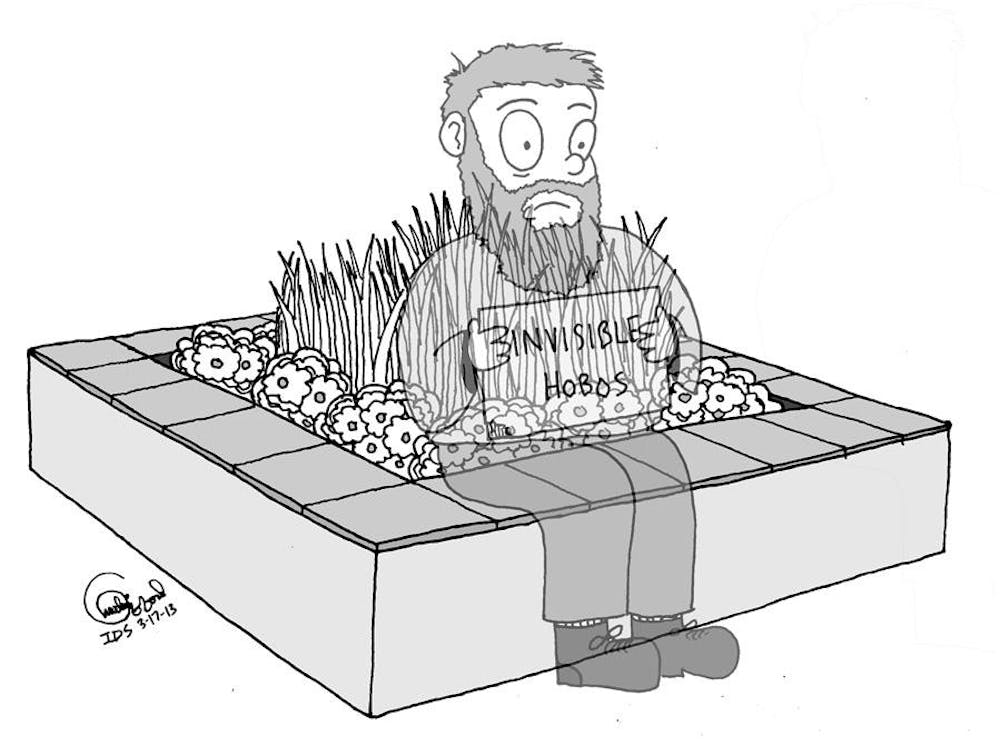
For his next trick, Indianapolis Mayor Greg Ballard will make his city’s panhandlers disappear.
Ballard plans to introduce an ordinance to the City-County Council this spring that would make any form of panhandling illegal in downtown Indianapolis. The measure would prohibit not only verbal requests for money but also passive solicitations from sign-holders.
Ballard’s proposed ordinance has drawn fire from the American Civil Liberties Union, which considers it a violation of First Amendment rights, and from concerned citizens who say it is nothing more than “trying to sweep a problem under the rug.”
We believe the ordinance is an unfortunate measure, poorly devised and perhaps just as distasteful as the behavior it seeks to eliminate. It hides and shifts a social problem while doing nothing to alleviate its causes.
While many panhandlers are probably scam artists, many are also probably homeless, suffering from addiction or mental disability.
Maybe you feel mugged when you give money to a panhandler. Maybe you feel guilty when you don’t. Panhandlers are unpleasant to look at, because they are a reminder of unpleasant socioeconomic realities.
Pro-ordinance leaders contend that panhandlers drive away business and harm the city’s economy.
Panhandlers are a feature of virtually every populous, prosperous city. Visitors to New York, Los Angeles, Chicago and Washington, D.C., are likely to see panhandlers on a regular basis.
Although panhandlers may be a nuisance and an eyesore, they have yet to cause the economies of these cities to collapse.
We have panhandlers in Bloomington, too. You often see them on Kirkwood Avenue. But their presence prevents very few of us
from going to Kilroy’s on Kirkwood, Which Wich or the Buskirk-Chumley Theater. They’re here, and we live with them.
Indianapolis already has an ordinance that bans aggressive panhandling, panhandling at night and near bus stops, ATMs, cars and other locations. The current ordinance stood up to an ACLU lawsuit in federal court because it was deemed to serve the public safety. Will an ordinance predicated almost exclusively on not offending business interests stand up to a similar challenge?
In addition to that question, Ballard will have to face up to others.
What will happen to panhandlers? Will they simply flock to other parts of Indianapolis? How will business owners in those neighborhoods feel? Will some panhandlers turn to less innocuous activities to support themselves? And if the ordinance passes, do we get to witness the absurdity of slapping beggars with tickets for city violations?
We understand that times are tough for Indianapolis businesses. The economic downturn has hit almost everyone.
But it has hit the poor particularly hard. Perhaps an increase in panhandling is a symptom of economic difficulties rather than a cause.
Indianapolis homelessness increased 5 percent last year, with a 34 percent increase among veterans. Meanwhile, Indiana cut its mental health budget by $4.3 million between 2009 and 2012.
Panhandlers are human beings, and if Ballard wants to impose a blanket ban on their disconcerting but generally harmless activities, he owes it to his city to come up with some ideas for diminishing the underlying pressures that encourage panhandling.
Mishandling panhandling
Get stories like this in your inbox
Subscribe