Ethnomusicology students showcased their research presentations Tuesday evening as part of the seventh annual Undergraduate Folklore and Ethnomusicology Symposium.
The symposium consisted of 11 presentations given by students in the senior capstone seminar, F497, taught by ethnomusicology professor Sue Tuohy.
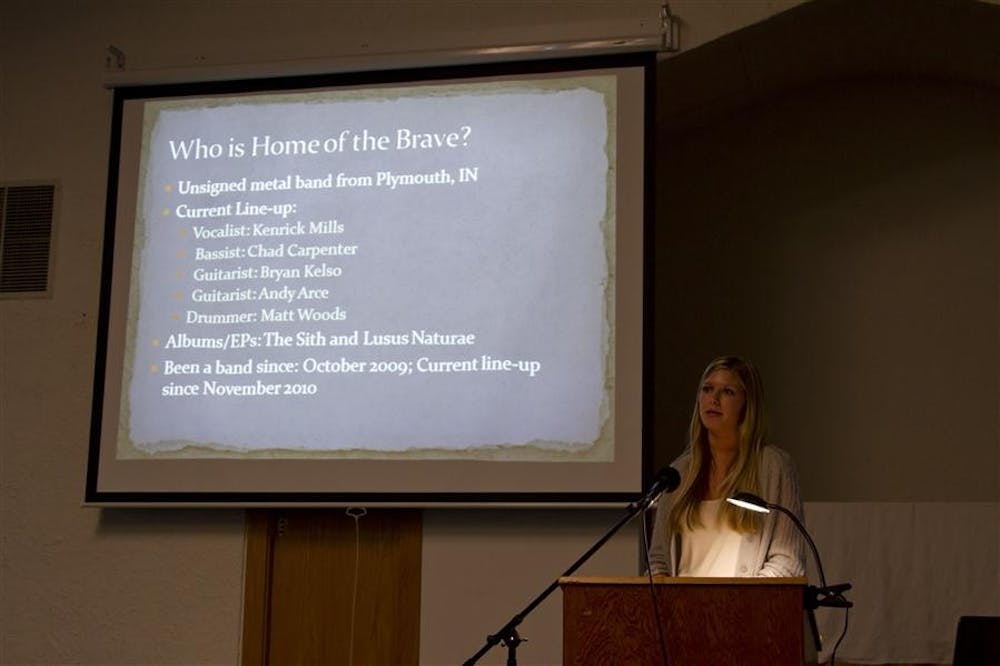
Senior Samantha Scheetz focused her presentation by following and interviewing Home of the Brave, a metal band from Plymouth, Ind.
“The vocalist asks everyone to throw their fists in the air and everyone obliged,” Scheetz said.
Scheetz said this suggests the aspect of community is present between the band and its fans.
“People are getting knocked down and everything,” Scheetz said. “The fact that people are willing to help them out and get them up and not let them lay suggests community.”
Scheetz said people generally attend Home of the Brave concerts because they are attracted to the sound.
“There are always those people traveling with them,” Scheetz said. “When you go to shows you’ll generally see the same faces you see at other shows.”
Senior Perry McAninch focused an ethnographic study on participants of the southern Indiana extreme metal scene.
“The Indiana scene is composed of smaller local scenes composed of Bloomington and Indianapolis which are often tighter-knit,” McAninch said.
McAninch said the scene is not huge and the level of female participants in heavy metal activities is generally low.
“I tried to gain an understanding of both structure of the southern Indiana mental scene and the experience members share that unites the scene,” McAninch said.
Senior Jon Stombaugh, a bassist and pianist, focused on the concept of music universals and history of theories.
He said music is one of the perks of being human.
“The universal language phenomenon, according to some, was converted to the distinction of music among many cultures,” Stombaugh said.
Stombaugh said there was no record for a society existing without some form of music.
“As far as we know, music has been with us since the beginning,” Stombaugh said.
Senior Steven Watkins showed how music can be incorporated into technologies used in video games.
Watkins said Pong, a video game released by Atari in 1972, established the idea of using sound in video games.
“Though there was little sound in the game Pong itself, it established the idea of using sound in video games to create a more realistic atmosphere,” Watkins said.
Watkins said Rally-X, one of the first video games to use full background music, caused an annoyance by constantly looping music.
“What the game Frogger did was the composer would make 30 second bits to go around the looping issue,” Watkins said.
Watkins said programmable sound generators, which allowed for a variety of complex sounds, were installed in most arcade games.
Nintendo used a custom-made sound chip based off the PSG.
“The interesting part of the sound chip for the Nintendo Entertainment System was most sound programmers for early consoles were not composers,” Watkins said. “This gave NES the upper-hand.”
Folklore students share music research
Get stories like this in your inbox
Subscribe