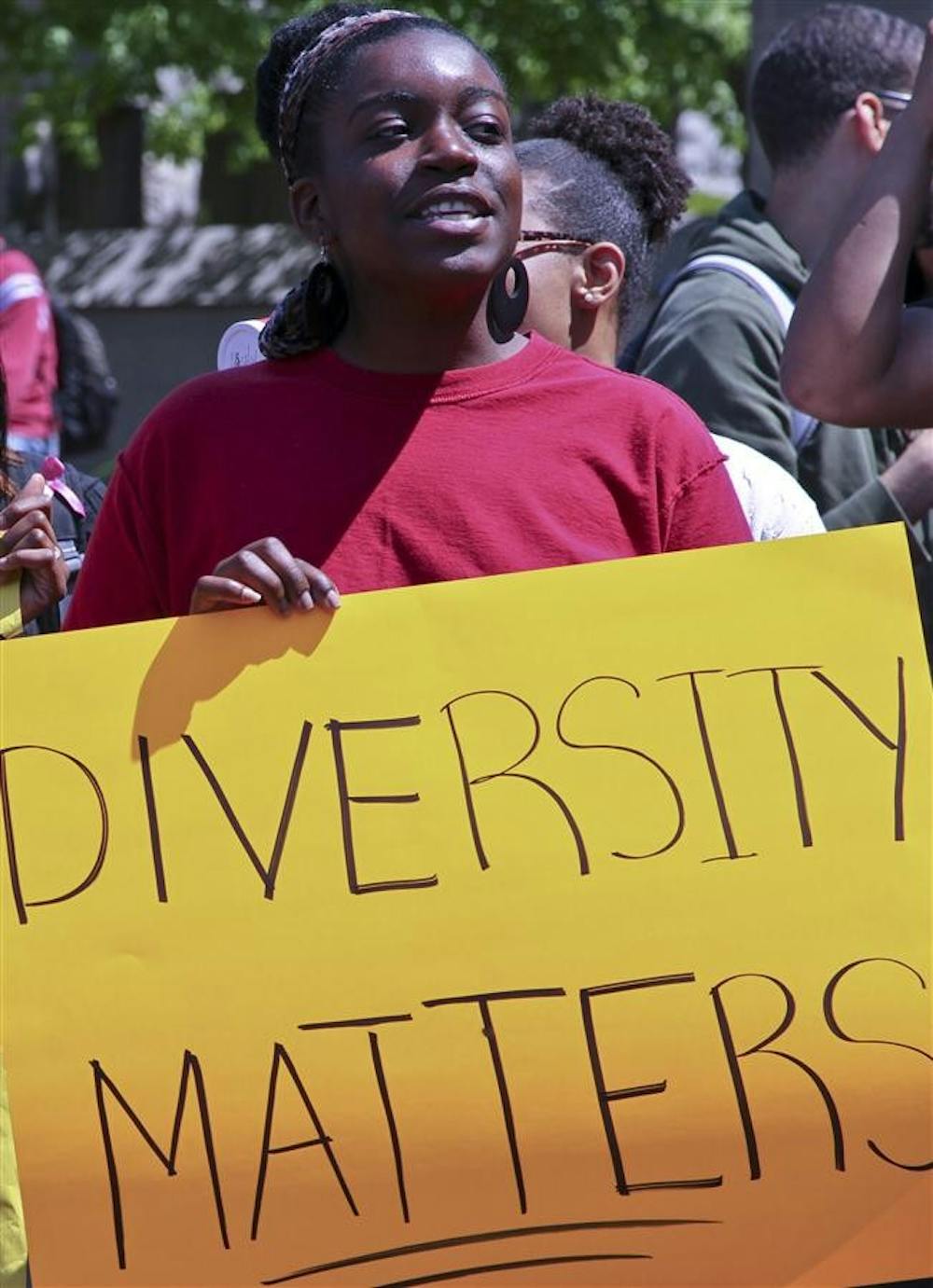
A group of concerned students met at noon in front of the Sample Gates to raise their voices in unison against what they believe is a lack of University-level support for diversity on campus.
Some students wore IU T-shirts turned inside out, symbolizing their frustration.
“We will not represent them if they will not represent us,” senior Traneisha English, who helped plan the event, said.
English and the group of mostly black students, which grew from just a few at noon to more than 50 by 2 p.m., chanted “IU, fulfill your promise” and “What do we want? Diversity. When do we want it? Now.”
That “promise” refers to a May 2006 IU Board of Trustees endorsement of a comprehensive strategy to double the enrollment of underrepresented minority students on the IU-Bloomington campus by the 2013-14 school year.
Following that announcement, the campus introduced both the 21st Century Scholarship Covenant and the Pell Initiative, both of which have potential to positively affect minority recruitment.
Similarly, the Hudson and Holland Scholars Program, a main vehicle for the recruitment, retention and graduation of high achieving minorities, would act on plans for expansion, according to the 2007 Enhancing Minority Attainment work plan. The work plan listed goals, objectives and implementation models for achieving increased campus diversity.
In June 2007, outgoing IU President Adam Herbert and then-President-elect Michael McRobbie jointly made a statement showing their commitment to diversity at IU.
“The time has come to extend the goal of increasing the enrollment of under-represented minorities at the Bloomington campus to all campuses of Indiana University,” Herbert and McRobbie wrote in the statement.
Since then, students noted the recent struggles of both Hudson and Holland and the Groups program, which helps recruit first-generation college, low-income Indiana residents who show academic promise. These troubles have, in part, been brought on by a tough economic climate, said Vice President of Diversity, Equity and Multicultural Affairs Edwin Marshall.
“I need to figure out how we can go on with as many resources as possible to make things happen that need to happen,” Marshall said.
He went on to say he thinks there is more that can be done, and that he’s currently having conversations with campus leaders with the aim of having solutions ready by the fall.
In the meantime, students decided to voice their discontent in an attempt to expedite the process and ensure that action is taken.
Two main ideas emerged from Wednesday’s rally.
These students said they feel the campus is not diverse enough due to a lack of prioritization on the part of the University, as seen through the yet-unfulfilled realization of the 2006 IU Board of Trustees goal. While the end date for the goal is the 2013-14 school year, students noted that the percentage of black students on campus has remained around 4 percent since the initiative was announced in 2006.
Secondly, the students feel the current support structures for existing minority students have weakened, and they seek personnel and resource cuts to be restored.
They distributed a list of six demands: establish accountability in efforts to hire diverse staff and recruit diverse students; double the numbers of historically underrepresented staff and professors; see evidence and transparency of IU’s efforts to fulfill the 2006 Board of Trustees declaration; expand and promote primary vehicles for attracting and retaining high achieving underrepresented students; see incorporation of diversity efforts into the academic environment; establish a permanent task force, involving students, to make sure the first five goals are met.
As campus buses unloaded at the Sample Gates stop, some students joined the gathering. Other passers-by stopped to ask the students what the protest was all about.
Steve Veldkamp, assistant dean of students and director of Student Life and Learning, greeted the students early in their rally, passing out small blue sheets detailing their rights as students to protest.
He said his office’s role is to provide students with necessary information and facilitate discussion, not to take sides.
“Especially for a liberal arts-based institution like IU, it’s essential for students to engage in conversations,” Veldkamp said.
Veldkamp said he’s noted a recent upswing in students vocalizing their concerns about the University. He referenced the recent two-day open forum called by Dean of Students Harold “Pete” Goldsmith and Interim Provost and Executive Vice President Lauren Robel, citing Robel’s comments that these times of financial instability are a likely contributing factor to students’ financial unrest.
“The University is being put in a position to figure out how they’re going to maintain those or potentially enhance them on their own dime when state appropriations are shrinking,” Veldkamp said of the current financial situation. “Where can you find the money? It’s a tough spot that everyone is being put in — students, administrators, faculty.”
And while students say the administration has paid more attention to the situation in recent weeks, they feel there is much more to be done.
Sophomore Brandon Washington, a Hudson and Holland Scholar, Groups member and 21st Century Scholar, attended the rally and helped hold up a sign that read “Fulfill the 2006 promise.”
“We really want the effort in really increasing the diversity here,” Washington said. “We don’t want, just like, the administration on paper to say that we’re increasing the diversity by counting the international students. We want domestic diversity to increase.”
Later in the rally, Robel met with some of the students, expressing her desire to hear the students’ concerns and work toward making change.
“She was very receptive,” English said. “She let us know it was a priority to her.”
And while she had heard similar messages before from Marshall, English added that she left her discussion with Robel optimistic, saying that it seemed like the students’ messages were at the very least being considered.