Taped high above the still-foggy window are blue construction paper letters. They spell out, “It’s fun to do the impossible.”
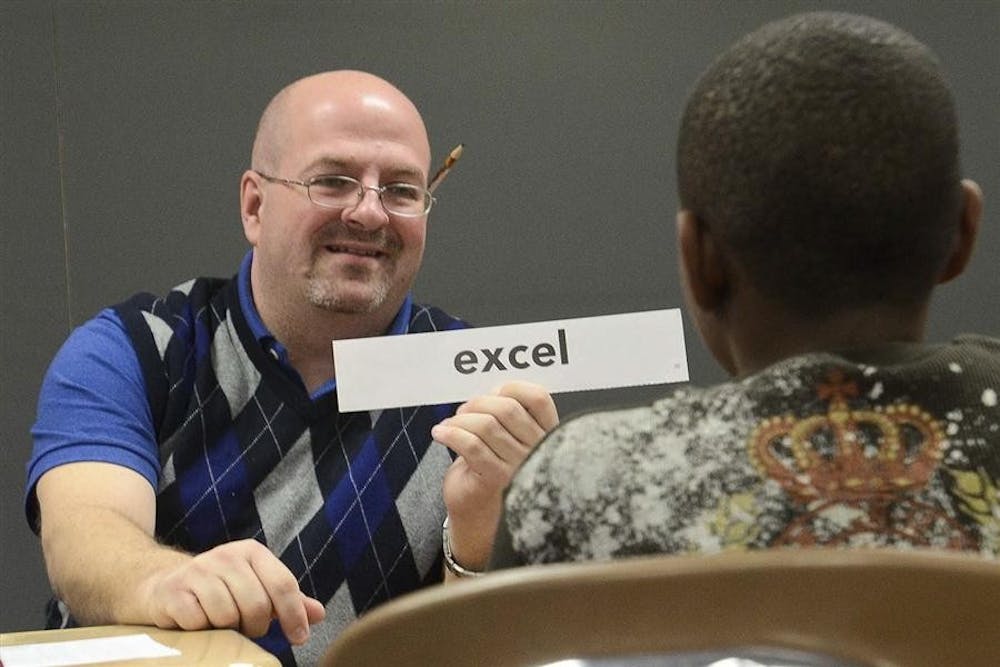
Below, Kraig Bushey — Mr. Bushey to his students — shakes up a can of Barbasol shaving cream and squirts it on the table in front of Jaymon. He pushes up his sleeves before using both hands to spread the shaving cream slowly and thoroughly on the smooth tabletop.
“Let’s start with ‘sheep,’” Bushey says, looking through glasses that have slid midway down his nose.
Eight-year-old Jaymon pauses for a moment.
In August, Jaymon had no idea how to spell “sheep.” Though he had technically started the second grade, he still struggled with remembering the whole alphabet.
Now, however, he can put his pointer finger into the white foam and trace “S-H-E-E-P.”
Jaymon is just one of 15 boys in Bushey’s self-contained classroom at Clear Creek Elementary School.
Students identified with special needs from all across the Monroe County Community School Corporation can be placed in this room.
As a second- through sixth-grade special education room, it’s one of only four in the district. Together, Bushey and his two assistant teachers, Anne Hyde and Stephanie Dalphin, work with students who can have any variation of disabilities: emotional disorders, ADHD, autism and cognitive disabilities are a few.
“These are supposed to be the most challenging kids in the corporation. They’ve tried every environment they can,” Bushey says. “This is kind of their last stop.”
***
Bushey flips on the lights to room A-140 at 7:48 a.m., a late start for him.
He’s usually at school by 7:30 a.m., an hour before the first bell rings.
But today, there’s a two-hour delay because of an early morning fog blanketing the school’s surrounding, windy roads.
Either way, he’s already been up for three hours. Every day, his alarm goes off at 4:30 a.m., though he says he never gets out of bed before 4:45 a.m. He’s training for the Cincinnati Flying Pig Marathon in May, so every morning, he heads to the local YMCA, where he ties his blue sneakers and starts running.
And thinking.
“These guys are my top priority,” Bushey says. “In the shower, when I’m running, I’m always thinking, ‘How can I help Logan today? Jaymon today?’”
According to the National Center for Education Statistics, 38.7 percent of students who have disabilities identified under the Disabilities Education Act do not graduate from high school.
It’s Bushey’s job to break that cycle, because he knows exactly where these kids are heading if he doesn’t. His fiancée, Trish Huffman, is a deputy prosecutor for Monroe County.
“There’s such an intersection between our two lines of work, unfortunately,” she says.
While she works with the behavioral problems of the adult population, Mr. Bushey says he works with the youth population who often fall in the same boat. Many times since they met in 2008, Trish has represented the parents of children in his classes.
“We’re trying to break that cycle,” he says. “With some kids, I don’t know if they’ll ever break out, they’re so deep in.”
For Jaymon, that cycle is starting to slowly unwind. With each new word he learns to read or spell, he is building the confidence he needs to succeed.
Sometimes, if Jaymon misses a day of school, he’ll call Bushey to read to him over the phone.
The first time he called was in late September, when he called to say he could actually read the word “Stop” on a stop sign. But he wasn’t always so open.
“Until he thought he could do it, he wasn’t going to try,” Bushey says. “One day we were working, he said, ‘I’m not stupid.’ It was sad and exciting at the same time.”
Jaymon has a moderate cognitive disability, which means he’s not expected to progress at a cognitive level typical for someone his age.
His behavioral difficulties hampered his ability to stay and pass in a regular classroom, Bushey says.
So Jaymon moved to the self-contained classroom at the beginning of the year. Early on, he would shut down when he was given an assignment.
“He’d crawl underneath his desk or put his head down,” Bushey says. “Like a turtle does when he’s scared.”
But he has found throughout the past few months that celebrating even Jaymon’s small accomplishments, like spelling the word “sheep,” can bring him out of that shell.
“When he does it, you get the biggest smile,” Bushey says. “He just giggles, almost, when he’s done.”
Whether he claps and does a silly dance for a student or lets him read to another student or someone in the main office, Bushey will do whatever it takes to offer encouragement.
“We try to build their confidence,” Bushey says. “Most of them have never been given the opportunity to succeed.”
***
Either Bushey or one of the assistant teachers always meets the students at the bus each morning to gauge what kind of day they’re having.
“A lot of times, they’ll bring baggage with them from home, so we have no reason why they’re mad or why they’re ready to punch somebody or why they’re upset,” Bushey says.
It’s not uncommon for a student to yell out “I hate you!” or hit one of the teachers or another student. Within one seven-hour day there is laughter, tears, shouting and smiles — and sometimes more shouting. But Bushey says he tries to not take it personally.
“For some, their life is a constant uproar,” he says. “This room is a place to call their own.”
If matters really get out of hand, he says he’ll walk away from the situation to grab a pencil from his desk so he can take a breath and regain his thoughts before choosing a course of action.
“They all need strong males. Most of them generally don’t have a guy around,” Dalphin says. “So they look to him.”
Bushey didn’t have it easy as a kid, either.
Growing up in a lower-income family in Vincennes, Ind., where both his parents worked, he remembers standing in line to get milk and cheese when his dad found himself out of work between two factory jobs.
He said he remembers his parents and two brothers having dinner together as a family and his dad not eating.
“I realize now that it wasn’t because he wasn’t hungry,” Bushey says. “It was because he wanted to make sure we all had enough to
eat first.”
The struggles he endured as a child help him to empathize with his students now.
“I always wanted people to be nice to me, and I just want these kids to be treated the same way,” Bushey says.
***
Seven mouths are hanging open, facing a giant bird-eating spider projected onto the screen at the front of the room.
Bushey is in the middle of showing everyone his favorite pet.
“Does this spider live in Indiana?” he says.
“Nooo!” the whole class calls back in unison.
When Bushey asks a question, students’ hands shoot into the air. One student, 7-year-old Lamar, sits on the edge of his chair, his toes just barely grazing the brown carpet. When he hears a question, his arm shoots into the air as he wiggles his hand at the wrist, silently begging for Bushey to call on him.
Other hands are doing the same wiggly, wriggly motion.
Despite whatever their labeled disability is, these kids are still at the age during which they think their teacher knows everything, that they can do no wrong.
And for a group of boys, it’s pretty hard to deny how cool a giant, hairy spider that eats small mammals and birds is.
Depending on the lesson, sometimes Bushey will stand in front of the class and teach like a typical elementary school room, while other times Bushey, Hyde and Dalphin will break the class into groups and work with them in smaller settings.
Today, everyone is revising the paragraphs they wrote about their favorite pets.
Lamar is working on his. His paragraph reads:
“My pet is Honey and The color is black and withe and dog. I got it from the pet shop. And my mom took me to the pet shop to git the dog and we git the dog food and a bed.”
Whether it’s making a student laugh to inspire him to get his work done or including him in his proposal to Huffman — he videotaped everyone in class singing The Muppets’ song “Rainbow Connection” — improving the lives of his students is his passion and goal above all else.
At the end of the song, everyone held up a sign that said, “Trish, will you marry me?”
“The day I dread getting up and coming to school will be the day I leave education,” Bushey says.
Special education teacher helps students in, out of the classroom
Get stories like this in your inbox
Subscribe