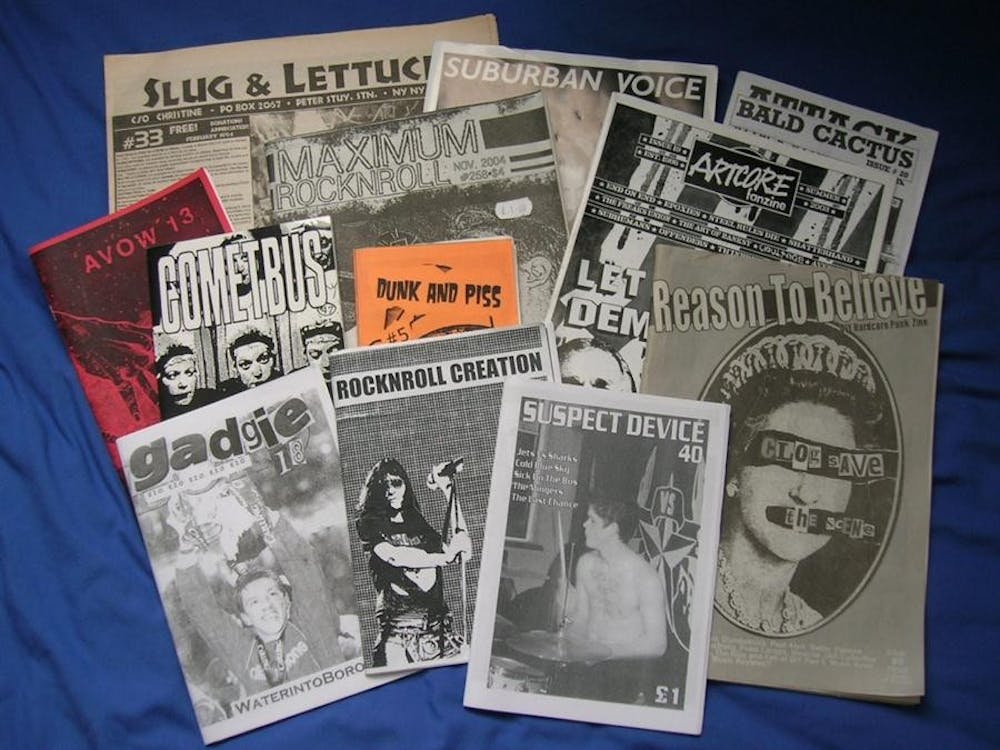
The cover of the inaugural issue of Tolivar is grainy, with its black ink roughly cast against an off-white card stock background. The photograph is an indecipherable puzzle, and the text is impossible to read without squinting. The only thing that’s perfectly clear on the whole front cover is the word “FREE,” printed starkly above the fanzine’s title. This is all by design.
“I’ve always liked the way gritty, distorted black and white pictures looked,” Tolivar publisher and Flannelgraph Records owner Jared Cheek said. “It seems a lot easier to trust something made out of love than something slick and mostly driven by money.”
Such grassroots sentiments are normal to hear in defense of the fanzine. It is a medium so indelibly intertwined with lo-fi DIY aesthetics that subtle attacks on industry machinery are inherent in any discussion of the product.
Fanzines’ publishers — as the name suggests, fans — are generally less equipped to incur the costs of publication than the commercial magazine press.
Still, to say that economic necessity leads to the ramshackle look of many fanzines is to miss the point entirely.
It’s an aesthetic choice, and one that leads to the synthesis of crudely drawn comics, hand-written record reviews and cut-and-pasted Xeroxes of interviews into something much more beautiful than the sum of its haphazard parts.
Tolivar executes this formula perfectly. Named for a 1968 Roger Miller song, the first issue of the Bloomington-based publication features an interview with “The Best Show” host Tom Scharpling, a Gilmore Girls-themed comic strip, republications of old personal ads, Facebook conversations between Flannelgraph artists, a photocopy of a Rik Smits basketball card and much more.
The Scharpling interview was Cheek’s impetus to set the project’s wheels in motion, but the ancillary features are perhaps even more fascinating.
“I was trying to think of fun ways to promote the record label I run, and I liked the idea of putting together a little handmade zine, so it had been in the back of my mind as something I’d like to do sometime,” Cheek said, though the inside cover of the first issue insists that Tolivar will be “more than just crummy commercials.”
In the ‘80s and early ’90s heyday of fanzines, they were primarily a place to cover what the mainstream magazines wouldn’t touch.
This made fanzine culture inextricably linked with the hardcore punk, extreme metal and science fiction film fan cultures.
Today, when fan journalism has mostly moved to the Internet in the form of blogs, Twitter and even sleek PDF fanzines, traditional ink-and-paper fanzines don’t need such gruesome niches, though having a very specific audience certainly helps.
The shelves at Boxcar Books and Landlocked Music are full of fanzines that run the gamut from pseudo-absurdist works of graphic fiction to ostensible music tomes that dip into a dozen other areas, like Tolivar.
Despite an increasingly Web-driven media world where even old guard print publications have a strong online presence, it seems as though there will always be a fiercely independent contingent of individualists who believe in the power of the cheaply printed page.
The open-ended nature of fanzines makes it difficult to pin down any one definition for the word, but Cheek has a pretty good one.
“I think it’s something that someone publishes in order to let people know about something that they care about, whether most people care about it yet or not,” he said.
Ultimately, that’s the drive behind the production of any fanzine. If the audience for some band, film or comic strip grows from 50 people to 100, then the fanzine has done its job.
The resilient fanzine
Get stories like this in your inbox
Subscribe