Newt Gingrich slammed Ron Paul for what Gingrich claims is Paul’s “systemic avoidance of reality,” in a CNN interview with Wolf Blitzer.
While Gingrich touched on many of Paul’s views during the interview, he reserved special admonition for the representative’s foreign policy positions.
He particularly criticized those regarding Iran, which he claimed “are totally outside the mainstream of virtually every decent American.”
The former speaker said Paul’s views are dangerous for America because they suggest America had a role to play in the rise of radical Islam in the Middle East.
For Gingrich, and most Republicans for that matter, anything short of “they hate us for our freedom” is “America-blaming” and unfit for the public narrative regarding American foreign policy.
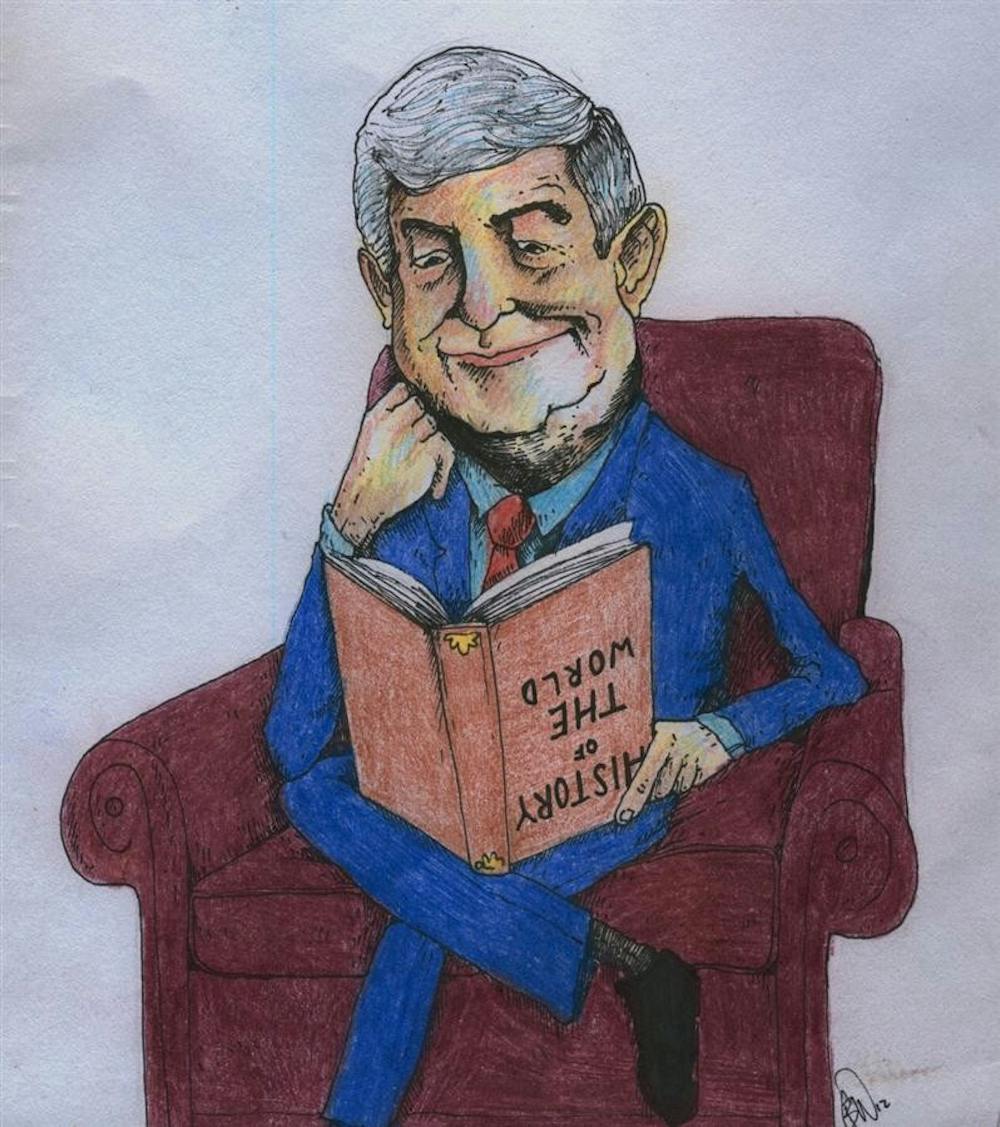
For a man who has a Ph.D. in history, you’d think Gingrich would know better than to supply such a simplistic rationale for the rise of radical Islamic regimes in the Middle East, but alas, he does not.
So, in lieu of a nuanced, contextual understanding of American foreign policy from the speaker, I’ll provide a history.
In 1953, at the request of the British Secret Intelligence Service, the American CIA carried out a coup d’état to remove from power the democratically elected Prime Minister of Iran, Mohammad Mosaddegh.
The British government was unhappy with Mosaddegh because he sought to nationalize the Iranian oil supply that, since 1913, had been under British control.
As a replacement for Mosaddegh, the United States and Great Britain installed an authoritarian military government overseen by Reza Shah Pahlavi.
The Shah ruled with an iron fist for 26 years until 1979 when the Iranian people overthrew him and installed the vehemently anti-western Islamic Republic of Iran, which rules Iran today.
In response to growing anti-western sentiment in Iran resulting from the Shah’s 26-year dictatorship, the U.S. looked to Saddam Hussein in neighboring Iraq to help limit Iranian influence.
To the CIA and the British, Hussein was an asset, “a presentable young man,” and, most importantly, anti-Iranian.
It wasn’t long before Iran and Iraq were at war.
And to bolster Iraq’s efforts, President Ronald Reagan sent a special envoy to the Middle East, Donald Rumsfeld, to offer Iraq weapons and intelligence.
Meanwhile, in Afghanistan, the U.S. was fighting an additional covert war, this time on the side of the Mujahideen against the Soviet Union.
The Mujahideen were eventually successful in their efforts because the U.S. was able to supply them with FIM-92 Stinger missiles that hampered Soviet movements long enough for them to outlast the Soviet’s economic means.
As was the case with Iraq and Iran, the Mujahideen would not remain American allies forever.
Today, some Mujahideen still exist in the form of al Qaeda and the Taliban.
You see, part of the U.S. effort to defeat the Soviets in Afghanistan also consisted of radicalizing the Afghan people.
To do this, the U.S. set up schools teaching radical Islam with the help of four million books printed in the U.S.
These books spoke of jihad and, according to the Washington Post, taught students “to count with illustrations showing tanks, missiles and land mines.”
From this radicalization effort, we got terrorist groups bent on jihad against the West.
The CIA calls such unintended consequences of foreign operations, “blowback."
This history is critical to understanding the context of our current foreign policy, which extends much further than what has happened in Iran, Iraq and Afghanistan during the past 50 years, which space prevents me from discussing.
The anti-western Muslims in the Middle East don’t hate America because we’re free and prosperous.
Rather, as former CIA bin Laden unit chief, Michael Scheuer, and Osama bin Laden himself pointed out, the reactions we get from radical Islamists in the Middle East today in the form of terrorist attacks and anti-western sentiment spawn directly from years of U.S. involvement in the region.
How would we feel if the Chinese were as involved in North America as we are in the Middle East, going even so far as to overthrow some of our democratically-elected governments?
Before Republicans and Newt Gingrich condemn Ron Paul and any American who agrees with him as indecent for their hesitancy to go to war with Iran, I suggest they sit back and look at the history of our involvement in the Middle East and ask themselves if another war in the region is a good idea.
One look should suggest the answer is pretty obvious.
— nperrino@indiana.edu
Newt’s simpleton foreign policy
Get stories like this in your inbox
Subscribe