
You hear them loud, and you hear them often. Whether they are protesting the company’s circumvention of state sales tax laws or its use of mobile applications to undercut competitor prices, the Amazon haters cannot be silenced.
I feel a special connection to Amazon. Ever since I began to enjoy reading in high school, Amazon has been my go-to place to find almost any book I’m interested in, regardless of whether it’s still in print.
That’s why, when the Amazon haters began jumping on the company for what they are calling the destruction of independent bookstores, I felt compelled to defend them.
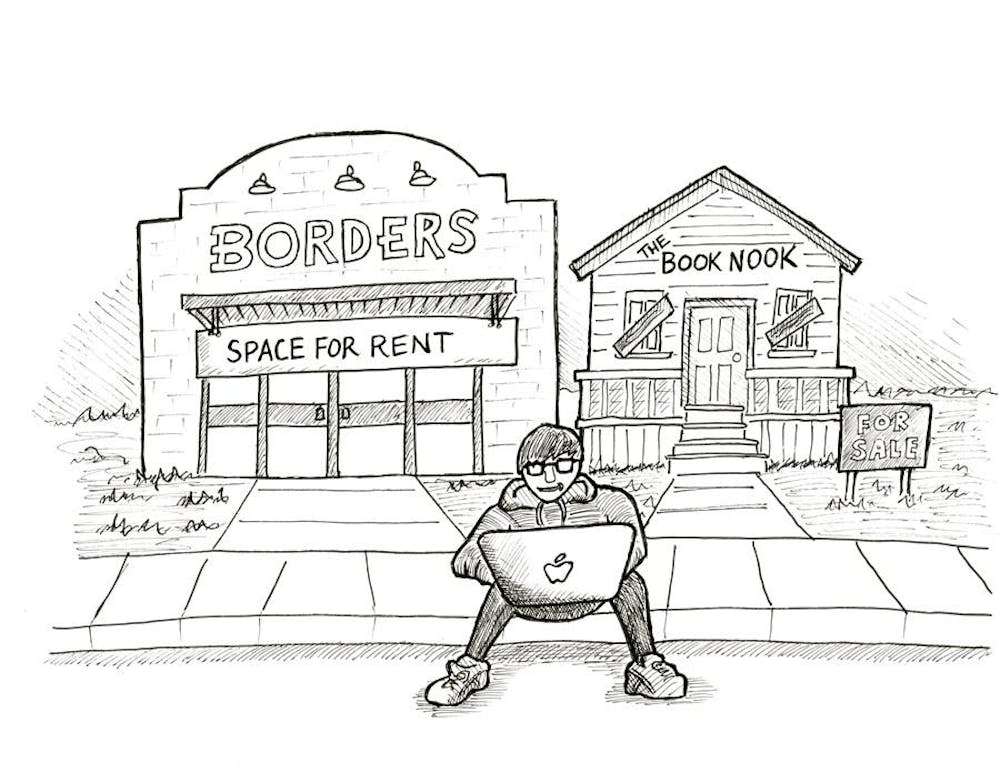
There’s no doubt that independent brick-and-mortar bookstores are dying. Even the large corporate ones are struggling. Borders went out of business last year and Barnes & Noble is now talking about separating their e-book and physical book businesses into two separate entities. But while many see them as the last guardians of local literary culture, I see them as the antiquated vestiges of our paper-saturated past.
Amazon is not killing independent bookstores, our digital modernity is. And while there are certainly some negative consequences of this, Amazon is not one of them.
I think of independent, brick-and-mortar bookstores much in the same way I think of typewriter sellers right as computers were becoming popular: Yes, I feel bad that those people are losing their jobs, but is society really worse off now that we have computers?
Amazon makes reading cheaper and easier. I feel safe in saying that were it not for Amazon, I wouldn’t read nearly as much. The process of driving to a bookstore, which I haven’t always been able to do because I haven’t always had a car, in and of itself is a deterrent.
On top of that, the additional cost one incurs when purchasing books from a brick-and-mortar store (sometimes double what you pay on Amazon) makes buying books expensive and inefficient.
But aside from the inefficiencies and frustrations that Amazon helps book buyers avoid, it also contributes to the greater diffusion of knowledge.
Before the digital revolution, publishers had to go through the brick-and-mortar bookstores to get their books into the marketplace. Bookstores, however, only had finite shelf space.
That meant that only those books that were more popular — which tended to be those put out by the large publishing houses — got on the shelves, while the other lesser-known titles and publishers were left out to dry.
With Amazon, there is no finite shelf space. That means almost any publisher can sell its books on Amazon, large or small, respected or not respected.
Even authors who don’t have publishers but publish independently have the ability to sell their works on Amazon.
This means that the marketplace for books has become richer, and the opportunity for the books to reach the masses has become greater.
Let’s not forget that Amazon also led the way in the e-book revolution with its release of the Kindle in 2007.
While the device may contribute to the death of bookstores, it certainly contributes to the life of many trees and to the intellectual development of many people.
Anyone who owns an e-reader, Kindle or otherwise, knows that for some reason they help readers read faster, which means more books are read, which means more knowledge.
There are some people who just like the atmosphere bookstores provide and care not for their costs and inefficiencies. These are the people who will always reject the Amazons of the world.
And I can empathize with them. I, too, like to periodically peruse through interesting bookstores to see what treasures I can find — but these stores aren’t going anywhere.
There will always be those niche bookstores that exist to cater to bookstore-lovers’ needs. For the rest of us who, for the most part, don’t care and just want to get our books in the most efficient and cost-effective manner, there will be Amazon.
— nperrino@indiana.edu
In defense of Amazon
Get stories like this in your inbox
Subscribe



