All opinions, columns and letters reflect the views of the individual writer and not necessarily those of the IDS or its staffers.
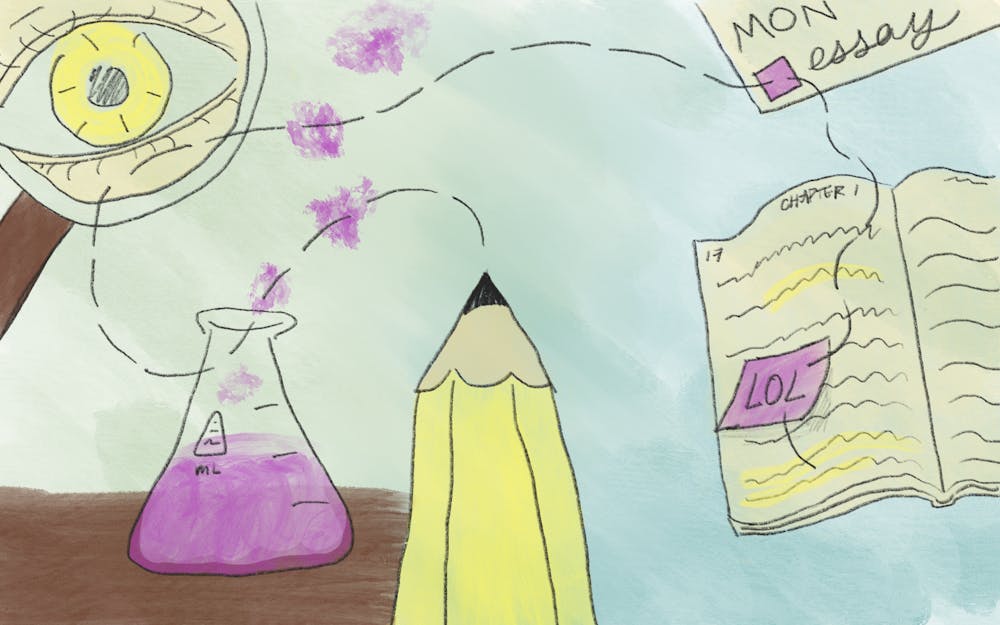
Whether your New Year’s resolution was to lock in this semester, you’re taking an intensive-writing course or you just want to better your ability to create new meaning from different ideas, this English major has you covered with one simple trick to write a strong essay: follow the scientific method.
Scientists developed the method during the Scientific Revolution, an era spanning from 1500 to 1600 when empirical data and abstract reasoning overtook common sense and a quantitative view of nature overtook a qualitative one.
These sentiments then blossomed in the Enlightenment period from 1600 to 1700. To truly understand the world around us, scientists thought we must pose questions of “how,” instead of “why,” scrupulously test these questions and formulate our findings into publicly available discoveries, theories and laws.
Science Buddies, a nonprofit educational organization, defines the scientific method as “a process for experimentation that is used to explore observations and answer questions.”
Are exploring your observations and answering questions not integral to essay writing? A great essay is nothing without a strong foundation — like the thesis statement or argument — and the guiding steps of the scientific method can provide a schematic to help you build just that.
I know the common tale of woe: a high school English teacher hounding you to strictly follow the five-paragraph essay format. However, that method falls apart when college professors demand more than two measly pages or an argument that requires more nuance than three body paragraphs. But without the five-paragraph safety net, how do you compose a thesis, let alone an A+ one? This is where the scientific method comes in.
According to the American Museum of Natural History, the five steps of the scientific method are as follows:
1. Define a question to investigate
Step one of any scientific inquiry is to observe; lean into your curiosity. For example, you might notice ladybugs collecting on your windowsill and wonder why they’re congregating there. Pursuing an answer to a question like this one lays the groundwork for a scientific experiment. You can do this, even before you put pen to paper.
One of the worst mistakes I, like many students, have made is to start hacking away at the keys before I had a sound argument. The strength of your argument makes or breaks your essay, so be patient with its construction; by leading with questions and curiosity, you’ll inevitably dive deeper into the text and your understanding of it.
First, read, then re-read your essay prompt. You should become very familiar with the question your professor is asking you to contemplate. Re-write the prompt in your own words or break it down into simpler bullet points to make sure you’re fully versed with your essay’s purpose.
2. Make predictions
Next, come up with a hypothesis, or a possible answer, to the question you defined above. Your hypothesis should be based on your observations, others’ theories in relevant literature and background research. For example, you might remember reading that spiders invade houses to escape the cold, so maybe the ladybugs on your windowsill are doing the same.
A student, in a parallel way, could do some quick research into the author, historical context or literary critics’ ideas on that source. You should also brainstorm answers to the prompt based on your first read-through of the reference material; the moments that stuck in your memory did so for good reason.
3. Gather data
Then, to test, you must gather data through further observation, conducting an experiment or running a mathematical model. It’s important that whatever procedure — or combination of procedures — you choose must be repeatable. This way, peers can double-check findings and therefore strengthen their significance. You could notice, for instance, that the ladybugs only gather on windowsills that get direct light, not indirect light, and gather data on the air temperature of each area.
When planning your essay, you can do the same to test your blossoming argument. Rifle back through your source while keeping the prompt at the back of your mind and your brainstormed questions in front of you. Then you can dive into close reading, looking for any relevant quotations to gather as data: highlight, underline, scribble notes or copy-and-paste.
4. Analyze the data
Once a scientist has gathered data relevant to their hypothesis, or guiding research question, they must analyze their data for patterns and relationships. Does the number of ladybugs collected increase or decrease with air temperature?
Now that you’ve compiled notes and quotations, ask yourself questions; what common themes, relationships, comparisons or contrasts do you notice between each piece of evidence?
5. Draw conclusions
At last, scientists must ask: What does the data say about their prediction? This is the point of no return; does the data support or reject your hypothesis?
As a writer, you are now tasked with picking one answer to the prompt. Now that you’ve analyzed your observations, does this data support your argument? Is there enough supporting evidence? Come up with possible counterarguments; negate them with your collected evidence, but if they seem stronger than your original argument, don’t be afraid to switch sides.
The best essay boils down to the strongest argument. So, if you find yourself struggling to come up with one, drop the five-paragraph essay format like a hot potato, lean into the philosophy of the Scientific Revolution and follow the scientific method.