
Identities are tricky, whether you consciously wear one yourself or it’s bestowed upon you by someone else.
They can be a brand under which to unite with others, or a label that oversimplifies ambiguous or irreducible elements of yourself.
Racial identity, sexual identity and religious identity often reveal self-evident truths about a person. They come with a set of assumptions that inform and are informed by the performance of each identity.
We can all be labeled, whether we choose to be.
You call yourself a Christian, but downplay it around your atheist friends. You have mixed feelings about being the only student of color in a class about racism in 20th century America. You call yourself queer, but the other students on the bus would call you something else.
Acknowledging the wide range of difference within any identity category and the constant struggle of maintaining an identity, there are two on campus not often politicized.
There’s no real theory or politics behind them, and they rarely feel as high stakes as a gender or racial identity.
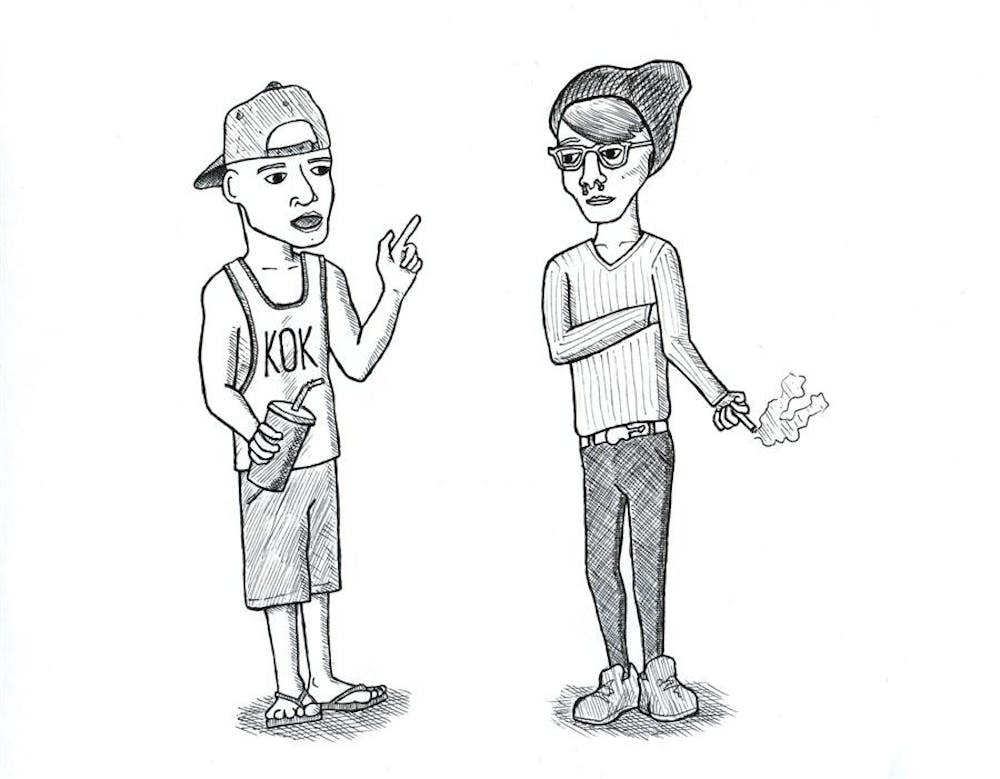
Try not to laugh, but I’m talking about bros and hipsters.
Let’s admit it, we’re all aware of this binary, and we all experience ourselves in some sort of relationship to it.
We know the stereotypes. Bros are loud, wear Sperrys, high-five and love K.O.K. Hipsters are vegan, wear used clothes, smoke cigarettes and love Tumblr.
Some hipsters have an unspoken resentment of bros. Some bros have an unspoken resentment of hipsters. Members of both categories openly mock members of the other.
To borrow a phrase from Althusser, we are always/already implicated in the bro/hipster binary.
I’m not trying to delegitimize the “normal” among us who don’t ascribe to either bro or hipster lifestyles or who feel discomfort within the binary.
Just as all identities are destined to come with normative images, these two categories also exclude and normalize.
I’m afraid it’s not just my friends who have pointed out gay bros or black hipsters — which isn’t to say these identities aren’t marginalized anyway. We forget our own privilege when assuming certain things about identity categories.
I don’t mean to speak for hipsters or bros. I can hardly speak for myself. I can speak to a project we’re all constantly undertaking, which is learning about our identity.
The trick to the trickiness of identity is exploring what we all share in common: alienation.
We’ve all felt embarrassment at our own ambivalence toward our friends and family.
We can’t always fit in with those closest to us.
The differences and similarities between one another are meaningful and should be felt out. We’ve got plenty in common. We all probably feel an affinity for music. We all probably want our friends to comment on our new profile picture.
But imagine the sort of connection we can make when we admit our insecurities to each other.
Of course, this isn’t likely. You don’t want to share important and sensitive information with people you hardly know.
You could, however, stand to become a better, more caring person if you acknowledge that those around you have their own shames and regrets.
We might not be able to figure out each other, but we can at least learn from knowing we’re all trying to figure out ourselves.
-
Identity wars on campus
Get stories like this in your inbox
Subscribe



