Based on the number of smokers outside Ballantine Hall or in front of Herman B Wells Library, IU students might not realize there is a smoking ban on campus.
However, according to an IU study, the smoking ban reduced student smoking during a two-year period and changed students’ attitudes toward smoking
regulations.
The study compared smoking behaviors on two demographically similar campuses — one with a campus-wide smoke-free policy, IU, and one without, Purdue University.
These results were unexpected, said Dong Chul Seo, the principal director of the study and associate professor of public health.
“I was surprised by the findings at IU campus because IU officials did not really enforce the policy,” Seo said. “I thought there might not be that much
significant change.”
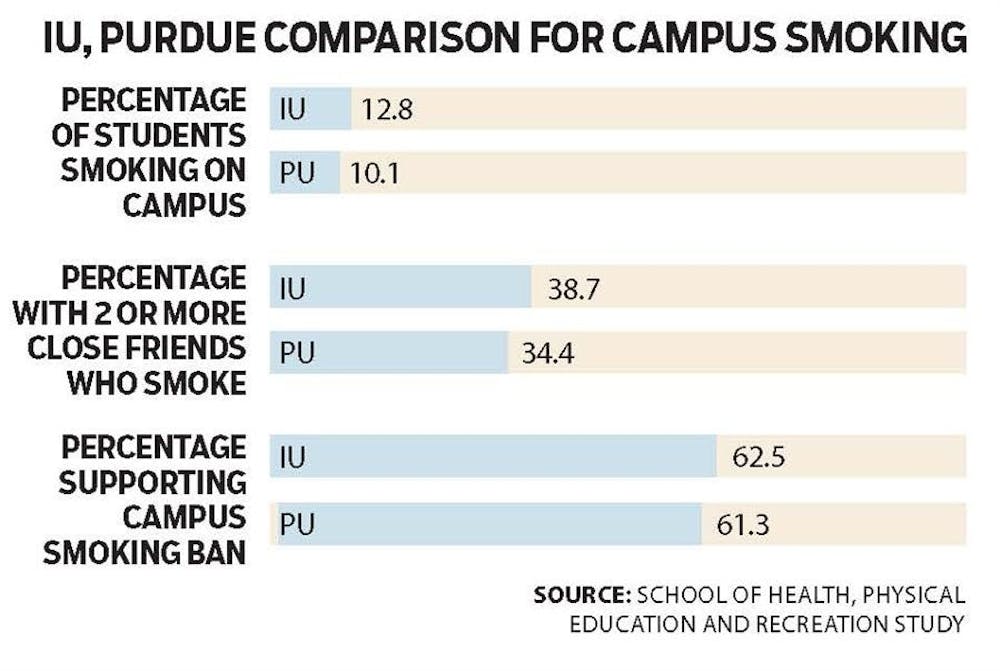
The percentage of students smoking at IU dropped by 3.7 percent during the study, while the smoking rate increased slightly at Purdue to 10.1 percent.
In addition, the percentage of IU students supporting a campus smoking ban increased by 5 percent to 62.5 percent while it decreased slightly at Purdue to 61.3
percent.
The enforcement of IU’s smoking ban is inconsistent, Dean of Students Harold “Pete” Goldsmith said.
“There is some enforcement, but it’s sporadic,” Goldsmith said. “It’s more enforced by complaints so that we can handle problematic areas on campus.”
Despite loose enforcement techniques, increased awareness through signs and anti-tobacco messages on campus buses might explain the decreased smoking rate, Seo said.
“As long as you are aware of certain policies and you have reasonable common sense, you might not be that comfortable when violating such a policy because you are a human being,” Seo said.
Enacting smoking bans on college campuses is important because the earlier people are exposed to tobacco products, the more likely they will be addicted in
the future.
In addition, there is a link between alcohol and tobacco use, Seo said.
“If you drink, you are more likely to smoke cigarettes,” Seo said. “It would be useful to tackle one of those two issues to help students reduce the amount of substances they use.”
This was one of the main goals of the smoking ban when it began in January 2008, Goldsmith said.
“It was a basic public health issue,” he said. “The administration was concerned about the health of the community with what we know about second-hand smoke.”
Smoking outside campus buildings and near on-campus apartments is a specific issue that bothers junior Holly Yeung, although she was not surprised by the results of the study.
“With the fact that we do have rules, people still ignore them, and that’s really irritating,” Yeung said. “So I guess it’s just the people that have severe addictions who just obviously don’t want to pay attention to the rules we have in place.”
Yeung said she thinks the ban could be more effective if smoking was monitored
better.
“If we could have someone at least pretending to monitor, rather than just having a sign, because that is so easy to ignore,” she said. “I would be willing to pay. I mean, we already have to pay for a lot of things anyways.”
Seo agreed that if enforcement of the smoking ban increased, the number of smokers would decrease greatly.
“I strongly believe that a ban with actual enforcement, even just a $20 fine per offense, would bring far more dramatic changes,” Seo said. “I do encourage IU administrators to consider enforcing the policy. It will make a difference.”
Study finds smoke-free policy decreases cigarette use on campus
Get stories like this in your inbox
Subscribe