
There’s a quick way to lose a pound and save a life.
Donate blood.
Now in its 15th year, the IU Blood Donor Challenge is again poised to provide more than 3,000 units of blood to those in need.
The challenge, coordinated by the IU Alumni Association, American Red Cross, Indiana Blood Center and South Bend Medical Foundation, began on Sept. 11 and runs through Nov. 4.
Alumni chapters, student organizations and other groups are competing to solicit the most units of blood. The winner will receive recognition at a home IU basketball game in November or December.
Though there’s a competition aspect, the main goal is to simply raise units of blood, said Nicki Bland, alumni programs officer for personal enrichment and philanthropy.
“We’re just trying to encourage our groups to do a blood drive and get involved in a different way,” Bland said. “It’s about the good will of donating blood and the feeling that comes with saving lives.”
Forty sponsors have registered their plans to host a drive, and as of Sept. 16, 153 units of blood had been collected from three different drives. The challenge is on its way to reaching its goal of 3,000 pints of blood by early November.
Last year, 3,766 pints were collected, exceeding the goal of 3,000.
“We would love to match that number, but if we get 3,000, that’d be excellent,” Bland said.
Considering each unit of blood can save up to three lives, IU has the power to save 9,000 lives if it meets its goal.
Despite high fall yields, IU does not maintain such levels as the year goes on.
“Typically, IU really overproduces in the fall, and then we tend to struggle in the spring,” said Ashley Lesage, donor recruitment representative for the Red Cross.
Illustrating room for improvement, the penetration rate — the ratio of number of donors to members of a population — of Purdue University is 20 percent, while IU’s is just 4 percent, Lesage said.
Students can on average donate four times per academic year and six times in one calendar year.
Hospitals request monthly quotas of blood from the American Red Cross. Any campus organization or group can be a blood drive sponsor at no cost.
These point people are responsible for providing a location to run the drive and signing up donors to give blood.
Donors are recruited four weeks before the event. Students as well as community members are encouraged to donate if eligible. Those interested can sign up in a variety of ways, from registering with a campus volunteer via a sign-up sheet to visiting RedCrossBlood.org to find blood drives in the area.
After filling out a few quick papers and passing a mini-physical, donors are ready to give. The entire process, barring any wait time, is about 35 minutes. As a thank-you, donors receive a free T-shirt that boasts the question “Is IU in your blood?”
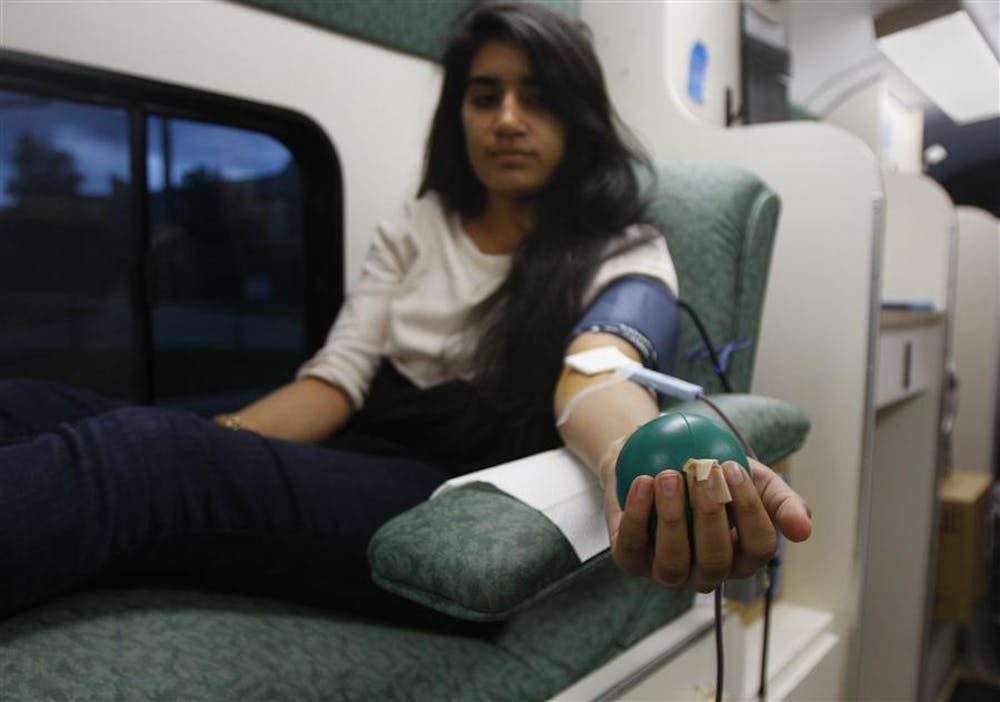
Ayesha Syed, freshman and member of IU’s American Red Cross club — which recruits many volunteers for blood donation events — signed up to donate at last week’s callout meeting. Though she had never donated, an interest in medicine and the Red Cross inspired her to give.
“I read that a lot of people need blood, so if I can help some of them, that’s awesome,” Syed said after her donation Monday at Collins Center.
Despite the momentary bee sting, as one Red Cross worker described it, Syed said the fleeting pain was worth it.
Walk-in donors decide to donate on the day of the drive as they pass the Red Cross bus or donation center.
The challenge is balancing pre-registered donors with new walk-ins, Lesage said. Red Cross phlebotomists, professionally trained blood-drawers, are equipped to handle the goal number of donors on any given donation day. If the number of potential donors exceeds that goal, long lines can form.
The base goal for organizations is usually 25 units, or pints, of blood. However, goals vary from sponsor to sponsor and are usually based on the previous year.
Volunteers are responsible — among other things — for attracting walk-in donors when pre-registered donor numbers are low.
Katie Betancourt, junior and volunteer, was stationed inside the Red Cross blood donation bus on Monday. She tended to those who were finished donating, providing them with snacks and drinks as well as their free T-shirts.
“Think if you got in a car accident and were injured. Wouldn’t you want blood?” she said. “That’s what we do. Give blood to help others survive.”
IU challenge helps save lives
Get stories like this in your inbox
Subscribe



