
In a recent editorial in the Washington Post, columnist Colbert I. King criticizes New York Times reporter Bill Keller for his insistent and continual inquisitions into presidential candidates’ religious beliefs.
With the GOP primary campaigns in full swing, the issue of the candidates’ religions is once again, as it is every election, becoming a topic of conversation.
King is right in pointing out the candidates’ right to privacy of their personal faiths and beliefs. He succinctly writes, “. . . go ahead and seek a candidate’s views on abortion, stem-cell research, assisted suicide, etc. Make up your mind based on the answers. However, the extent to which those views are influenced by religion is the candidate’s business, not yours.”
I agree with King’s assessment that there is too much emphasis on candidates’ religious beliefs. I would add to his argument in the following ways:
First, when a candidate begins to tout his religious pedigree, it moves the focus of the election from actual policies and the candidate’s leadership abilities to a popularity contest.
We have the privilege and curse of living in a country where anyone can vote, and oftentimes a candidate’s religion is the sole basis for a majority of the votes he or she might receive, regardless of his or her ability to be an effective leader or policy maker. It is easier to vote for someone we feel is more like us than it is to engage with proposed policies or analyze any specific political ideology.
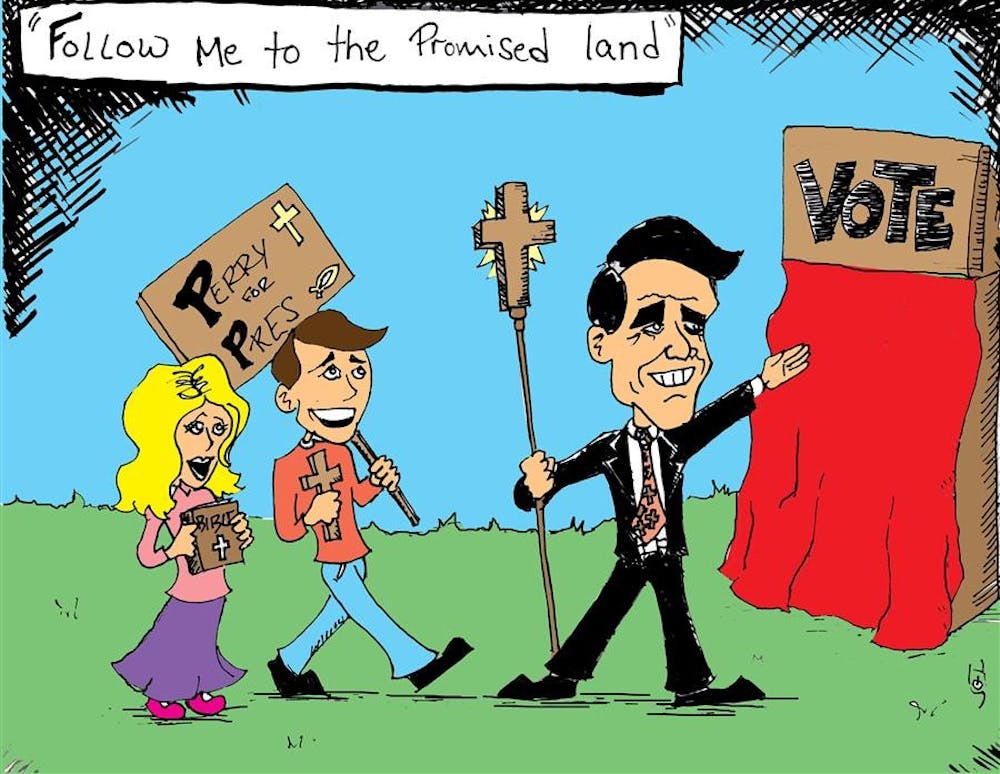
This might be why Rick Perry seems to be trying to prove he is more of a Christian than his opponents. When religion becomes a tool in the popularity contest of national elections, the religion that the candidate attempts to represent must reach the lowest common denominator.
If the majority of Americans claim to believe in God and consider themselves to be some sort of Christian, a candidate must wrap himself or herself in this vague, watered-down travesty of religion so as to appeal to the largest majority of voters.
The separation of church and state is for the sake and purity of the church as well as for the state. We would all be better off if candidates stopped trying to lure in votes by parading their religiousness.
I am not writing this as an irreligious person, wishing for the eradication of all religion in public life.
On the contrary, I am a Christian, and it is because of this that I take issue with politicians using their religion as a cheap attempt for political gain. Jesus himself said, “But small is the gate and narrow the road that leads to life, and only a few find it,” Matthew 7:14. I instinctively become leery of any politician who gains popularity by touting his religion.
I also find it dubious when figures like Rick Perry lead massive rallies to pray for the country to follow the path of righteousness.
This came a month after he refused to intervene and save the life of a Mexican national on death row who was not advised of his right to obtain legal counsel from his home country, which international law requires.
Concerning the two GOP frontrunners, there is a huge divide between Mitt Romney’s and Rick Perry’s faith as it relates to their campaign.
Perry obviously knows that in a religious popularity contest he has the edge against Romney because evangelicals far outnumber Mormons. I know it is a concern for many that Mitt Romney is Mormon.
It might be frustrating for many voters that, for the most part, he is silent about his Mormonism in comparison to Rick Perry’s in-your-face evangelicalism.
But whether Romney is relatively silent about his Mormonism because he doesn’t want his otherness to be highlighted, he believes that his religion has no bearing on his ability as a president or both, he is right in his silence.
— sdance@indiana.edu
GOP candidates lack religious modesty
Get stories like this in your inbox
Subscribe



